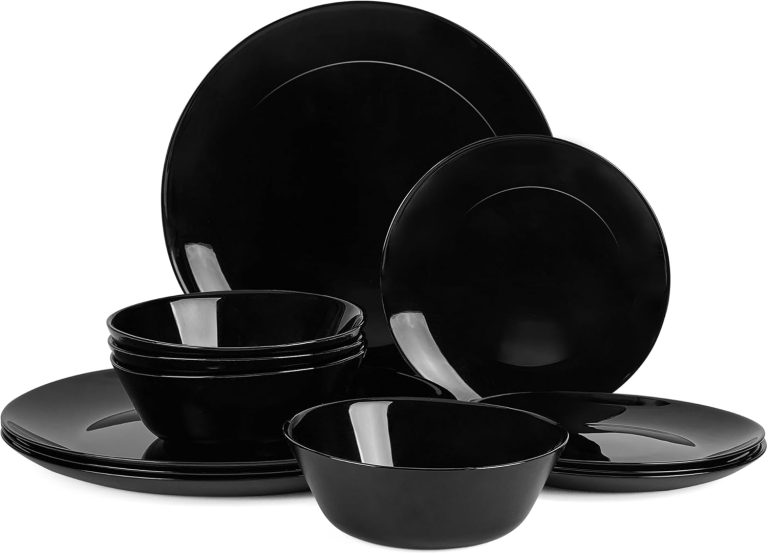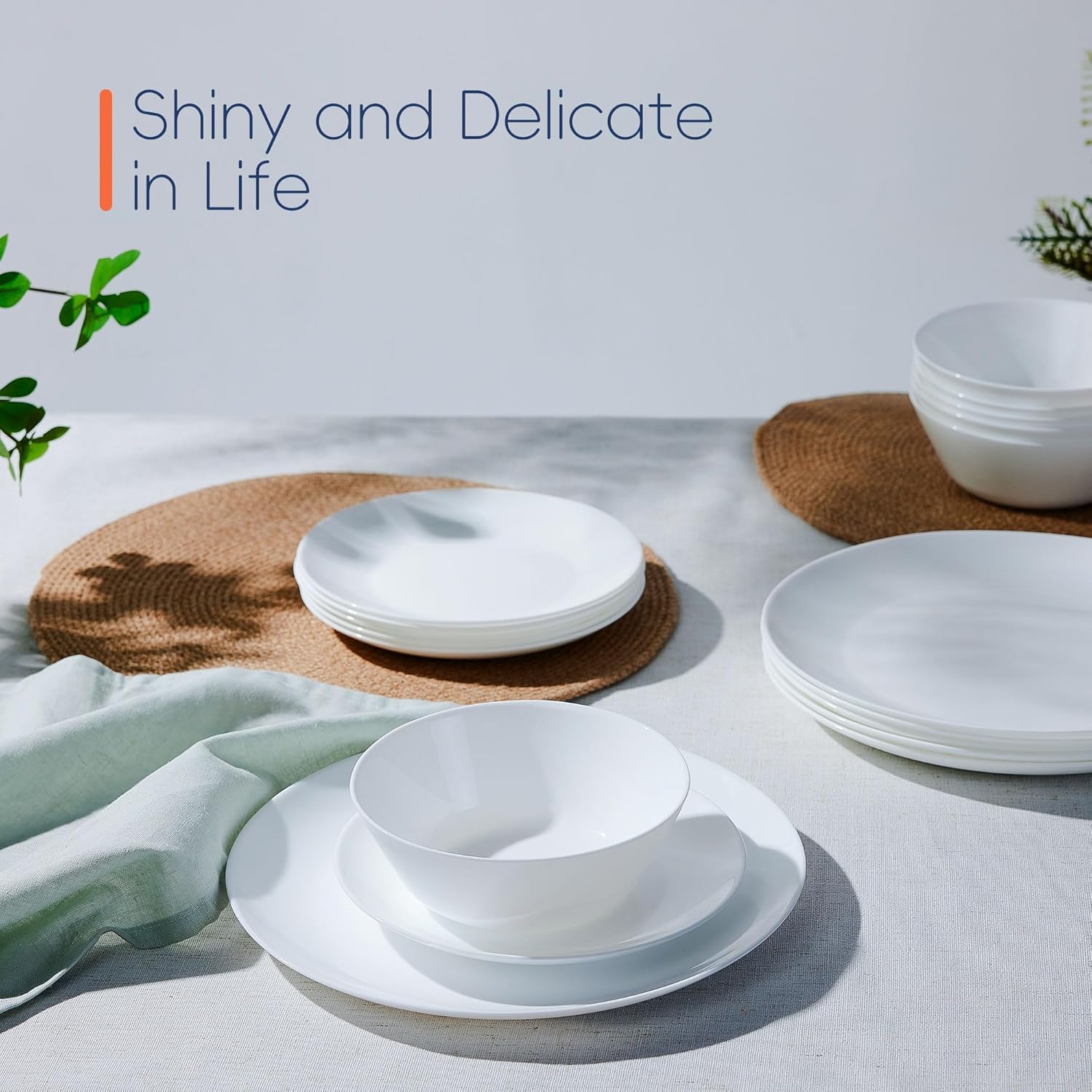
Opalware is the better everyday choice for most households, while bone china earns its keep for formal dining and gifting. The real decision isn’t “which material wins”; it’s which one matches how you actually eat.
What Is Opalware, and What Is Bone China?
If you’re weighing these two side by side, start with our complete non-toxic dinnerware guide for the broader material landscape, then use this comparison to settle the opalware-versus-bone-china question specifically.
Opalware and bone china look similar on a table; both come in bright, clean white, but they’re made from entirely different raw materials, manufactured through different processes, and built for different kinds of use.
What Opalware Is Made Of
Opalware is a type of tempered glass, sometimes called opal glass or milk glass. It contains no clay, no bone ash, and no porcelain; it starts as raw glass that’s heated to extreme temperatures and then rapidly cooled at controlled intervals.
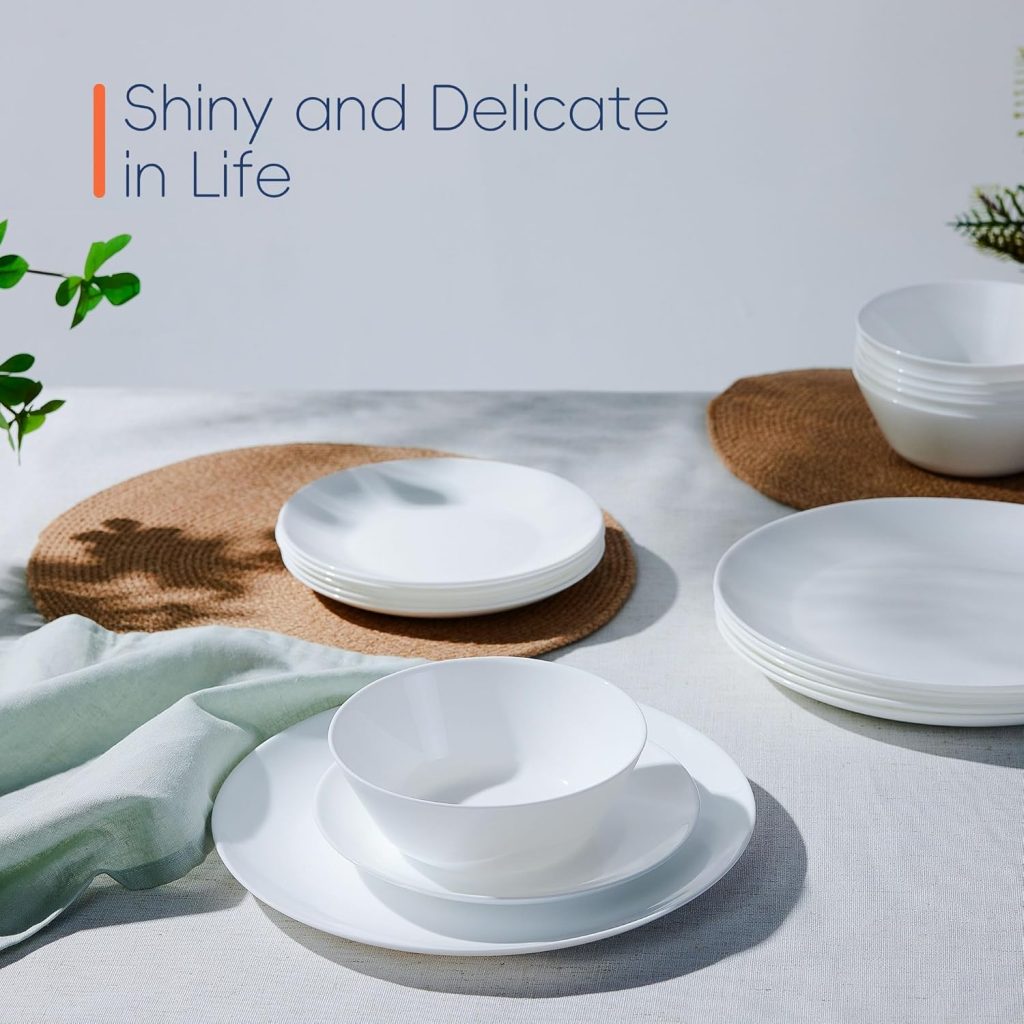
That process, called recrystallization, restructures the glass at a molecular level, giving it the milky-white opacity opalware is known for and roughly two to three times the mechanical strength of standard glass or ceramic.
Because it’s a single fused glass material rather than a layered or painted one, opalware’s durability comes from the glass itself, not a coating. If you’re also considering laminated glass dinnerware, it’s worth seeing how Corelle compares to Arcopal Opalglass dinnerware, since both use a different glass construction method than tempered opalware.
What Bone China Is Made Of
Bone china is a ceramic material made from a mixture of kaolin clay, feldspar, quartz, and bone ash — typically at least 30% bone ash by composition.
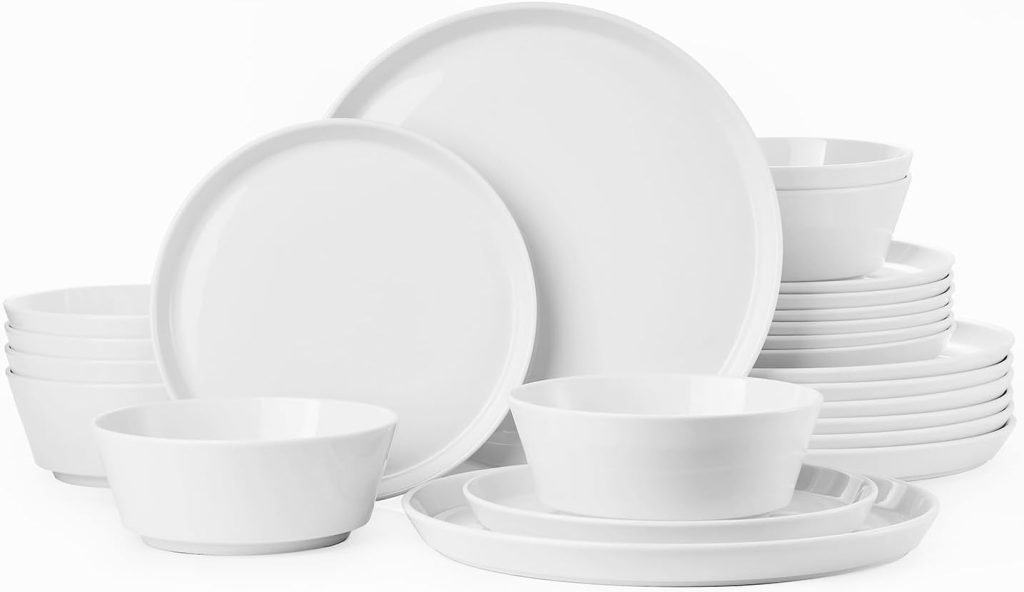
The bone ash is what gives bone china its signature qualities: a bright white body, translucency when held to light, and a strength-to-thinness ratio that regular ceramic or porcelain can’t match. Bone china is fired at high temperatures, and the body itself is manufactured lead-free.
Any lead risk associated with bone china doesn’t come from the clay-and-bone-ash mixture it comes from what happens after firing, which is the distinction most comparisons skip entirely.
Is Opalware or Bone China Safer? Lead and Cadmium Facts
Neither material is inherently unsafe, and neither is automatically safe just because of what it’s made of; the real safety question is about decoration, not the base material.
Both opalware and bone china can be manufactured to fully comply with FDA and California Proposition 65 limits on lead and cadmium leaching, and reputable brands in both categories do.
Why Bone China’s Lead Risk Comes From Decoration, Not the Body
Most articles comparing these two materials treat “bone china” as a single safety verdict, as if the answer to “does bone china have lead” is a flat yes or no. It isn’t.
The bone china body, the clay, feldspar, and bone ash mixture, is manufactured to be lead-free.
The risk enters during decoration: overglaze paints, hand-applied colors, and metallic rims (gold or platinum trim) are added after the piece is glazed and fired at a lower temperature, and that lower-temperature application is where lead has historically been used as a flux to fix pigment to the surface.
“According to the California Department of Public Health, tableware that exceeds Proposition 65 lead standards may still be sold in the U.S. if it carries a warning, while tableware that exceeds FDA lead limits cannot be legally sold. These are separate regulatory thresholds applied to finished tableware, depending on the testing standard and the part of the item being evaluated.”
In practice, that means a plain white bone china plate with no rim decoration sits in a fundamentally different risk category than a hand-painted or gold-rimmed one from the same manufacturer.
The same logic applies in reverse to opalware: a plain opal glass piece is chemically inert, but a metallic-rimmed or heavily printed pattern introduces the same decoration-based variable.
If you’re specifically comparing glass dinnerware brands on this point, Corelle’s lead-free vitrelle glass is a useful reference case, since Corelle publishes clear guidance on which of its patterns are undecorated.
FDA and Prop 65 Standards for Both Materials
For a broader look at which materials clear both standards by default, see our fully lead-free ceramic dinnerware options.
The table below summarizes how the two main U.S. standards apply to opalware and bone china.
| Standard | What It Regulates | Applies To |
|---|---|---|
| FDA 21 CFR Part 177.2600 / CPG Sec. 545.450 | Maximum lead leaching level in ceramics and glassware; products exceeding it cannot legally be sold | Both opalware and bone china (finished, decorated piece) |
| California Prop 65 | Requires a warning label if lead exposure exceeds a very low safe-harbor threshold; does not ban the product outright | Both materials, though decorated bone china is flagged more often than plain opalware |
| “Lead-Free” / “ND” (non-detectable) labeling | Voluntary manufacturer claim, ideally backed by a third-party lab report | Look for this on any decorated or metallic-rimmed piece in either material |
Durability: Which One Actually Survives Daily Use?
Opalware wins on everyday durability by a clear margin, while bone china wins on longevity if it’s never dropped.
The two materials fail in opposite ways: opalware resists impact but can chip at the edges over years of stacking, while bone china is more breakable on impact but holds its finish almost indefinitely with careful handling.
Chip and Drop Resistance
| Factor | Opalware | Bone China |
|---|---|---|
| Drop resistance | Roughly 2x higher than standard ceramic or bone china | Lower; a plate dropped squarely on a hard floor will often chip or crack |
| Everyday chip resistance | High — tempered glass structure resists edge chipping | Moderate — thin, high-fired body is strong but less forgiving of impact |
| Pattern durability | Patterns are fused and resist fading through repeated dishwasher cycles | Painted or printed patterns can wear faster if not fired under the glaze |
Dishwasher, Microwave, and Oven Safety
| Use | Opalware | Bone China |
|---|---|---|
| Dishwasher | Safe in nearly all cases | Safe, though hand-washing extends the life of metallic rims |
| Microwave | Safe for plain, undecorated pieces | Safe for plain pieces; metallic rims will spark and must be avoided |
| Oven/stovetop | Not recommended — opalware is not rated for direct heat or broiler use | Not recommended for direct stovetop heat; check manufacturer guidance for oven-safe lines |
| Thermal range | Withstands roughly 180–240°C depending on brand | Withstands up to roughly 200°C |
Opalware vs Bone China for Kids and Everyday Family Meals
Opalware is the more practical choice for households with young children, mainly because it removes the guesswork around handling.
Bone china can still work for everyday meals in the right household, but it asks more of the people using it.
Why Opalware Wins for Households With Children
- Opalware’s higher drop resistance means fewer broken plates from the everyday mishandling that comes with kids setting or clearing the table.
- Its non-porous glass surface doesn’t absorb food odors or stains, so it stays hygienically clean through repeated dishwasher cycles.
- Plain opalware is microwave-safe, which matters for reheating kid-sized portions without needing a separate set of plastic dishes.
- Many opalware lines are manufactured without bone ash, which some households prefer for vegetarian or vegan kitchens with children.
For dinnerware built specifically with young kids in mind, our full lead-free picks for kids narrow the field further by age and durability needs.
When Bone China Still Makes Sense Day-to-Day
Bone china isn’t automatically off-limits for daily use — a plain, undecorated bone china set with no metallic rim can hold up to regular meals as long as it’s handled with reasonable care and isn’t dropped on hard flooring.
Households without young children, or those who already have a habit of hand-washing good dinnerware, can reasonably use bone china as an everyday set rather than reserving it for special occasions.
The tradeoff is simply that bone china demands more attentiveness than opalware does, not that it’s unsafe or unsuitable for regular meals.
Price and Long-Term Cost of Ownership
Opalware costs less upfront and usually costs less over time too, but the gap narrows if bone china is handled carefully and never broken.
Upfront Cost Per Set
| Material | Typical Price Range | What Drives the Range |
|---|---|---|
| Opalware | Roughly $0.08–$0.92 per piece at wholesale scale, or $30–$80 for a retail family set | Brand, pattern complexity, and set size |
| Bone china | Roughly $0.52–$117 per piece depending on design, or $80–$400+ for a retail set | Bone ash percentage, hand-decoration, gold/platinum trim, and brand prestige |
Replacement Cost Over 5 Years
A spec comparison doesn’t tell you what either material actually costs a household over time, so it helps to work through a real scenario.
A family of four replacing roughly one to two opalware pieces a year from breakage, a reasonable estimate for a household with kids, spends a modest, predictable amount annually restocking a set that likely cost $30 to $80 to begin with.
Bone china flips that equation: the upfront cost is higher, but a quality set stored with felt separators and hand-washed regularly can last 10 to 15 years without needing a single replacement piece, since its main failure mode is drop damage rather than wear.
The household that comes out ahead financially with bone china is the one with steady, careful handling and no young kids in the kitchen rotation.
The household that comes out ahead with opalware is the one prioritizing low replacement cost and tolerance for occasional breakage over a decade of daily use.
Neither material is the “cheaper” one in every scenario; it depends on how many pieces you’re likely to break, not on the sticker price alone.
Vegan and Ethical Considerations: Bone Ash vs Bone-Ash-Free
Opalware is bone-ash-free by design, while bone china’s defining ingredient is bone ash, a distinction that matters if you or someone in your household avoids animal-derived materials on principle.
Why Opalware Is Bone-Ash-Free by Design
Opalware’s strength comes entirely from its tempered glass structure, not from any animal-derived additive, which means it’s inherently suitable for vegetarian and vegan households without needing to check ingredient sourcing.
This is a structural fact of the material rather than a marketing claim specific to any one brand since opalware contains no clay or bone ash at all; the vegan question simply doesn’t apply to it the way it does to ceramic tableware.
Bone China’s Bone Ash Content Explained
Bone china typically contains at least 30% bone ash, sourced from animal bone, which is mixed into the clay body before firing to produce its signature translucency and strength.
This means traditional bone china is not vegetarian or vegan by definition, regardless of brand or price point.
Buyers who want the look of fine china without the bone ash content have other options in porcelain or fine ceramic, but bone china specifically derives its name and its core properties from that ingredient.
Which Should You Choose? A Decision Framework by Scenario
Rather than weighing every spec separately, it’s more useful to match your actual situation to a recommendation — for a full breakdown of lead-free dinnerware materials beyond just these two, that guide covers the wider field once you’ve settled the opalware-versus-bone-china question.
- You have young kids and want one set for daily use: Choose opalware. Its drop resistance and non-porous surface reduce most of the daily risks associated with a busy kitchen.
- You’re building a wedding registry or want a formal set for entertaining: Choose bone china. Its translucency and prestige are specifically what formal dining calls for, and careful handling is more realistic for occasional-use pieces.
- You’re outfitting a small kitchen or rental and want low replacement cost: Choose opalware. Its lower per-piece price and higher impact resistance make it the more forgiving option when storage space and budget are both tight.
- You entertain often but also want a set that survives a dishwasher-heavy routine: Choose opalware for daily rotation and reserve a small bone china set specifically for hosting, rather than trying to make one material do both jobs.
- You want a vegan or bone-ash-free set on principle: Choose opalware, since bone china cannot meet that requirement by definition regardless of brand.
If you’re still deciding between the two, start with a small opalware set for daily use and add bone china only once you know how much hands-on care your household can realistically commit to.
Opalware vs Borosil
Quick note before the table: “Opalware” refers to a material (opal glass), while “Borosil” is actually a brand best known for borosilicate glass products.
So this comparison is really opal glass vs borosilicate glass, worth clarifying so you aren’t confused.
| Feature | Opalware | Borosil (Borosilicate Glass) |
|---|---|---|
| Material | Opal glass (glass fused with ceramic-like opacifiers) | Borosilicate glass (glass with boron trioxide added) |
| Appearance | Opaque, milky-white, ceramic-like look | Transparent/translucent, glossy glass look |
| Heat resistance | Moderate — safe for warm food, not for direct flame or oven use (in most cases) | High — withstands sudden temperature changes and oven/microwave use |
| Thermal shock resistance | Low to moderate | Excellent — resists cracking from hot-to-cold or cold-to-hot transitions |
| Best used for | Everyday dinnerware — plates, bowls, serving dishes | Cookware, bakeware, storage containers, lab equipment |
| Weight | Slightly heavier, feels ceramic-like | Lighter, feels like glass |
| Chip/crack resistance | Good, but can chip on edges over time | Very durable, resistant to chipping |
| Microwave safe | Usually yes (check product specs) | Yes |
| Oven safe | Generally no | Yes |
| Price range | Budget-friendly | Slightly higher, especially for cookware range |
| Visual style | Elegant, opaque, feels like fine china | Clear, modern, functional look |
Takeaway: Opalware wins on everyday elegance and affordability for dining sets, while Borosil (borosilicate glass) wins on heat resistance and functionality for cooking and storage.
Is Bone China better than Porcelain Dinnerware?
There’s no single “better option“; it depends on your values:
Bone china tends to win on:
- Strength-to-thinness ratio — bone ash (25%+) makes it stronger despite being thinner and more delicate-looking
- Translucency — has a warmer, ivory-white glow when held to light
- Chip resistance — more durable against everyday chipping
- Elegance factor — often seen as the more premium/luxury choice for fine dining and gifting
Porcelain tends to win on:
- Heat retention — often slightly better for keeping food/drinks warm
- Cost — generally more affordable than bone china
- Versatility — better suited for oven-to-table or more rugged daily use (depending on type — hard-paste vs soft-paste porcelain)
- Color — cooler, whiter tone vs bone china’s warmer ivory tint.
“Bone china is generally considered superior for fine dining and gifting due to its strength, elegance, and translucency, but porcelain remains the more practical, budget-friendly choice for everyday use.
The ‘better‘ option really depends on whether you’re prioritizing luxury and durability or affordability and everyday functionality.“
Bone China vs Porcelain
| Feature | Bone China | Porcelain |
|---|---|---|
| Composition | Contains bone ash (typically 25–50%) mixed with kaolin, feldspar, and quartz | Made from kaolin, feldspar, and quartz (no bone ash) |
| Color | Warm, ivory-white tone | Cooler, brighter white tone |
| Translucency | Highly translucent, glows softly when held to light | Translucent, but less so than bone china |
| Strength | Very strong despite thin walls, due to bone ash content | Strong, but generally needs to be thicker to match bone china’s durability |
| Chip resistance | Excellent — more resistant to chipping | Good, but slightly more prone to chipping than bone china |
| Weight | Lighter, feels delicate | Slightly heavier, feels sturdier |
| Firing temperature | Fired at lower temperatures (~1,200–1,250°C) | Fired at higher temperatures (~1,400°C), making it very hard |
| Durability | Long-lasting with proper care, resists cracking | Very durable, especially hard-paste porcelain |
| Price | Generally more expensive | Comparatively more affordable |
| Best used for | Fine dining, gifting, formal tableware | Everyday use, oven-to-table dishes, decorative items |
| Style/appeal | Seen as more luxurious and elegant | Seen as classic, versatile, and practical |
| Maintenance | Dishwasher safe (most brands), but hand wash recommended for longevity | Generally low-maintenance, dishwasher and microwave safe (varies by type) |
Bone china offers superior strength, elegance, and translucency at a higher price point, while porcelain delivers reliable durability and versatility at a more accessible cost, making the choice largely dependent on the occasion and budget.
Frequently Asked Questions
Is opalware or bone china better overall?
Neither is universally better; opalware is the stronger choice for daily use and budget-conscious households, while bone china is better suited to formal dining and gifting.
Opalware offers roughly twice the drop resistance of bone china and costs less upfront, making it the more practical everyday pick.
Bone china offers translucency and prestige that opalware doesn’t attempt to replicate, which is why it remains the standard choice for weddings, holidays, and other occasions where appearance matters more than durability.
Does bone china contain lead?
The bone china body itself is manufactured lead-free, but decorated pieces — those with hand-painted colors or metallic rims — can introduce lead through the overglaze application process.
This is why a plain white bone china plate and a gold-rimmed one from the same manufacturer can fall into different safety categories under FDA and Prop 65 standards.
Checking for “lead-free” or third-party lab documentation matters more for decorated pieces than for plain ones.
Is opalware completely lead-free?
Plain, undecorated opalware is lead-free by material composition, since it’s made entirely from tempered glass with no clay or bone ash additives.
As with bone china, the exception is heavily decorated or metallic-rimmed opalware, where the same decoration-based risk applies.
Reputable brands test finished pieces against FDA 21 CFR Part 177.2600 and label accordingly, so checking for that certification is the most reliable way to confirm a specific set.
Which is more durable, opalware or bone china?
Opalware is more durable against everyday impact, showing roughly twice the drop resistance of standard bone china in manufacturer testing.
Bone china is more durable against long-term wear and pattern fading if it’s handled carefully and never dropped, since its high-fired body resists degradation over 10 to 15 years of gentle use.
Which one is “more durable” for your household depends on whether your bigger risk is accidental drops or years of repeated washing, and most families with kids face more of the former.