Carote’s coating is marketed as PFOA-free, and that claim checks out. Whether it’s also PTFE-free, which is the stronger and more relevant claim, isn’t something Carote or its retailers clearly confirm anywhere we could find.
Below is what’s actually documented about the coating, where the pans are made, and when a scratched or chipped pan crosses into a real safety concern.
Is Carote Cookware Non Toxic?
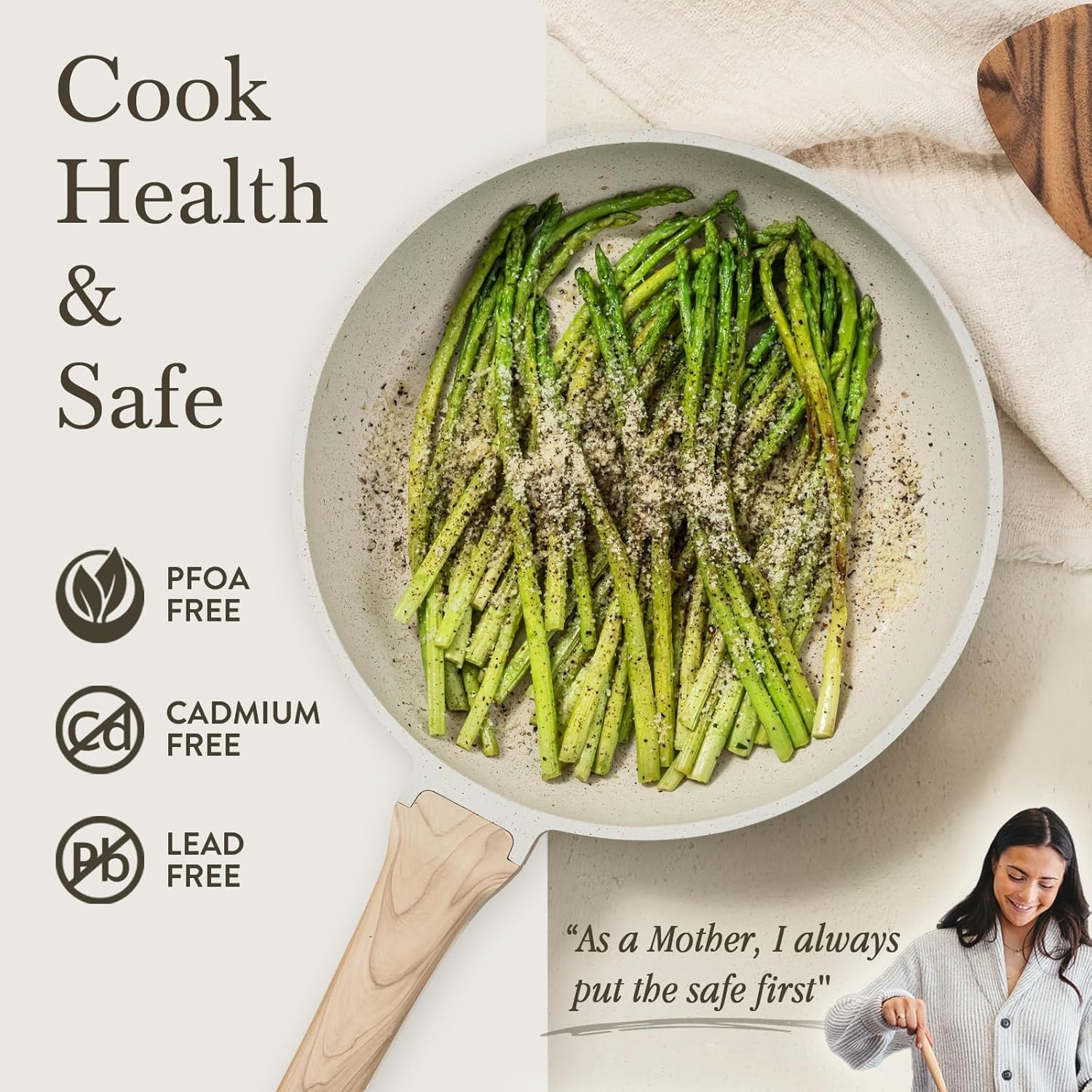
Carote’s granite and ceramic nonstick cookware uses a die-cast aluminum base with a sol-gel ceramic coating, and it’s marketed as PFOA-free, PFOS-free, lead-free, and cadmium-free across its own listings and Amazon product pages.
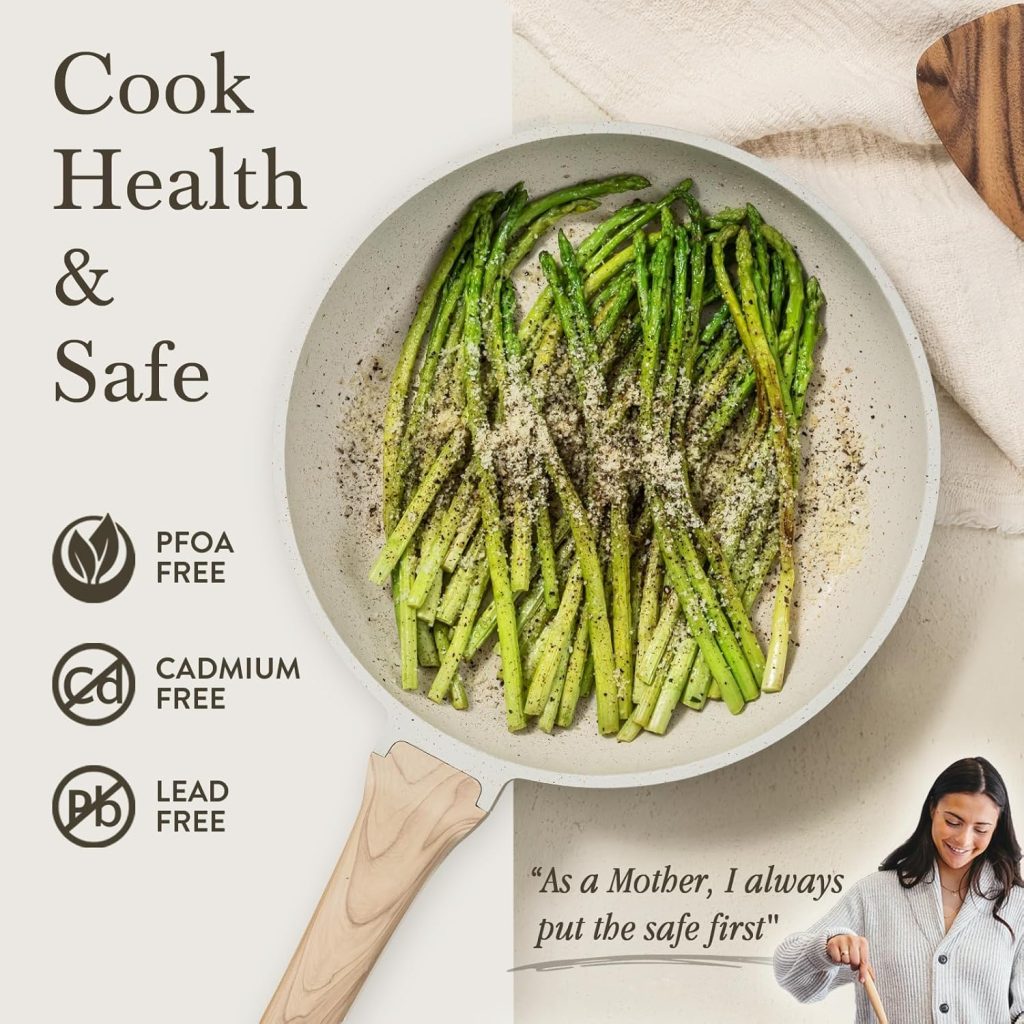
That’s a real and verifiable claim. What isn’t consistently confirmed is whether the coating is also PTFE-free, a separate and stronger claim that some third-party review sites make on Carote’s behalf without citing a source.
Until that gap closes with a direct statement from Carote, the accurate answer is that Carote is non-toxic under normal use in the way most budget nonstick cookware is, not that it’s been verified free of every PFAS compound.
What “PFOA-free” does and doesn’t tell you
PFOA-free means a product doesn’t contain perfluorooctanoic acid, a specific chemical once used in manufacturing some PTFE-based nonstick coatings and phased out of that process industry-wide by 2013.
It’s a real safety improvement over older Teflon production, but it says nothing about whether the finished coating still contains PTFE (Teflon) itself, which belongs to the broader PFAS family.
PFAS-free or PTFE-free are separate, stronger claims that specifically rule out the whole chemical family, not just one legacy processing agent.
A product can be accurately labeled PFOA-free while still being a PTFE-based coating.
Why the coating source matters more than the brand name
Carote is one brand selling a coating type that several manufacturers use, so the safety question isn’t really “is Carote safe” in isolation; it’s “what coating family does this specific product use.”
The same question applies across the healthy or safe non-toxic cookware brands on the market: a brand name alone doesn’t tell you whether you’re looking at a PTFE-based coating with PFOA removed or a genuinely PFAS-free ceramic or titanium surface.
Carote’s own marketing language leans on the weaker PFOA-free claim, which is worth noticing before assuming the stronger claim applies too.
What Carote’s Granite and Ceramic Coatings Are Actually Made Of
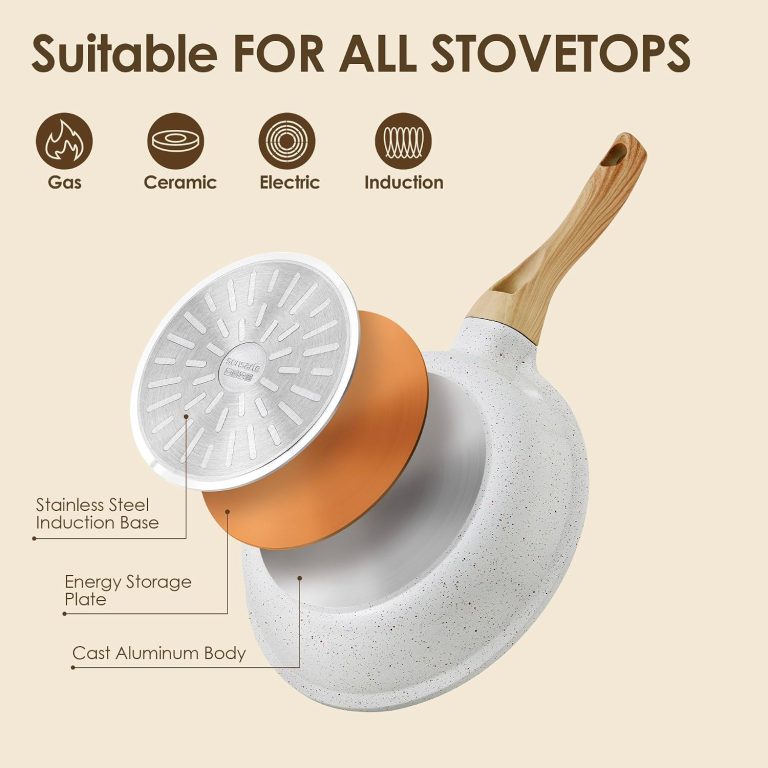
Carote cookware starts with a die-cast aluminum body, chosen for fast, even heat conduction, then covered in a nonstick coating marketed under the “granite” or “marble” name depending on the color finish.
Die-cast aluminum base and the sol-gel ceramic layer
The base metal in Carote cookware is reinforced die-cast aluminum, a manufacturing method that produces a sturdier body than the thinner spun or stamped aluminum used in some cheaper cookware.
Multiple sources describe the coating itself as a sol-gel ceramic type, meaning it’s built from a silica-based liquid precursor that cures into a hard, glass-like surface rather than a sprayed fluoropolymer.
The speckled “granite” or “marble” look comes from mineral particles mixed into that coating, not from actual stone.
As long as the coating stays intact, it fully separates the food from the aluminum underneath, which is the same basic safety principle behind ceramic cookware being considered safe more broadly.
The ILAG question: why a “Swiss-made coating” claim doesn’t confirm PFAS-free
Several sources describing Carote’s coating credit a Swiss company called ILAG as the supplier, often presenting the name itself as a safety credential.
ILAG is a real, well-established coating manufacturer headquartered in Wangen, Switzerland, and it’s been making nonstick coating systems since 1955.
The detail those sources leave out is that ILAG makes both traditional PTFE-based coating systems and a completely separate line of PFAS- and PTFE-free ceramic sol-gel coatings, confirmed on ILAG’s own site, sold under different product names within its catalog.
Naming ILAG as Carote’s coating supplier, by itself, doesn’t establish which of those product families is actually on a given Carote pan.
It’s the equivalent of saying “made with steel” without saying which grade. Carote’s coating is plausibly one of ILAG’s PFAS-free ceramic lines given the PFOA-free marketing and ceramic description, but that’s an inference, not a confirmed fact, and none of the sourcing we reviewed closes that gap with a direct statement from either company.
Does Carote Cookware Contain PTFE?
There’s no confirmed, sourced answer to whether Carote’s coating contains PTFE, and readers should be skeptical of any source, including this one, that states it with full certainty.
Before trusting any brand’s PFAS claim at face value, it’s worth learning how to check any pan for PFAS using the label language that actually distinguishes a real claim from a vague one.
What Carote and its retailers actually claim, vs. what’s confirmed
| Claim | Where it appears | Independently confirmed? |
|---|---|---|
| PFOA-free | Carote’s own product listings, Amazon, Walmart | Yes, consistent across every official listing reviewed |
| PFOS-free | Carote’s own product listings | Yes, consistent claim, matches standard industry phase-out |
| Lead-free / cadmium-free | Carote’s own product listings | Stated consistently; no independent lab data located |
| PTFE-free / “Teflon-free” | Some third-party review sites, not Carote’s own core marketing | No independent source or lab test located confirming this |
| “Certified” Swiss ILAG coating | Several third-party review and affiliate sites | ILAG is a real company; specific product line used is not confirmed |
Claims about Carote that aren’t independently verifiable
- Some sites cite a specific academic study on Chinese cookware branding that we could not locate or verify from any traceable source, which is a red flag worth generalizing: an unfamiliar study citation with no link or journal name attached should not be treated as evidence.
- Several pages list precise coating-layer percentages and thickness figures with no test lab or methodology named, a level of false precision that reads as authoritative but isn’t traceable to any real measurement.
- References to “ISO 9001 certified” manufacturing appear on a few review sites without a certificate number or issuing body, which makes the claim impossible to verify independently.
- Specific lab-test thresholds (exact heavy-metal detection limits, for example) appear on at least one site with no named laboratory, which is a common tell of manufactured-sounding rather than sourced content.
Where Is Carote Cookware Made?
Carote’s manufacturing origin is one of the more consistently documented facts about the brand, unlike its coating chemistry.
Manufacturing origin: China and Vietnam
Carote states in its own FAQ that its products are made mainly in China and Vietnam, in facilities the company describes as meeting BSCI or SMETA ethical manufacturing standards.
This is a rare point of direct transparency from the brand itself rather than something pieced together from third-party sourcing investigations, and it lines up consistently across every retailer listing and review site we checked.
For readers who specifically want cookware manufactured domestically, our guide to non-toxic cookware made in the USA covers brands that manufacture in the United States rather than overseas.
Company background: who makes Carote
Carote is a cookware company that began producing kitchenware in China in 1992, initially finding early traction in the Italian market before expanding globally.
The brand is now sold across dozens of countries, primarily through Amazon and Walmart in the US market, and operates as a large-volume, direct-to-consumer cookware brand rather than a boutique or heritage cookware maker.
That business model, high volume and low overhead, is a large part of why Carote sets typically cost a fraction of premium ceramic or stainless competitors.
When Does a Scratched or Chipped Carote Pan Become a Safety Concern?
A new Carote pan in good condition and used correctly is low-risk.
A pan with a visibly chipped or peeling coating is a different situation, and multiple verified customer reports describe reaching that point faster than buyers expect.
What Carote owners report about coating wear
| Source | Reported issue | Timeframe |
|---|---|---|
| Better Business Bureau complaint | Chipping and scratching on the cooking surface despite using only silicone utensils and hand washing | Approximately 4 months |
| Better Business Bureau complaint | Coating peeling off the pan entirely, plus discoloration | Within weeks of a prior repaired issue |
| Trustpilot review | Handles failing and coating flaking from the pan base | Within 1 year |
| Trustpilot review | Company response to a chipping complaint stated chips and scratches are “normal” from spatula and hard-food use and declined warranty replacement | Reported directly by the customer |
In more than one case reviewed here, Carote’s customer service response to a warranty claim characterized visible chipping as expected wear rather than a defect, which is worth knowing before assuming a damaged pan will be replaced under warranty.
When to replace a Carote pan
- Replace the pan once any bare aluminum is visible through the coating, since that’s the point where food can directly contact the base metal during cooking.
- Replace it if flaking or peeling has started anywhere on the cooking surface, even in a small area, since coating damage tends to spread with continued use rather than stay contained.
- Replace it if the surface shows persistent discoloration that doesn’t wipe away, which several owners report as an early sign of coating breakdown.
- Stop using it at high heat, even before replacement, if you notice reduced nonstick performance combined with any visible surface change, and shift that pan to low or medium heat cooking only until it’s replaced.
How Carote Compares to Other Non-Toxic Cookware Brands
Carote sits at the budget end of the non-toxic cookware market, and how it compares to other brands depends heavily on whether you’re comparing coating chemistry, price, or durability.
For a broader look at two verified mid-range options, see how Caraway and GreenPan compare before deciding whether the price gap over Carote is worth it for your kitchen.
Carote vs. GreenPan, budget ceramic vs. verified ceramic
| Feature | Carote | GreenPan |
|---|---|---|
| Coating type | Sol-gel ceramic, granite/marble finish | Sol-gel ceramic (Thermolon) |
| PFAS-free claim | PFOA-free stated directly; PTFE/PFAS-free not directly confirmed by the brand | PFAS-free stated directly by the brand across its lines |
| Typical set price | Under $150 for a full set | $200 to $400 for a comparable full set |
| Manufacturing origin | China and Vietnam | Primarily Thailand and China depending on line |
| Reported durability | Coating wear commonly reported within months in verified complaints | Longer-reported coating lifespan in general, though ceramic coatings from any brand wear faster than PTFE over time |
Carote vs. Viking, budget nonstick vs. a multi-material brand
These two brands aren’t really direct competitors, since Viking spans everything from plain stainless steel to multiple nonstick chemistries at a much higher price point, while Carote is a single-category budget nonstick brand.
The more useful comparison is between Carote and Viking’s own nonstick lines specifically.
See our full breakdown of Is Viking cookware non-toxic? for how Viking’s PFAS-free PureGlide Pro and Hybrid Plus lines compare to its older PFOA-free-only Hard Anodized line, since that same PFOA-free-versus-PFAS-free distinction is exactly the one that matters most when evaluating Carote too.
If chemistry confirmation matters more to you than price, our best non-toxic cookware guide highlights brands that make a direct, specific PFAS-free claim on every line they sell, not just their newest one, so you’re not left inferring the answer the way you have to with Carote.
FAQ
Is Carote cookware safe for everyday cooking?
Yes, for a new or well-maintained pan used at moderate heat with non-metal utensils.
Carote’s coating is a die-cast aluminum base sealed with a sol-gel ceramic layer, and the brand’s PFOA-free, PFOS-free, lead-free, and cadmium-free claims are consistent across its official listings.
The caveat is durability: multiple verified customer complaints describe chipping or peeling within four months to a year, and a damaged coating changes the safety picture, so check your pan’s surface condition regularly rather than assuming safety is a one-time question answered at purchase.
Does Carote cookware contain PFAS or PTFE?
This isn’t clearly confirmed either way by Carote’s own marketing.
The brand consistently claims PFOA-free, which only rules out one legacy manufacturing chemical, not the broader PFAS family that includes PTFE.
Several third-party sites claim Carote is PTFE-free or Teflon-free, but none of the sourcing we reviewed traces that claim back to a direct statement from Carote or an independent lab test.
The coating supplier some sources name, Switzerland’s ILAG, makes both PTFE-based and PFAS-free product lines, so naming the supplier alone doesn’t settle the question.
Is Carote cookware made in China?
Yes, primarily. Carote states directly in its own FAQ that its cookware is manufactured mainly in China and Vietnam, in facilities the brand describes as following BSCI or SMETA ethical manufacturing standards.
This is one of the more transparent and consistently documented facts about the brand, unlike its exact coating chemistry, and it lines up across every retailer listing and independent review we checked during research for this article.
Is it safe to keep using a scratched Carote pan?
It depends on how serious the damage is, not on whether any scratch exists at all. Light surface marks from normal cooking generally aren’t a safety concern.
A pan is a genuine concern once bare aluminum is visible through the coating, once the coating is actively flaking or peeling anywhere on the cooking surface, or once persistent discoloration appears that doesn’t wipe clean.
At that point, replace the pan rather than continue cooking on it, since coating damage tends to spread rather than stay contained once it starts.