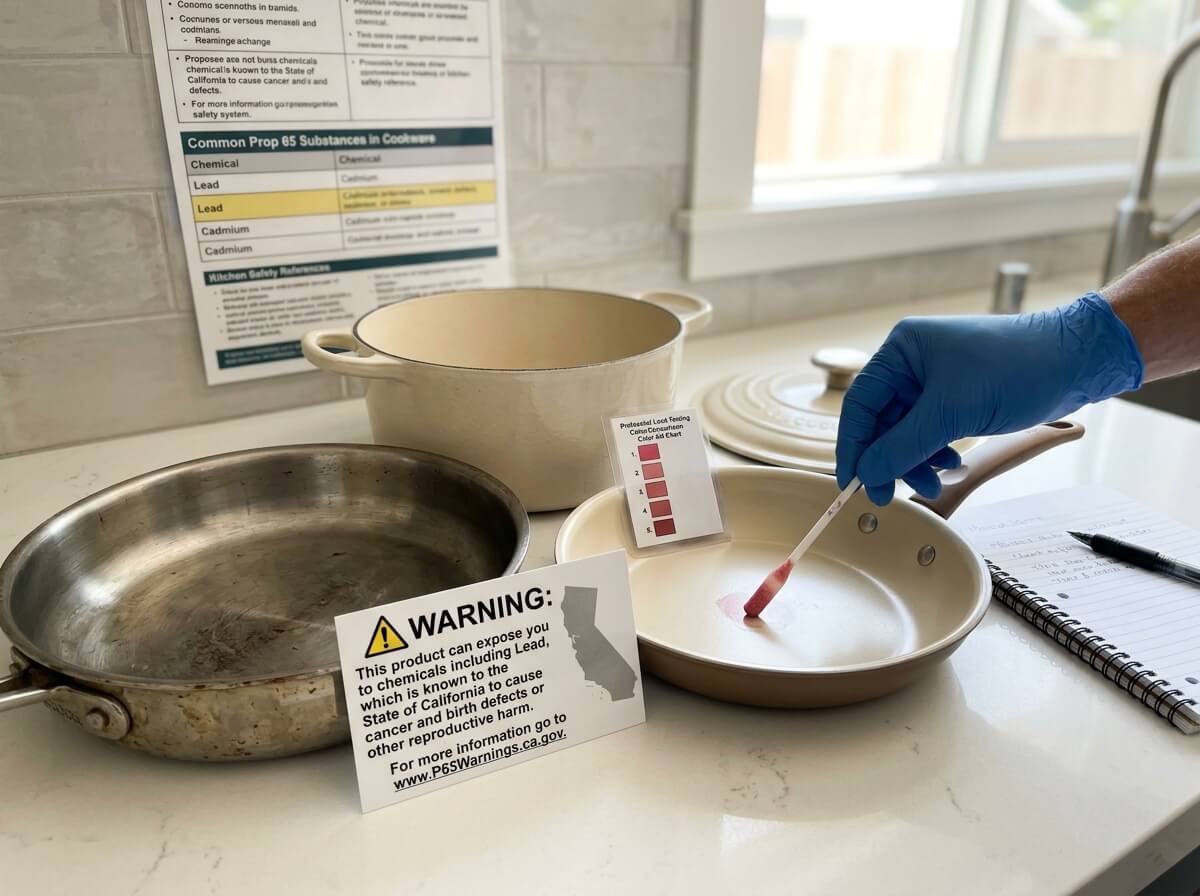
A Prop 65 warning on a cookware label means the manufacturer is telling you the product may expose you to a chemical California has listed as capable of causing cancer or reproductive harm, at a level the state’s own conservative threshold treats as worth disclosing.
It does not mean the product violates FDA rules, and it does not automatically mean the risk is significant in practice.
Those two facts get confused constantly, and untangling them is most of what this label is actually about.
What a Prop 65 Warning Actually Is
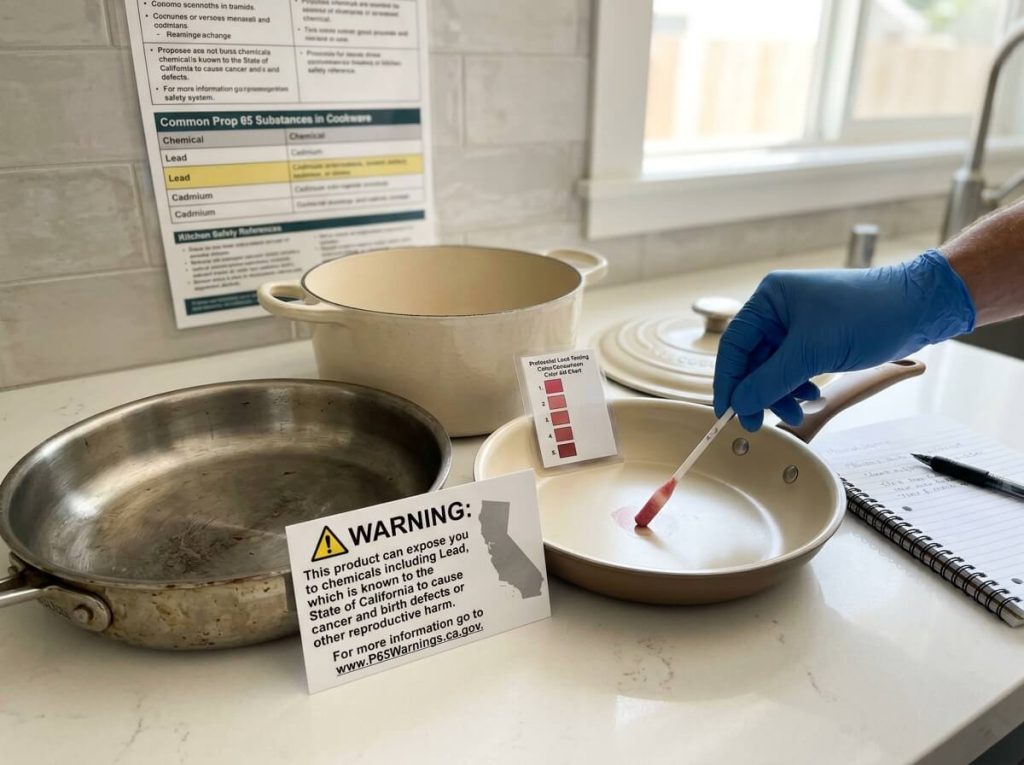
A Prop 65 warning is a disclosure required under California state law when a business knowingly exposes consumers to a chemical the state has identified as a carcinogen or reproductive toxicant, above a specific regulatory threshold.
It’s a right-to-know mechanism, not a safety certification or a ban; the product remains legal to sell with the warning attached.
The Law Behind the Warning: The Safe Drinking Water and Toxic Enforcement Act
“Proposition 65” is the common name for California’s Safe Drinking Water and Toxic Enforcement Act of 1986.
A voter‑approved ballot initiative that requires businesses to provide a clear and reasonable warning before exposing anyone in California to chemicals on the state’s official list of substances known to cause cancer, birth defects, or other reproductive harm.
A list now containing more than 900 chemicals and maintained by the Office of Environmental Health Hazard Assessment (OEHHA).
Because the law applies to any business that sells or ships products to California consumers, including online retailers, many national brands choose to place Proposition 65 warnings on products sold throughout the U.S. rather than maintain California‑specific packaging, which is why these warnings often appear on items purchased far outside the state.
Why the Warning Doesn’t Mean What Most People Assume
Seeing this warning on cookware does not mean the product has failed an FDA safety review or that using it poses a meaningful health risk in ordinary use.
Prop 65’s threshold for requiring a warning is set far more conservatively than most federal safety standards, and a product can carry the label while remaining fully compliant with FDA regulations for the same chemical.
The warning also doesn’t distinguish between a product that barely crosses California’s threshold and one that contains a chemical at a much higher level; both get the same label.
Reading the warning as “this specific product is dangerous” skips past what it’s actually built to communicate, which is closer to “this chemical is present at a level California requires us to disclose.”
What Actually Triggers a Prop 65 Warning on Cookware
Cookware warnings almost always trace back to one of a handful of chemicals showing up in a coating, glaze, or metal alloy, and understanding which one is present tells you far more than the warning label alone.
If your concern is specifically nonstick coatings, it helps to already understand what PFAS-free actually means, since PFAS is one of the chemicals that can trigger this exact warning.
The Chemicals Most Often Responsible: Lead, Cadmium, Nickel, and PFAS
| Chemical | Where it shows up in cookware | Why does it trigger a warning |
|---|---|---|
| Lead | Ceramic and glass glazes, solder in older cookware, and some imported decorative pieces | Even trace amounts can exceed California’s very low daily exposure threshold |
| Cadmium | Bright-colored ceramic glazes and decorative finishes | Used historically as a pigment, it can leach at levels above the state’s threshold |
| Nickel | Stainless steel alloys | Usually present at levels too low to require a warning, though some products still carry one defensively |
| PFAS | Nonstick coatings such as PTFE-based surfaces | Certain PFAS compounds are separately listed as reproductive toxicants under Prop 65 |
For a closer look at how to identify PFAS specifically in a coating, see our guide on how to know if your cookware has PFAS.
Why Cast Iron and Ceramic Cookware Get Flagged More Than Stainless Steel
Comparing materials side by side shows why some cookware carries this warning far more often than others, even among products generally considered safe.
| Material | Typical Prop 65 status | Why |
|---|---|---|
| Cast iron (bare or enameled) | Sometimes flagged | Raw iron ore naturally contains trace lead and cadmium, which can carry through manufacturing even without being intentionally added |
| Ceramic-glazed cookware | Frequently flagged | Glazes historically relied on lead or cadmium-based pigments for color and finish |
| Stainless steel | Rarely flagged | Nickel is present in the alloy, but typically at levels below California’s safe harbor threshold |
| Uncoated carbon steel | Rarely flagged | No glaze or coating layer means fewer chemicals of concern are present at all |
For more on how these two popular materials actually compare, see our breakdown of ceramic vs cast iron cookware, and for a deeper look at coating safety specifically, see whether ceramic cookware is safe for everyday use.
The “Safe Harbor” Threshold: Why So Many Products Get a Warning for So Little Risk
Prop 65 warnings are triggered by crossing a specific numeric exposure threshold, not by the mere presence of a listed chemical, and that threshold is set at a level most people would consider extremely cautious.
How NSRL and MADL Levels Are Set
California’s Office of Environmental Health Hazard Assessment (OEHHA) has established Proposition 65 “safe harbor” thresholds in two forms: No Significant Risk Levels (NSRLs) for chemicals listed as causing cancer and Maximum Allowable Dose Levels (MADLs) for chemicals listed as causing birth defects or other reproductive harm.
NSRLs are set so that daily exposure at that level over a lifetime would be expected to cause no more than one additional cancer case per 100,000 people over 70 years, while MADLs define an exposure level below which reproductive toxicity warnings are not required.
For lead, OEHHA’s safe harbor values are an oral NSRL of 15 micrograms per day and a MADL of 0.5 micrograms per day, reflecting a very small allowable daily dose for reproductive effects.
Businesses that can show typical exposures from their products are at or below the relevant NSRL or MADL do not need to provide a Proposition 65 warning; when exposure cannot be demonstrated as below those thresholds, many companies opt to include a warning as the more conservative legal choice.
Why Manufacturers Often Warn Even When Risk Is Minimal
Once you understand the safe harbor system, the reason so many products carry this warning becomes a matter of incentives rather than actual danger.
Businesses that want to skip the warning carry the burden of proving their product’s exposure falls below the relevant NSRL or MADL, which typically requires laboratory testing and an exposure assessment that can be costly to produce and to defend if challenged.
There is no legal penalty for adding a Prop 65 warning to a product that doesn’t need one. There is a real penalty for failing to warn when required, discussed in the enforcement section below.
Given that asymmetry, many manufacturers, especially smaller ones, choose to add the warning by default rather than fund testing to avoid it, which means the presence of a warning by itself says very little about how close a product actually is to the safe harbor threshold.
How Prop 65 Enforcement Actually Works
Prop 65 is unusual among consumer protection laws because private individuals and organizations, not just government regulators, are allowed to bring enforcement actions, and that structure shapes how aggressively the warning gets applied across the market.
The 60-Day Notice and “Bounty Hunter” Lawsuits
- Any person or organization can enforce Prop 65 by first serving a 60-day notice of violation, along with a certificate of merit, on the business in question.
- If California’s Attorney General doesn’t pursue the matter within that window, the private party is free to file a lawsuit and pursue civil penalties directly.
- Civil penalties can reach $2,500 per violation per day, and settlements commonly land between $25,000 and $250,000 or more once attorneys’ fees are included.
- Law firms and advocacy groups that specialize in these cases, sometimes called Prop 65 bounty hunters,” monitor products sold into California and file large numbers of these notices each year.
- More than 5,000 60-day notices were filed against consumer product companies in 2025 alone, with heavy metals like lead and cadmium among the most frequently cited categories.
What’s Changing: The 2025–2028 Short-Form Warning Update
- OEHHA finalized amendments to the short-form warning regulations, effective January 1, 2025, with a three-year transition period ending January 1, 2028.
- Under the previous short-form rules, a warning could simply read “WARNING: This product contains a chemical known to the State of California to cause cancer” without naming which chemical was responsible.
- The updated short-form warning must now name at least one specific chemical for each applicable risk category, so a cookware label might instead read something like “WARNING: Can expose you to lead, a chemical known to the State of California to cause birth defects or other reproductive harm.”
- Products manufactured and labeled before January 1, 2028, can continue using the older, more generic short-form language for an unlimited sell-through period, so both versions will likely appear on store shelves and online listings for several more years.
- Once fully in effect, this change means shoppers will increasingly be able to tell from the label itself whether a cookware warning concerns lead, cadmium, PFAS, or another chemical, rather than facing the same vague notice regardless of the actual substance involved. If a cookware brand’s warning does turn out to concern PFAS specifically, that’s often a sign worth pairing with a broader look at transitioning away from non-stick cookware rather than relying on the warning label alone.
None of this tells you which specific pan or set to buy, which is really a separate question from what the warning label itself means.
For that, see our full non-toxic cookware brands, built around verified materials and coatings rather than label language alone.
FAQ
Does a Prop 65 warning mean my cookware is unsafe?
Not necessarily, and treating the warning as a direct safety verdict misreads what it’s designed to communicate.
A Prop 65 warning means estimated exposure to a listed chemical crosses California’s safe harbor threshold, which is set far more conservatively than most federal safety standards and doesn’t account for how a product is actually being used.
A fully FDA-compliant product can still carry the warning, and the label doesn’t distinguish between exposure that barely crosses the threshold and exposure at a much higher level.
The warning is a disclosure requirement, not a recall notice or a certification that harm will occur.
Is a Prop 65 warning only required in California?
Legally, yes, but in practice, the warning shows up nationwide because most retailers and online sellers ship to California by default.
Since Prop 65 applies to any product sold to a California consumer, and separating inventory or labeling by state is impractical for most manufacturers, national brands typically add the warning to every unit regardless of where it’s ultimately sold.
That’s why you might see this label on cookware purchased in a state with no equivalent law of its own.
The warning’s presence outside California reflects a business’s labeling strategy more than any expansion of the underlying legal requirement.
How is Prop 65 different from FDA regulations?
Prop 65 and FDA regulations use different thresholds, different enforcement mechanisms, and different goals, which is why a product can satisfy one and still trigger a warning under the other.
FDA rules for cookware and food-contact materials generally focus on whether a chemical migrates into food at a level considered unsafe under federal testing standards, while Prop 65 relies on its own no significant risk level and maximum allowable dose level calculations that are typically far more conservative.
Prop 65 is also enforced partly through private lawsuits rather than solely through a federal agency, which changes how aggressively warnings get applied across the market.
A product can be fully legal under FDA rules and still require a Prop 65 warning in California.
Does stainless steel cookware ever get a Prop 65 warning?
Occasionally, but it’s less common than with ceramic-glazed or cast iron cookware, since stainless steel alloys typically contain nickel at levels below California’s applicable safe harbor threshold.
Some manufacturers still add a Prop 65 warning to stainless steel products defensively, without having tested the specific alloy, simply because there’s no penalty for warning unnecessarily and a real one for failing to warn when required.
If you see the warning on a stainless steel product, it’s worth checking whether the manufacturer discloses which specific chemical prompted it, since that information increasingly appears on brand websites even when it isn’t yet required on the physical label.