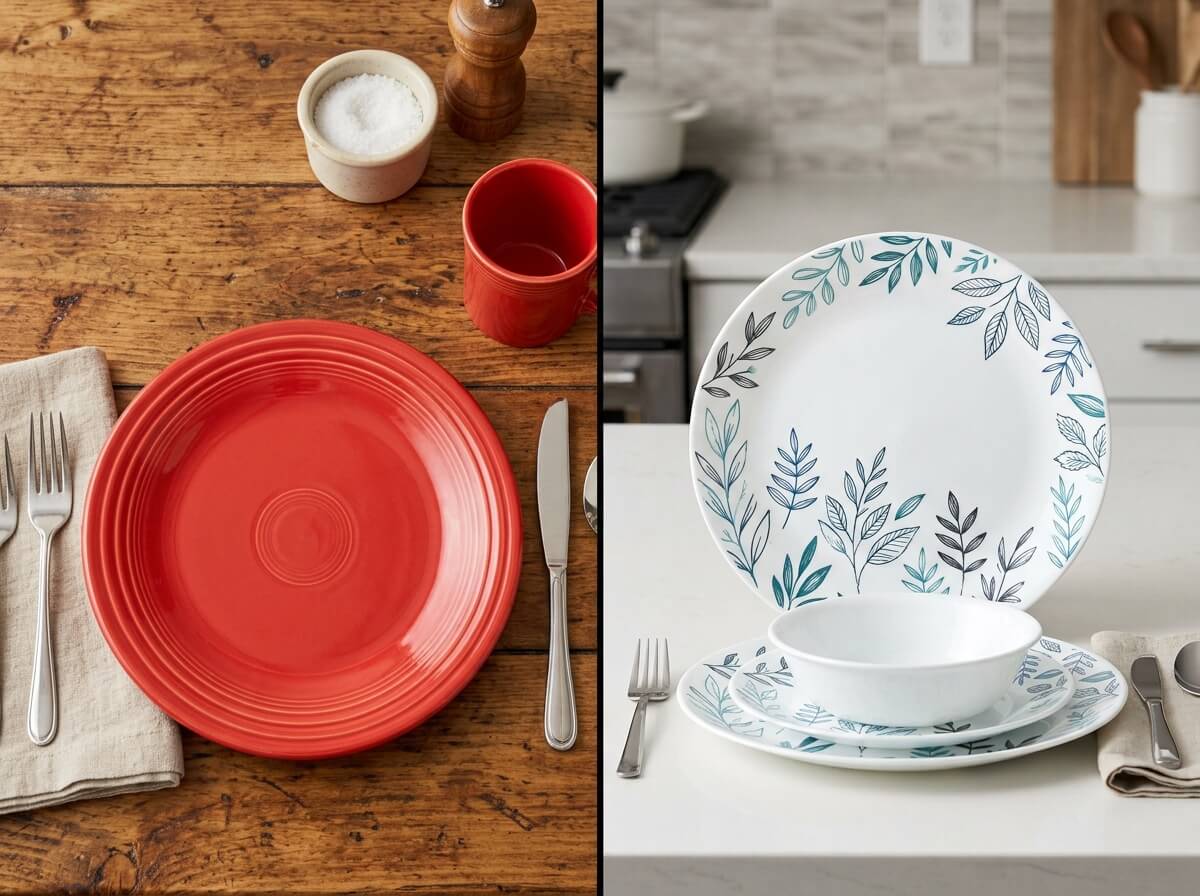
Corelle wins on weight, storage, and everyday chip resistance.
Fiestaware wins on color, durability in oven use, and the kind of dish you’d actually want sitting out on a table.
Neither one is simply “safer” than the other once you separate current production from anything made before 2000, which is the part most comparisons skip.
Fiestaware vs Corelle at a Glance
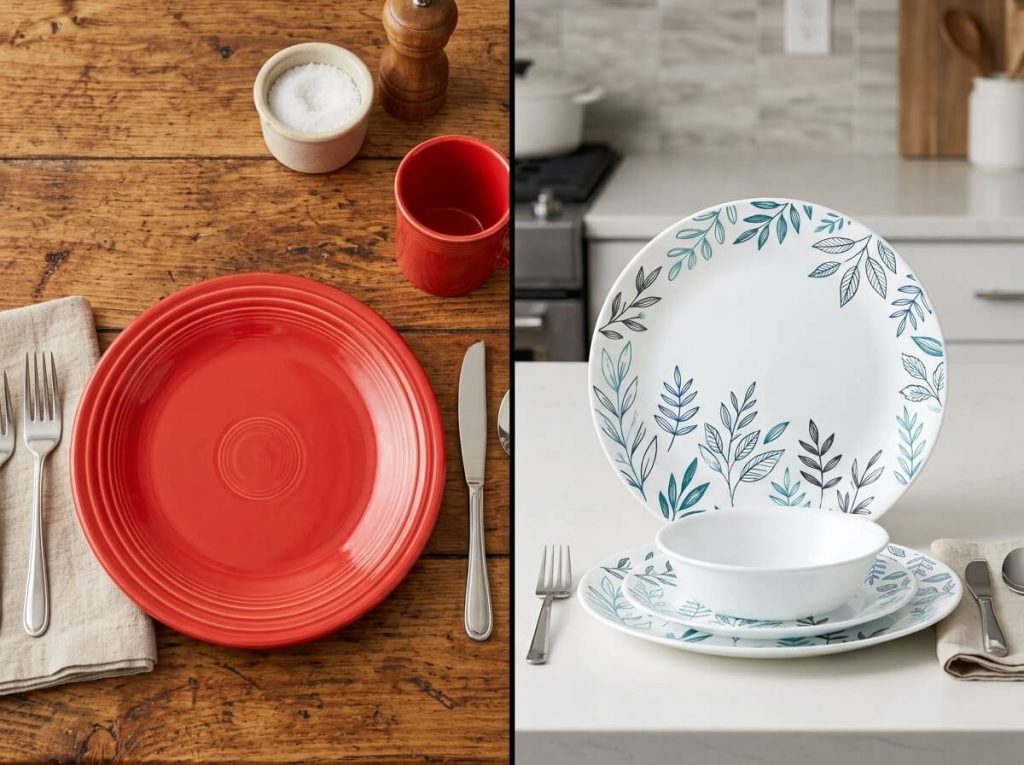
| Features | Fiestaware | Corelle |
|---|---|---|
| Material | Vitrified ceramic china | Vitrelle laminated glass |
| Weight | Heavy, substantial feel | Light, thin profile |
| Chip resistance | Chips on hard impact | Highly chip resistant |
| Break pattern | Chips or cracks | Can shatter into small, sharp pieces |
| Oven safe | Yes, up to 350°F | Oven safe up to 350°F (176 °C) only in a fully preheated conventional or convection oven. |
| Microwave safe | Yes | Yes |
| Dishwasher safe | Yes | Yes |
| Color range | Dozens of rotating colors | Mostly white and printed patterns |
| Starter set price | Higher per piece | Lower per piece |
If you want the specifics on how Corelle stacks up against a third major brand, we’ve also compared how Corelle compares to Pfaltzgraff in a separate breakdown.
What Are Fiestaware and Corelle Made Of?
The two brands aren’t variations on the same material. They’re built from fundamentally different things, and that difference explains almost every other item on the comparison table above.
For more on how different lead-free dinnerware materials compare across the whole category, it helps to start with what’s actually in each piece.
Fiestaware’s Vitrified China Body
Vitrified china is ceramic clay fired at high heat until it becomes non-porous and glass-hard all the way through.
Homer Laughlin China Company has produced Fiestaware in Newell, West Virginia, since 1936.
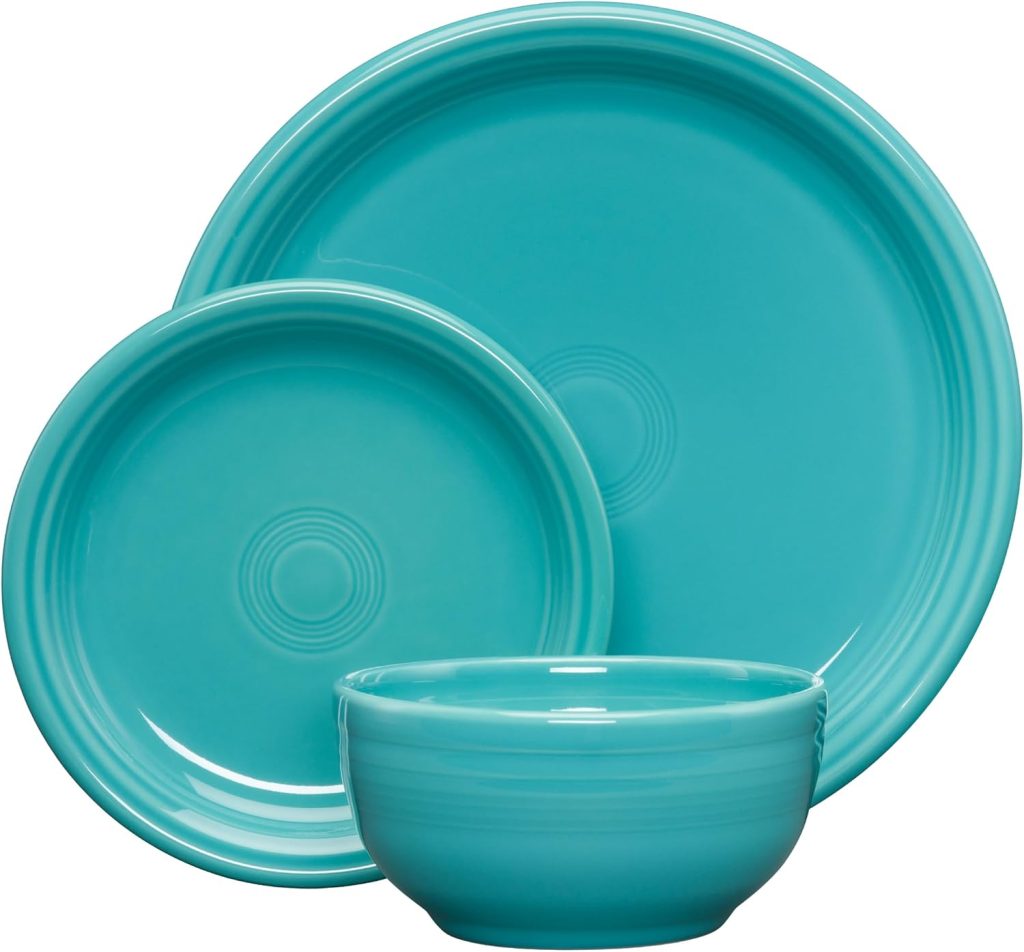
The glaze sits on top of that fired clay body and is what gives Fiestaware its saturated colors, from cobalt blue to scarlet to sunflower yellow.
Because the base material itself is thick and dense, a Fiestaware plate has real heft in the hand.
That’s also why it tolerates oven heat: the ceramic body and glaze expand and contract together without cracking under normal baking temperatures.
Corelle’s Vitrelle Tempered Glass
Vitrelle is Corelle’s proprietary three-layer glass laminate, not a ceramic at all. Two outer layers of glass are fused around a thin core layer, and the whole sandwich is tempered for strength.
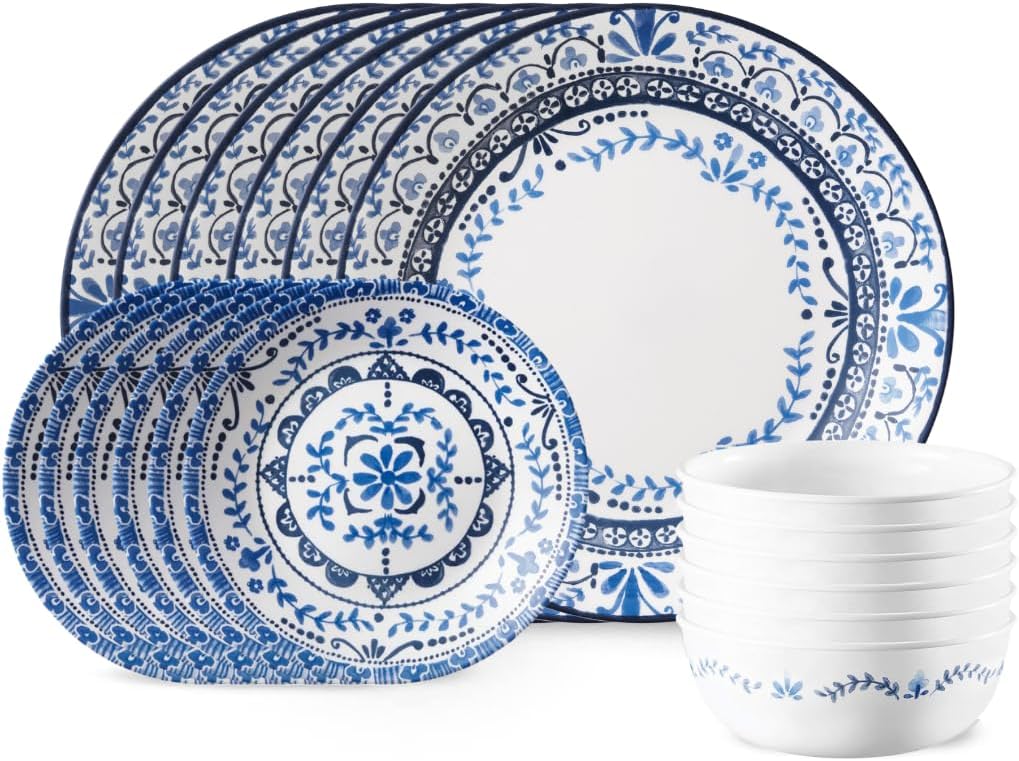
That’s why a Corelle plate weighs a fraction of what a Fiestaware plate does, and why it can survive drops that would chip other glassware.
Patterns and colors on Corelle are printed onto the surface rather than fired into a thick glaze, which is a detail that matters later when the safety comparison comes up.
Durability: Chip Resistance vs Shatter Risk
Corelle resists chips better than Fiestaware does. Fiestaware resists total breakage better than Corelle does.
Those are two different kinds of durability, and which one matters more depends on how you actually use your dishes.
How Each Brand Handles Everyday Drops
Corelle’s tempered glass laminate is specifically engineered to shrug off the small impacts that come from daily use: plates knocking together in a drying rack, a bowl set down a little too hard on the counter.
That’s the durability Corelle is known for and the reason it became a go-to for households with kids.
Fiestaware, being a thicker ceramic, is more prone to small chips along the rim from the same kind of everyday contact, particularly on well-used pieces that have been through years of stacking and unstacking.
The Shattering Trade-Off
The catch is what happens when each material fails outright.
Corelle’s tempered glass is built to resist minor impacts, but when it does break past that threshold, usually from a hard drop onto a tile or concrete floor, it can shatter into a wide spray of small, sharp fragments rather than breaking into a few large pieces.
Fiestaware behaves more like traditional ceramic: it tends to chip, crack, or break into fewer, larger pieces rather than scattering.
If you have young kids or pets underfoot, that difference in failure mode is worth weighing alongside the chip-resistance numbers.
Kitchen Practicality: Oven, Microwave, and Storage
Fiestaware can go from oven to table. Corelle can also go in the oven, but with a little catch. That single difference decides a lot of kitchens’ choices before price or color ever comes into it.
Oven and Broiler Safety
| Feature | Fiestaware | Corelle |
|---|---|---|
| Conventional oven | Safe up to 350°F | Oven safe up to 350°F (176 °C) only in a fully preheated conventional or convection oven. |
| Broiler | Not recommended | Not oven safe |
| Freezer to oven | Allow dish to reach room temperature first | Not applicable |
| Stovetop | Not safe | Not safe |
Microwave and Dishwasher Use
- Both Fiestaware and Corelle are microwave safe for reheating and light cooking.
- Both brands are top-rack dishwasher safe under normal cycles.
- Fiestaware’s glaze can show wear from years of abrasive dishwasher detergent, appearing as a dulling of the surface shine rather than a safety issue.
- Corelle’s printed patterns can fade with heavy dishwasher use over many years, particularly on the plate’s food-contact surface.
Cabinet Storage and Stacking Space
This is where the material difference from earlier in the article shows up in a way you can actually measure with a tape measure.
A stack of ten Corelle dinner plates takes up roughly the same vertical space as five or six Fiestaware plates, because Vitrelle glass is manufactured thin and flat by design, while Fiestaware’s vitrified china body is thicker and often has a slightly raised foot or rim that keeps plates from nesting as tightly.
It isn’t just that “Corelle stores better,” it’s that the glass laminate process that makes Corelle light and chip-resistant is the same process that makes it stack thin.
If you’re working with a small apartment kitchen or limited cabinet space, that’s a direct consequence of the material choice covered above, not a separate feature to weigh on its own.
Is Fiestaware or Corelle Safer? Lead and Cadmium Explained
Both brands’ current production is FDA compliant and Prop 65 disclosed, but “compliant” isn’t the same claim as “contains zero lead or cadmium,” and the real risk in both brands is concentrated in specific eras and specific decorated patterns rather than spread evenly across every piece either company has ever made.
Modern Fiestaware: What “Lead-Free” Actually Means
Homer Laughlin states that all Fiestaware made since the line’s 1986 relaunch is lead-free and meets FDA food-contact standards, and the company says it regularly tests new and existing glaze colors for cadmium leachability to stay within FDA and California Proposition 65 limits.
That claim has also been publicly challenged. Lead Safe Mama, an independent product-safety testing organization run by lead-poisoning-prevention advocate Tamara Rubin, has used XRF testing to find lead and cadmium in a range of Fiestaware pieces depending on age and color, and has specifically pushed back on Fiesta Tableware’s “lead-free” marketing language for not addressing cadmium content.
Homer Laughlin’s own compliance statements are about leachable lead and cadmium staying under FDA thresholds, not about total heavy-metal content being zero, and that distinction is where most of the confusion online comes from.
Modern Corelle: Vitrelle Glass vs Painted Patterns
The question of whether Corelle dinnerware is lead-free has a different answer depending on which part of the plate you’re asking about.
Corelle’s parent company, Instant Brands, states that Vitrelle glass itself contains no lead or cadmium, and that it routinely tests products for both metals at third-party labs to confirm compliance with FDA and Prop 65 requirements.
The undecorated white lines, like Winter Frost White, are made from that plain Vitrelle glass with no painted surface.
Patterned collections are a different story: Lead Safe Mama’s 2019 XRF testing of a then-current, open-stock Corelle Key West pattern found 141 parts per million of cadmium on the decorated surface, above Washington State’s 40 ppm consumer-goods limit and Denmark’s 75 ppm limit, the two most commonly cited regulatory thresholds for cadmium in consumer products.
If avoiding heavy metals entirely is your top priority, an undecorated white Corelle piece and a plain, unpatterned line generally carry less risk than a heavily painted pattern from either brand.
Vintage Fiestaware and Vintage Corelle: The Real Risk
This is where the two brands’ histories diverge most sharply, and where most comparison articles stop covering the topic in enough detail to actually be useful.
| Dinnerware Brand | Modern (current production) | Vintage |
|---|---|---|
| Fiestaware | FDA/Prop 65 compliant per Homer Laughlin; independent testing has still found cadmium in some current colors | Pre-1972 “Fiesta Red” used uranium oxide, then cadmium pigments; EPA advises against everyday use of pre-1986 pieces |
| Corelle | Vitrelle base glass contains no lead or cadmium; painted patterns have tested positive for cadmium in independent testing, including 141 ppm on a 2019 Key West piece | Pre-2000 patterns (Butterfly Gold, Spring Blossom, Meadow, and similar) have tested as high as roughly 16,700 ppm lead on the decorated food surface; Instant Brands confirmed in 2022 that vintage decorating processes used leaded glaze |
The practical takeaway: if you own or are buying secondhand Fiestaware from before 1986, or Corelle with a painted pattern from before 2000, treat it as display-only rather than everyday dinnerware unless you’ve had it independently tested.
Current production of both brands is a different situation, but neither company’s “lead-free” language means the same thing as “contains no cadmium whatsoever.”
Price and Value: Is Fiestaware Worth the Extra Cost?
Fiestaware costs more per piece than Corelle, usually by a wide margin, and whether that gap is worth paying depends on whether you’re buying dishes to use hard every day or dishes you want to enjoy looking at.
Starter Set Price Comparison
| Dinnerware Sets | Corelle | Fiestaware |
|---|---|---|
| Basic 4-piece place setting | Lower cost, often sold as large multi-setting boxed sets | Higher cost, frequently sold as individual open-stock pieces |
| Individual replacement plate | Inexpensive to replace | More expensive to replace |
| Full 16-piece starter set | Budget-friendly for outfitting a whole household | A meaningful investment, especially in multiple colors |
Long-Term Value and Replacement Pieces
Corelle’s boxed sets are usually the cheaper way to outfit a kitchen from scratch, and individual replacement pieces are easy to find at a low cost when something breaks.
Fiestaware works differently: its open-stock model means you buy pieces individually, often in whatever colors you want to mix, and because colors get periodically retired and reintroduced, current pieces stay easy to match for years after purchase in a way that many other patterned dinnerware lines don’t.
That system also supports a real secondhand and collector market, so a chipped piece from a retired color can often be replaced without buying an entirely new set.
If durability and cost per piece matter more than long-term color flexibility, non-toxic dinnerware made in the USA from either brand’s current, undecorated lines is generally the safer everyday bet.
Which One Should You Choose?
The right answer depends on which of three situations actually describes your kitchen: everyday family use, safety as the top priority, or buying secondhand and vintage pieces.
If you’re outfitting a household that uses dishes hard every day, Corelle’s chip resistance and light weight make it the more practical daily driver.
If avoiding heavy metals is your main concern, stick to undecorated, current-production lines from either brand and treat anything vintage or heavily patterned as a separate decision.
If you already own or are shopping for secondhand pieces, the era matters more than the brand name on the box.
Choose Corelle If…
- You have kids or a busy household and want dishes that survive daily handling without chipping.
- Cabinet space is tight, and you need dinnerware that stacks flat.
- You want a large, budget-friendly starter set rather than building a collection piece by piece.
- You’re prioritizing an undecorated, plain-white pattern to minimize any exposure to painted decoration. For families specifically shopping with lead exposure in mind, our guide to lead- and cadmium-free dinnerware for kids and toddlers goes deeper on which lines to look for.
Choose Fiestaware If…
- You want dishes that can go straight from the oven to the table.
- You’re building a colorful table setting for entertaining rather than daily rotation.
- You don’t mind paying more per piece for a heavier, more substantial feel in hand.
- You’re interested in an open-stock system that lets you mix colors and replace individual pieces over time.
Once you’ve settled on Fiestaware or Corelle, the next natural comparison is against a third popular brand many shoppers cross-shop against Corelle on price and pattern variety.
If you’re still weighing options, our full list of the best non-toxic, lead-free dinnerware covers current-production lines across several brands, all evaluated against the same FDA and Prop 65 standards discussed above.
FAQ
Is Fiestaware safer than Corelle?
Neither brand is categorically safer than the other; it depends on the era and pattern.
Current-production Fiestaware and Corelle are both FDA compliant and Prop 65 disclosed, but independent testing has found cadmium in some modern pieces from both brands, particularly in painted patterns and saturated colors.
Undecorated, current-production lines from either company carry the lowest documented risk.
Vintage pieces from before the mid-1980s (Fiestaware) or before 2000 (Corelle) carry meaningfully higher risk and are generally better treated as display pieces.
Is vintage Corelle safe to use every day?
Vintage Corelle patterns made before roughly 2000, including lines like Butterfly Gold and Spring Blossom, have tested positive for lead on the decorated food surface in independent XRF testing, with some results in the thousands of parts per million.
Instant Brands, Corelle’s parent company, has confirmed that leaded glaze was used in the decorating process for vintage dishware.
These pieces are generally safer treated as collectibles or display items rather than everyday dinnerware unless independently tested and confirmed safe.
Which dinnerware lasts longer, Fiestaware or Corelle?
It depends on what kind of wear you’re measuring.
Corelle resists everyday chips better than Fiestaware and holds up well to years of stacking and daily handling, but its printed patterns can fade over time, and it’s more vulnerable to total breakage from a hard drop.
Fiestaware chips more easily on the rim from daily contact but rarely fails catastrophically the way Corelle can when dropped hard, and its fired-in glaze color doesn’t fade the way a printed Corelle pattern can.