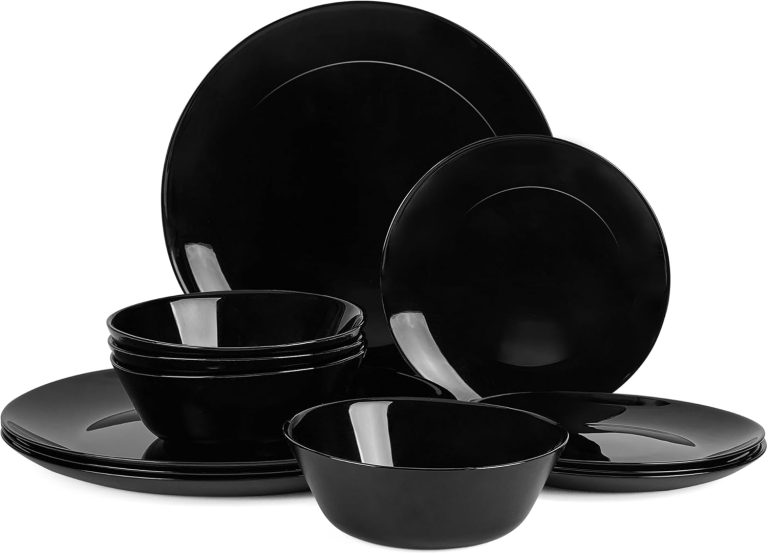
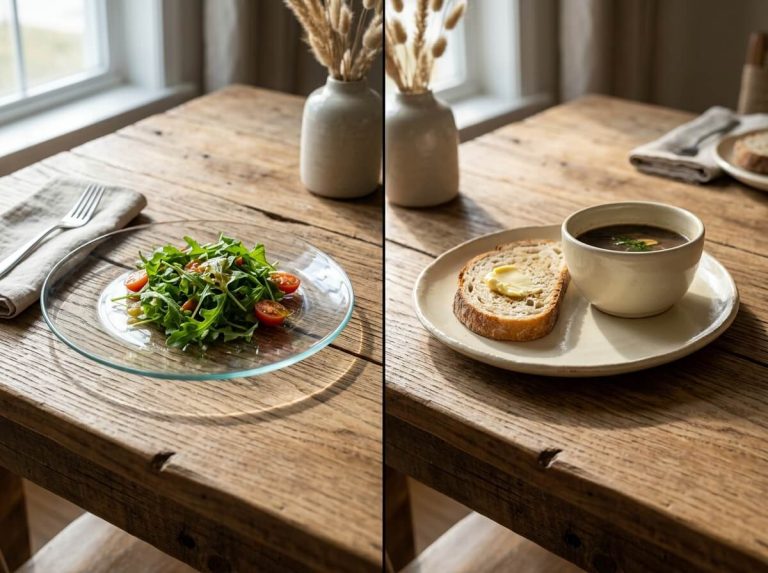
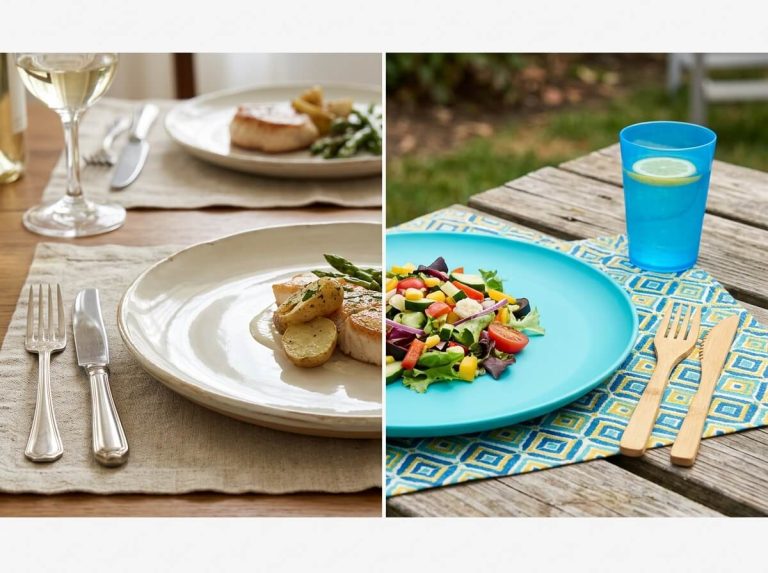
The safest lead-free dinnerware materials fall into a handful of distinct categories, and each one carries a different kind of risk rather than a single shared one: ceramic and glass can leach through their glaze, plastic and “eco” composites can leach through their resin, and metal can leach through its alloy.
Understanding which mechanism applies to a given material tells you far more than a simple “safe” or “unsafe” label, and it’s the fastest way to evaluate a dinnerware set you’re not sure about, whether it’s porcelain, tempered glass, stainless steel, or a bamboo-look bowl from a big-box store.
The Four Ways Dinnerware Materials Can Leach Toxins
Every dinnerware material that poses a chemical risk does so through one of two broad pathways: glaze-based leaching or resin migration, plus a much smaller metal-leaching pathway, and a fourth category of materials with essentially no leaching pathway at all.
Knowing which pathway applies to a material tells you what questions to ask before you buy it, rather than relying on a brand’s marketing language.
Glaze-Based Leaching (Ceramic and Glass)
Glaze-based leaching happens when a glassy coating applied to ceramic or decorated glass contains lead or cadmium, and that coating chemically breaks down under heat, acidity, or time, releasing those metals into food or drink.
This is the pathway responsible for essentially all lead risk in ceramic dinnerware and most lead risk in glass; the clay or glass body underneath is rarely the source, and the surface finish is.
Historically, lead compounds were used as a flux in glazes because they lower the melting point and produce a glossy finish cheaply, and while this practice has declined sharply in regulated markets, it hasn’t disappeared everywhere.
Acidic foods like tomato sauce, citrus, and vinegar accelerate this breakdown, and heat speeds it up further, which is why the same dish can test differently depending on what’s served in it and for how long.
Resin-Migration Leaching (Plastic, Melamine, and Composites)
Resin migration is a different mechanism entirely: instead of a surface coating breaking down, it’s the base material itself, a cured plastic resin slowly releasing unreacted or partially reacted chemical building blocks into food, especially under heat.
Melamine dinnerware is made by curing melamine and formaldehyde together into a hard resin, and when that curing process is incomplete, or the resin is repeatedly exposed to hot or acidic contents, residual melamine and formaldehyde can migrate out.
This pathway matters because it explains why “natural-looking” composite dinnerware bamboo fiber, wheat straw, and similar plant-fiber blends isn’t actually a different, safer category from melamine.
It’s the same resin with a different filler, a point this guide comes back to in detail below.
The distinction between these two pathways also explains why the same safety rule of thumb “avoid heat and acidity” applies across such different-looking materials for entirely different chemical reasons.
With glaze-based leaching, heat and acid attack a thin surface layer that sits on top of an otherwise inert clay or glass body, so the risk is concentrated at that surface.
With resin migration, heat and acid act on the bulk material itself, which is why scratched, worn, or aging plastic and composite dinnerware tends to become progressively higher-risk over its lifespan in a way that intact glazed ceramic generally does not.
Ceramic and Porcelain: Where Lead Risk Concentrates
Ceramic dinnerware is capable of being genuinely lead-free, but risk within this category varies enormously by clay type and glaze quality.
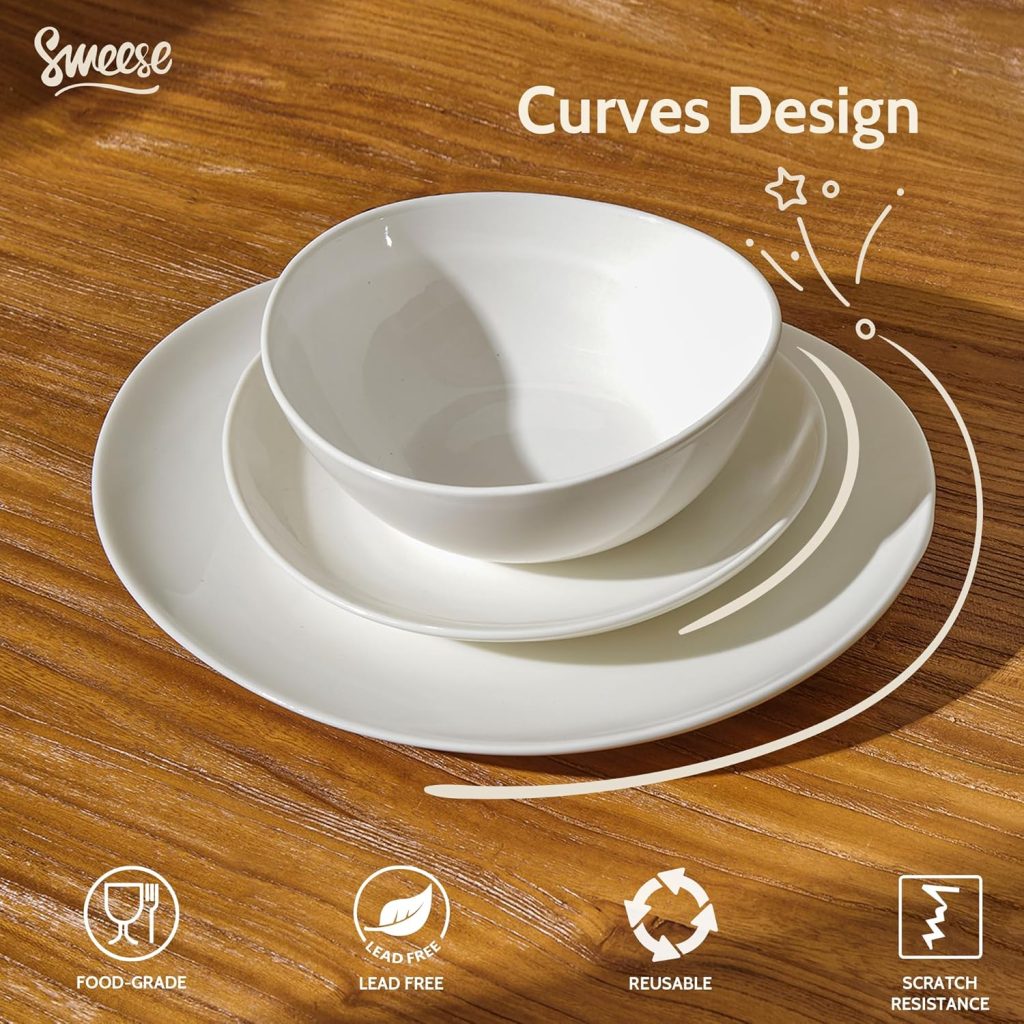
For a deeper breakdown, our full ceramic-specific safety breakdown covers testing standards and buying questions in more depth than this overview can.
The short version: firing temperature and glaze integrity, not the word “ceramic” itself, determine whether a piece is actually safe.
Porcelain, Stoneware, and Earthenware Compared
| Material | Typical firing temperature | Density/porosity | General lead-risk profile |
|---|---|---|---|
| Porcelain | ~2,300°F+ | Fully vitrified, non-porous | Lowest risk when properly fired; the category benchmark for both safety and durability |
| Stoneware | ~2,100–2,300°F | Dense, low porosity when well-glazed | Moderate risk; safety depends on glaze recipe and firing consistency more than the clay body itself |
| Earthenware | Lower firing temperature | More porous, especially if under-fired | Highest risk category, particularly in low-cost or handmade pieces where flux-heavy glazes are more common |
Porcelain’s high firing temperature fully vitrifies the clay, sealing off the pathways lead would otherwise use to migrate.
Stoneware sits in the middle, durable and largely non-porous when made well, but some budget manufacturers use lower-melting, flux-heavy glazes to cut production costs, which raises lead risk independent of the clay type.
Earthenware needs the most caution of the three: its lower firing temperature and higher porosity mean glaze quality has to do more work, and that’s exactly where inconsistent or untested production shows up most.
Cadmium and the Bright-Color Glaze Problem
Bright red, orange, and yellow ceramic and glass glazes have historically relied on metal-oxide pigments, including cadmium- and lead-based colorants, which is the real explanation behind the common advice to avoid vividly colored dinnerware.
This isn’t a blanket rule against color in general; it’s specifically about pigments concentrated in the direct food-contact zone, meaning a rim decoration or an interior glaze pattern carries more relevance than an exterior-only design element that food never touches.
Modern, reputable manufacturers have largely reformulated these pigments to remove cadmium and lead, but inexpensive or imported pieces with limited testing history are where this risk still shows up most consistently.
If a colorful piece of dinnerware doesn’t come with any documentation about its glaze composition, treating the color itself as a prompt to ask more questions rather than an automatic disqualifier is the more useful approach.
Where the decoration sits on the piece matters as much as the color itself.
A glaze pattern on the interior of a bowl or around the rim of a plate sees far more direct, repeated food contact than an identical pattern on the exterior base of the same piece, so two dishes with the same colorful design can carry meaningfully different real-world risk depending on placement alone.
This is also why a piece can pass a general safety check and still warrant caution for daily use: testing protocols in some markets specifically target the rim and lip area precisely because that’s where contact and wear concentrate over years of use.
Glass Dinnerware: Where It’s Safest and Where It Isn’t
Plain, undecorated tempered or borosilicate glass is one of the lowest-risk dinnerware materials available, because glass itself has no glaze layer to break down and no resin to migrate.
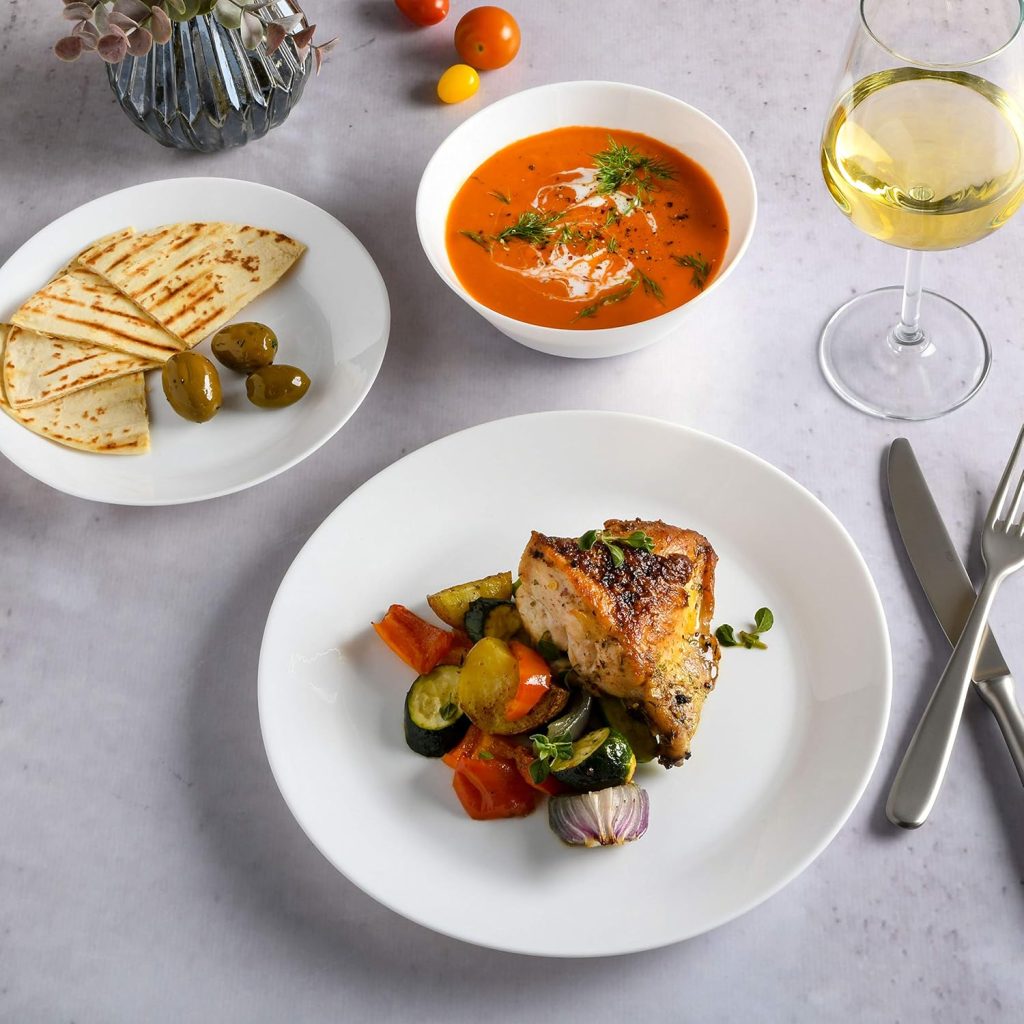
The risk in this category comes almost entirely from decoration and a specific older subtype called lead crystal.
Tempered/Borosilicate Glass vs. Lead Crystal
| Type | Composition | Lead content | Risk level |
|---|---|---|---|
| Tempered soda-lime glass | Standard glass, heat-treated for strength | None | Very low; the standard for modern everyday glass dinnerware |
| Borosilicate glass | Boron-oxide glass formulation | None | Very low; resists thermal shock better than soda-lime |
| Lead crystal | Glass with lead oxide added for clarity and weight | Can reach roughly 24% lead content by weight in older pieces | High for regular food or drink contact; best reserved for display or occasional use |
Everyday modern glass dinnerware plates, bowls, and drinkware sold as tempered or borosilicate glass is manufactured without added lead and doesn’t rely on a glaze that can break down.
Lead crystal is a distinct, older category made by deliberately adding lead oxide to increase sparkle, clarity, and weight, and it’s this specific subtype, not glass in general, that carries meaningful lead exposure risk with regular use.
Decorated or painted glass introduces a separate, unrelated risk if the paint itself contains lead-based pigment, which is why plain, undecorated glass remains the safest choice within this category, and it’s worth checking our dedicated look at whether Corelle dinnerware is lead-free since Corelle’s laminated glass construction is a common point of confusion for shoppers comparing glass options.
The At-Home Ring Test and Its Limits
The ring test is a common at-home method for spotting lead crystal: fill the glass partway with water, tap the rim gently, and listen for a clear, sustained bell-like ring rather than a short, dull clink.
The reasoning behind it is that real lead increases the density and resonant properties of glass, which does tend to produce a longer, higher-pitched tone in leaded pieces compared to standard soda-lime glass.
What this test isn’t is a validated laboratory method: it’s a folk heuristic with no formal accuracy data behind it; it can be affected by the glass’s shape and thickness independent of lead content; and it tells you nothing about decorative paint on the surface of an otherwise lead-free piece.
For painted or tinted glass specifically, a separate and more direct check is to lightly rub a finger across any colored detailing; if the paint has texture or feels raised rather than fused smoothly into the glass, that’s a stronger signal of a decorative coating worth questioning than the ring test would ever provide on its own.
Stainless Steel: The Metal Exception
Stainless steel is the one common dinnerware material governed by a leaching mechanism separate from both glaze breakdown and resin migration, and it’s generally considered one of the lowest-risk options available, particularly for households prioritizing durability over glass or ceramic’s breakability.
Why 18/8 and 18/10 Grades Matter
Food-grade stainless steel is typically labeled by its chromium and nickel content; 18/8 or 18/10, referring to 18% chromium and 8% or 10% nickel, and this alloy composition is what determines both corrosion resistance and the very small amount of nickel that can migrate under prolonged contact with acidic foods.
Unlike lead, which has no established safe exposure level, nickel is a normal dietary trace element for most people, and the amounts involved in stainless steel food contact are generally far below any level of concern for the general population.
The practical exception is nickel sensitivity: people with a diagnosed nickel allergy can react to even the small amounts stainless steel releases, which is worth knowing if that applies to your household, but it’s a distinct issue from lead or cadmium exposure and isn’t a reason for most buyers to avoid the material.
Lower-grade or poorly manufactured stainless steel is where the small additional caution lies.
Steel that isn’t a genuine food-grade alloy, or that has a thin, low-quality finish, can corrode faster and release more metal over time than a proper 18/8 or 18/10 piece, particularly with prolonged contact with salty or acidic foods.
This is less a reason to avoid stainless steel broadly and more a reason to buy from brands that state their actual grade rather than using generic terms like “premium steel” without a number attached.
Who Stainless Steel Works Best For
- Households with young children benefit from stainless steel’s break-resistance, since it survives drops that would chip or shatter ceramic or glass.
- Campers, boaters, and anyone serving food outdoors gain a practical advantage from steel’s combination of durability and light weight compared to ceramic sets.
- Families managing a nickel allergy should look specifically for nickel-free or nickel-reduced alloy options rather than assuming all stainless steel is equivalent.
- Anyone wanting a glaze-free, resin-free option with essentially no decoration-related lead risk gets that by default with plain stainless steel, since there’s no coating layer to evaluate.
- Households that regularly microwave food should note that stainless steel is not microwave-safe, which makes it a poor single-material solution if microwave reheating is a daily habit.
Melamine, Plastic, and “Eco” Bamboo/Wheat Straw Materials
Standard melamine dinnerware is a hard plastic resin that can migrate small amounts of melamine and formaldehyde into food, particularly when heated, and that same risk profile extends to bamboo- and wheat-straw-labeled dinnerware far more often than most shoppers realize.
Why “Bamboo” and “Wheat Straw” Dinnerware Is Usually Still Melamine Plastic
Dinnerware labeled “bamboo” or “wheat straw” is, in the large majority of cases, melamine-formaldehyde resin with plant fiber added as filler, not a separate, plant-based material.
Manufacturers blend bamboo powder, wheat straw, or corn starch into the same melamine-formaldehyde resin used in standard melamine dishware, then market the finished product around its plant-based filler rather than its actual plastic base, which is why these items are frequently described as “eco-friendly” or “natural” even though their core chemistry is unchanged.
Government and academic testing has repeatedly found that this labeling gap has real safety consequences.
One study found that 35% of bamboo-melamine tableware samples exceeded the applicable melamine migration limit, and related research showed that bamboo-filled melamine-formaldehyde products can deteriorate under use conditions, increasing migration of melamine and formaldehyde.
A related study testing kids’ bamboo dinner sets specifically found melamine migration exceeding the applicable limit in a majority of the products tested.
None of this means every bamboo- or wheat-straw-labeled product is unsafe, but it does mean the “natural material” framing on the packaging is not evidence of lower risk, and these products should be evaluated using the same caution applied to standard melamine rather than treated as an automatically safer alternative.
Heat, Acidity, and When Migration Risk Spikes
- Hot liquids and foods are the single biggest trigger for melamine and formaldehyde migration, with laboratory testing showing migration rates climb sharply once contents exceed roughly 70°C (158°F).
- Repeated microwave use is specifically discouraged for melamine and bamboo/wheat-straw composite dinnerware, since manufacturers themselves generally label these products as not microwave-safe.
- Acidic foods and drinks accelerate migration similarly to their effect on ceramic glaze, making tomato-based dishes, citrus, and vinegar-based dressings higher-risk contents for this material category.
- Scratched or worn surfaces increase migration risk over time, since surface damage exposes more resin area and can accelerate breakdown with repeated washing and use.
- Extended contact time: food or drink left sitting for hours rather than a quick meal gives migration more time to occur even without added heat or acidity.
How to Match a Material to Your Actual Use Case
No single dinnerware material is the right default for every household, and matching material to actual use daily meals versus occasional entertaining, kids versus adults, microwave-heavy routines versus stovetop-to-table serving narrows the decision far more effectively than chasing a single “safest” label.
Parents specifically working through this for young children will find our full guide to non-toxic dinnerware for kids and toddlers useful alongside the checklist below.
A Decision Checklist by Household Need
- If breakage around young children is the main concern, prioritize stainless steel first and well-glazed porcelain or tempered glass second, and avoid loose glass pieces for unsupervised toddler use.
- If daily microwave reheating is a household habit, choose porcelain, stoneware, or borosilicate glass, since melamine, bamboo/wheat-straw composites, and stainless steel are all poor fits for that routine.
- If serving hot, acidic foods regularly, think tomato-based sauces or citrus-heavy dishes — favor plain tempered glass or high-fired, well-glazed ceramic over any melamine-based composite.
- If you’re buying for outdoor or travel use where weight and durability matter most, stainless steel is the strongest single-category choice, with tempered glass as a heavier but still reasonable second option.
- If you’re drawn to bamboo- or wheat-straw-labeled products for their look, treat them as standard melamine plastic for safety purposes and reserve them for cold, brief-contact uses rather than daily hot meals.
Certifications and Claims Worth Trusting Across Any Material
- A specific, quantified lab result — such as a stated leaching concentration or an explicit “non-detect” finding — is more meaningful than a general “lead-free” or “food-safe” claim on its own.
- Compliance with California’s Prop 65 threshold is a stricter benchmark than the general national FDA action level, so a brand that names Prop 65 compliance specifically is signaling a higher bar.
- A brand willing to share its actual glaze, resin, or alloy composition on request is a stronger trust signal than one that only offers a blanket safety statement, and you can check whether your specific dinnerware brand is lead-free as a next step before you buy.
- Country-of-origin transparency matters more for glaze- and resin-based materials than for plain glass or steel, since manufacturing consistency has the biggest effect on exactly those two leaching pathways.
- A certification claim without a named testing body or lab behind it carries far less weight than one that specifies who performed the test and under what standard.
Once you’ve decided which material family fits your household best, the fastest way to shortcut brand-by-brand research is to start from options that have already been evaluated against these criteria.
You can browse our picks for the best non-toxic lead-free dinnerware to see specific sets that hold up across the material categories covered above.
Frequently Asked Questions
What is the safest material for dinnerware overall?
There isn’t a single safest material for every situation, but plain, undecorated tempered or borosilicate glass and well-certified high-fired porcelain are generally considered the two lowest-risk options, since neither relies on a glaze prone to breaking down under normal conditions.
Stainless steel is a close third, particularly for households prioritizing durability over glass or ceramic’s breakability, though it isn’t microwave-safe.
The material that’s actually safest for you depends on your specific use case: daily microwave use, breakage risk around kids, or frequent acidic and hot foods each favor a different one of these three options.
Is bamboo or wheat straw dinnerware actually non-toxic?
No, dinnerware labeled bamboo or wheat straw is almost always melamine-formaldehyde plastic resin with plant fiber added as filler, not a separate natural material, and it should be evaluated with the same caution as standard melamine rather than assumed safer because of its “eco” framing.
Laboratory testing has found meaningful rates of melamine and formaldehyde migration exceeding applicable limits in these products, particularly with hot contents, and at least one study found that the plant fiber component can intensify rather than reduce that migration.
If you’re buying for children specifically, treat these products as appropriate for cold, brief-contact use rather than daily hot meals.
Is stainless steel dinnerware better than ceramic for kids?
For breakage resistance, yes, stainless steel survives drops that would chip or shatter ceramic, which makes it a practical choice for young children still learning to handle dishes carefully.
For lead-specific safety, well-certified lead-free ceramic and stainless steel are both very low risk, since stainless steel’s leaching pathway involves alloy metals like nickel rather than lead at all.
The clearer deciding factor for most families is durability and microwave compatibility rather than lead risk, since a well-glazed, certified ceramic piece and a stainless steel piece are both reasonable choices on the safety front alone.
How can I tell if glass dinnerware contains lead?
The most accessible at-home check is the ring test: fill the glass partway with water, tap the rim gently, and listen for a clear, sustained ring rather than a short, dull clink, since lead increases the density and resonance of glass.
This test is a useful screening heuristic, not a validated laboratory method, so a negative result is reassuring but not conclusive, especially on unusually thick or oddly shaped pieces.
For painted or decorated glass specifically, lightly rubbing a finger across the colored detailing to check for raised, textured paint is a more direct way to flag a potential lead-paint risk that the ring test wouldn’t catch on its own.