A dish can pass every “lead-free” claim on its packaging and still not be legally safe for a child to eat off, chew on, or drop on the floor.
That’s because two separate federal standards govern lead in kids’ dinnerware, and most buying guides quietly collapse them into one.
Understanding both is the fastest way to actually choose safe dishes instead of guessing based on a label.
Why “lead-free” means something different for kids’ dishes
The word “lead-free” gets applied to two different tests that measure two different risks. One asks whether lead leaches out of a dish into the food sitting on it.
The other asks how much lead is present anywhere in the dish at all, because a child might chew, suck, or mouth the object directly. A plate can satisfy the first test and still fail the second.
The FDA standard: lead that leaches into food
The FDA’s rule is about migration, not total content. It asks how much lead moves from the glaze or surface into food during normal cooking, serving, and storage.
Historically, the FDA capped leachable lead at 3 micrograms per milliliter for flatware.
In 1993, it tightened that to 0.5 micrograms per milliliter for cups, mugs, and pitchers, since those vessels hold liquid longer and are more likely to be reheated.
That’s also why an old ceramic dinner plate and an old ceramic mug from the same production run can carry different risk profiles: the mug holds acidic or hot liquid against the glaze far longer.
The CPSC/CPSIA standard: total lead in a child’s product
The Consumer Product Safety Commission regulates a completely different exposure pathway.
Under the CPSIA (Consumer Product Safety Improvement Act), accessible components of children’s products intended for children 12 and under may not contain more than 100 ppm lead in substrate material, and paint or other surface coatings are capped at 90 ppm.
The CPSC isn’t worried about what leaches into a meal. It’s worried about what happens when a toddler mouths the rim of a plate, sucks on a painted handle, or chews a decorated edge during teething.
A dish marketed as a “kids’ plate” has to meet this content limit whether or not it also passes the FDA’s food-contact leaching test.
The practical result: a plate can be entirely safe to eat off by FDA’s leaching standard and still have a painted rim that would fail CPSIA’s children’s-product limit the moment that same plate gets marketed “for kids.”
These aren’t competing opinions about safety. They’re two different legal tests answering two different questions, and a genuinely safe kids’ dish has to clear both.
BPA-free doesn’t mean lead-free
BPA-free labeling tells you almost nothing about lead.
The two are unrelated chemical concerns, tested and disclosed separately, and a manufacturer can advertise one without ever addressing the other.
What BPA-free actually certifies
BPA (bisphenol A) is a plastic hardener linked to hormone disruption. “BPA-free” means a product doesn’t use that specific compound in its plastic resin, full stop.
It says nothing about lead, cadmium, or other heavy metals, which are separate contaminants tested under entirely different standards.
A silicone or plastic dish can be genuinely BPA-free and still use a lead-containing pigment in its coloring, or a metal fastener with high lead content in a handle or rivet.
Where lead hides even in “safe” labeled dishes
- Bright, saturated glaze colors on ceramic dishes are more likely to use lead or cadmium compounds as pigments, especially in reds, oranges, and yellows.
- Painted or decaled patterns on any material, whether ceramic, glass, or metal, carry more risk than plain, undecorated surfaces, since the decoration itself is the most common source of lead.
- Imported and unbranded dinnerware sold through marketplaces and discount retailers shows up disproportionately in enforcement actions, largely because quality control is less consistent than it is for established manufacturers.
- A 2025 FDA enforcement action flagged 19 imported cookware and dinnerware products for dangerous lead leaching. The items had been sold openly in ethnic markets across California, New York, Illinois, and other states, a reminder that “lead-free” printed on packaging is a claim, not a guarantee, and that current-year products aren’t automatically exempt.
- Vintage and antique ceramic pieces predate modern lead restrictions entirely, so age alone is a meaningful risk signal regardless of how a piece looks.
The safest materials for kids’ and toddlers’ dishes, ranked
| Material | Lead risk | Durability for toddlers | Microwave safe | Best for |
|---|---|---|---|---|
| Food-grade stainless steel | Very low; metal itself is inert, risk only from decorative coatings | Excellent; dents but doesn’t shatter | No | Daily use, throwing, outdoor meals |
| Tempered glass (e.g., Vitrelle-style) | Very low when plain/undecorated | Excellent; chip-resistant, doesn’t warp or stain | Yes | Long-term family dinnerware, reheating |
| Food-grade silicone | Low; risk is in pigments/fillers, not the base polymer | Good; flexible, resists cracking | Yes (check brand specifics) | Babies starting solids, suction plates |
| Solid, untreated bamboo | Variable, depends entirely on binders used | Fair; can wear or absorb moisture over time | No | Occasional use, travel, picnics |
| Melamine | Not recommended | Excellent (shatterproof) | Never | Avoid for regular use |
Stainless steel
Stainless steel is one of the lowest-risk materials available because the base metal doesn’t contain lead and doesn’t need a glaze or paint to function.

What you do need to check is whether any colored coating, handle, or decorative element is separately confirmed lead-free, since the metal body being safe doesn’t guarantee every attached piece is.
It’s heavier and louder when dropped than plastic, but for a toddler who throws dishes, that trade-off is usually worth making.
Food-grade silicone
Platinum-cured, food-grade silicone is inert and doesn’t need a glaze, paint, or coating to work, which removes the most common source of lead contamination in dinnerware.
The caveat is pigmentation.
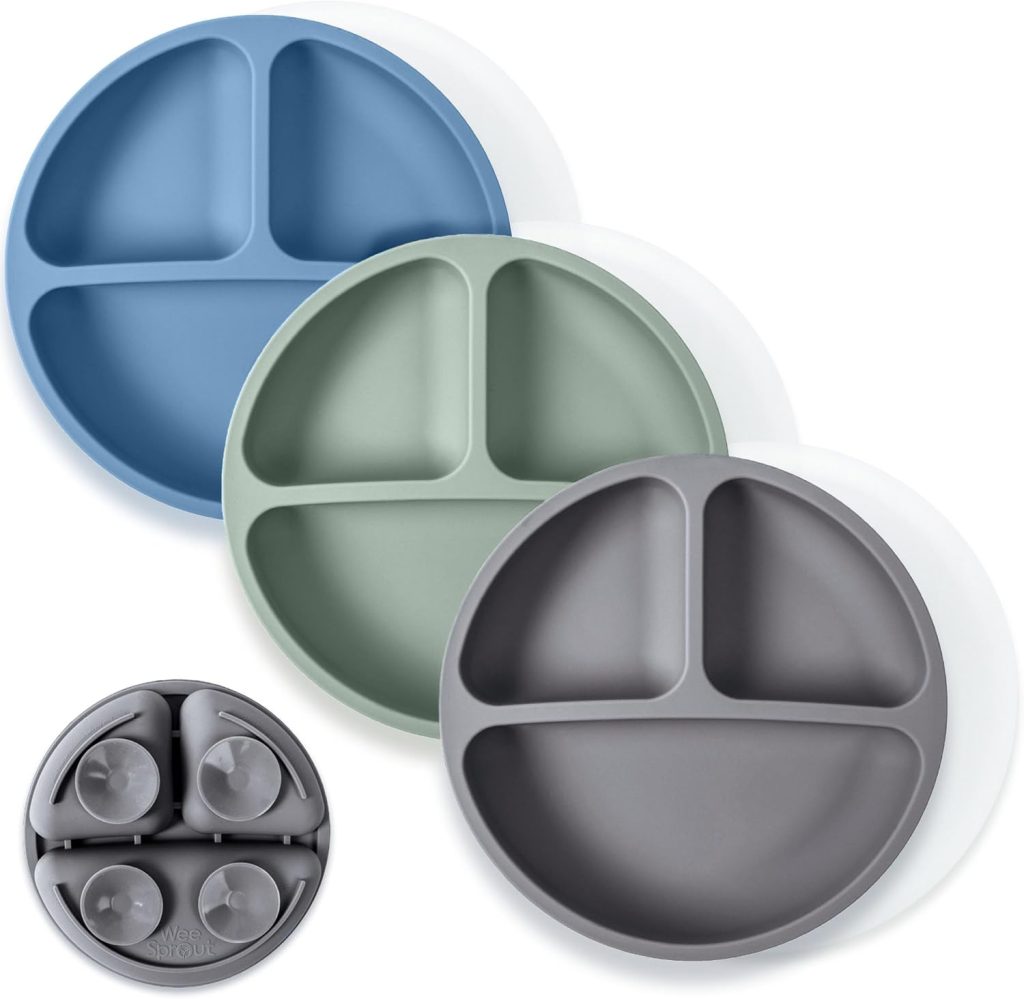
Brightly colored silicone should come from a brand that discloses its colorant sourcing, because color additives are where contamination risk concentrates in an otherwise safe material.
Plain or lightly colored silicone from an established brand is a reasonable default for babies starting solids.
Tempered glass (e.g., Vitrelle-style)
Multi-layer tempered glass, the kind used in laminated glass dinnerware, is essentially inert and non-porous when undecorated, which is why plain white pieces in this category consistently rank among the safest options available.
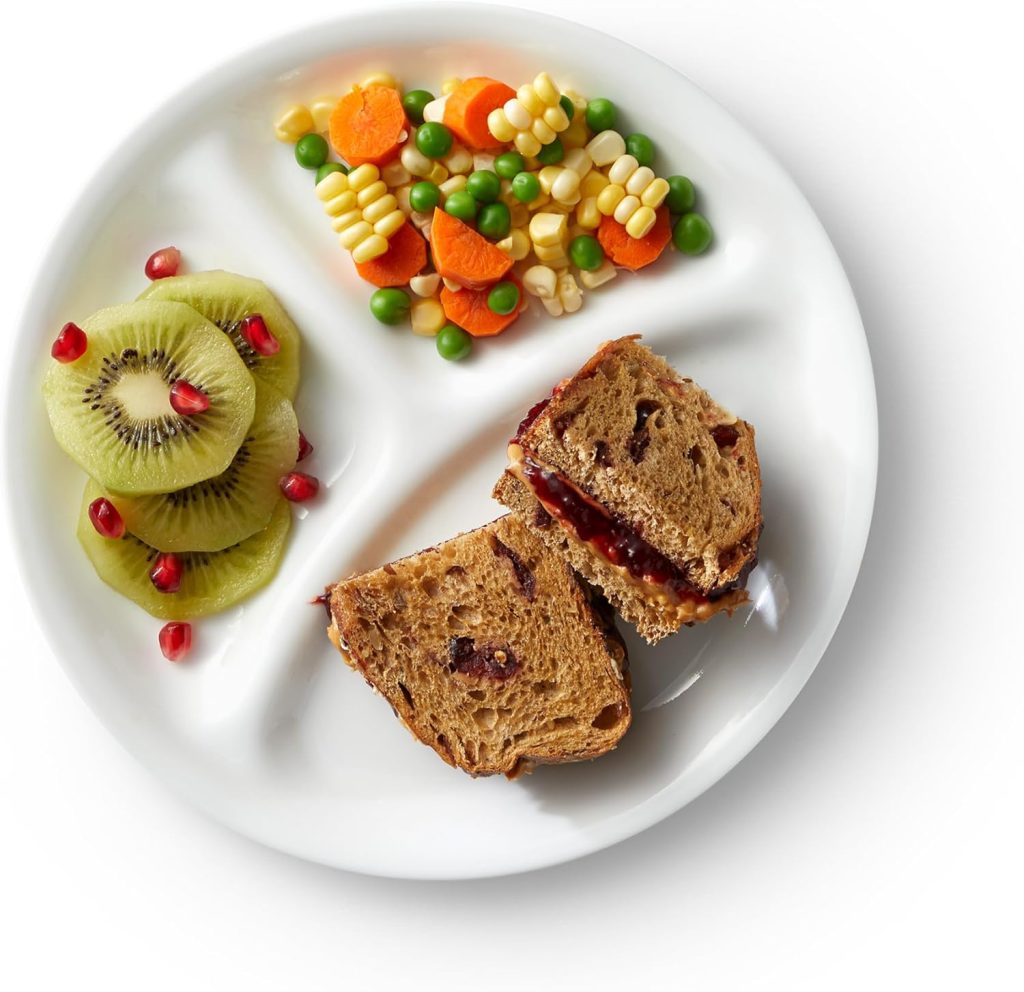
Risk comes back the moment a pattern, decal, or painted rim gets added, since it’s the decoration, not the glass, that can introduce lead.
For families choosing dinnerware to last well beyond the toddler years, plain tempered glass is one of the few materials that works for both the 2-year-old and the rest of the household.
Bamboo: what to check before you buy
- Confirm the listing explicitly states “no melamine binder” or “100% bamboo fiber,” since many bamboo-labeled plates are actually a bamboo-fiber-and-melamine composite.
- Avoid microwaving any bamboo composite dish, even if it’s labeled microwave-safe, because heat is what triggers resin breakdown in blended products.
- Favor solid, single-piece bamboo construction over molded composite pieces, which are more likely to contain synthetic binders.
- Hand wash rather than dishwasher, since repeated heat cycles degrade bamboo composites faster than other materials.
- If you’d rather have a ceramic alternative with more consistent, testable safety data than bamboo composites typically offer, our lead-free ceramic dinnerware guide breaks down which glazes and firing methods to look for.
Why melamine is the one material to avoid
- Melamine dinnerware is popular for kids specifically because it’s lightweight and shatter-resistant, which makes it feel like the obvious toddler choice.
- Despite frequently being labeled “top rack dishwasher safe,” melamine should never be used for hot food or drinks, because heat, especially in a microwave, causes it to leach melamine and formaldehyde compounds into food.
- Scratches from utensils create grooves in the surface over time, which can harbor bacteria on top of compromising the material’s chemical stability.
- Melamine dinnerware gets used daily and repeatedly for a toddler’s meals, so the cumulative exposure from routine use is the real concern here, not any single meal.
Matching dinnerware to your child’s age and stage
| Age stage | What matters most | Recommended materials |
|---|---|---|
| 6 to 12 months (starting solids) | Suction stability, soft edges for gums, no small detachable parts | Food-grade silicone, stainless steel with silicone trim |
| 1 to 3 years (toddlers) | Break resistance, weight for throwing, no microwave dependency | Stainless steel, tempered glass, solid bamboo |
| 4+ years (independent eaters) | Transitioning toward regular household dinnerware | Tempered glass, ceramic, standard stainless steel |
6 to 12 months (starting solids)
At this stage, a baby’s dishes get handled as much with the mouth as with the hands, which makes total lead content (the CPSC standard) the more relevant concern over food-contact leaching.
Silicone suction plates and stainless steel utensils with silicone grips are the most common choices in this window, since both materials are inert and don’t rely on a glaze that could introduce lead.
1 to 3 years (toddlers)
Toddlers drop, throw, and reheat food constantly, so durability and microwave independence matter more here than at any other stage.
Stainless steel and tempered glass both hold up to daily use without melamine’s unsafe-reheating trade-off, which is why they dominate recommendations for this age group specifically.
4+ years (independent eaters)
By preschool age, most children can move toward the same dinnerware the rest of the household uses, provided it’s plain, undecorated tempered glass or ceramic rather than heavily patterned pieces.
This is also the point where families often fold “kids'” dishes into general kitchen rotation instead of keeping a separate set.
What about dishes you already own: hand-me-downs and vintage pieces
Not every risky dish in a home was bought recently.
A lot of lead exposure risk comes from dishes that were already in the cabinet: inherited sets, thrift store finds, or pieces bought before modern lead restrictions existed.
The good news is that this risk is identifiable, not random.
Signs a dish may be high-risk
- The piece predates the mid-2000s, before many manufacturers updated lead-glaze formulations industry-wide.
- The decoration is painted, hand-applied, or a raised decal rather than printed under a clear protective glaze.
- The pattern uses bright reds, oranges, or yellows, colors more commonly associated with lead- or cadmium-based pigments.
- The piece is unbranded, imported, or purchased secondhand with no manufacturer information available.
- The glaze feels rough, pitted, or worn in a way that suggests the protective coating has broken down over time.
How to actually test a dish for lead
- Check the underside of the piece for a manufacturer mark and approximate production date, since era alone narrows risk significantly.
- Search the manufacturer’s name alongside “lead safety” or “Prop 65” to find any published testing statements for that product line.
- If the piece is undecorated and plain, treat it as lower risk by default. If it’s patterned, treat the pattern itself as the thing to investigate.
- For any piece you’re still unsure about, use an at-home lead test swab as a first screen; these detect lead at the surface but aren’t a substitute for lab testing.
- For a dish your child uses daily, or one you can’t confidently date, send it to a certified third-party lab for leachable and total lead testing rather than relying on a home kit result alone.
- Retire any piece that tests positive or ambiguous from food use, especially for children, even if you keep it around as a display item.
Is Corelle safe for toddlers?
Modern Corelle is safe for toddlers. The more useful question is which Corelle, since risk in this specific brand comes down almost entirely to production era and decoration rather than the base material.
Why the answer depends on the decade
Corelle’s base material, Vitrelle, is a laminated tempered glass that’s essentially inert on its own.
The lead risk associated with the brand comes from decoration: painted, decaled, or patterned pieces made before roughly 2005 have tested at lead levels considered unsafe for children’s use, in some cases dramatically so, while plain or lightly decorated pieces from the same era have tested well within safe limits.
Post-2005 Corelle dinnerware generally meets current FDA leachable-lead standards, and the company has stated its products have been lead- and cadmium-free since 2005. The takeaway isn’t “avoid Corelle” or “trust Corelle.”
It’s that two Corelle plates can carry meaningfully different risk profiles depending on age and decoration, which makes the brand name alone an unreliable safety signal.
For a full breakdown of which specific Corelle patterns and eras have tested positive for lead, see our full Corelle lead safety breakdown.
What to check on the bottom of the plate
- Look for a backstamp indicating the collection name and approximate production year.
- Note whether the visible pattern is painted or decaled versus a plain, undecorated white or clear surface.
- Cross-reference the collection name against Corelle’s published lead-safety statements for that product line.
- If the piece is unmarked, visibly worn, or predates the 2000s with no clear documentation, treat it with the same caution as any other unverified vintage ceramic or glass piece.
Choosing the right material and age-appropriate dish covers most of the lead-exposure question for daily use, but material is only one variable.
The same lead-safety principles apply across cookware and bakeware too, not just plates and bowls. If you’re setting up a full kitchen with young kids in mind, our full non-toxic dinnerware roundup extends this same framework to full sets, brand by brand, so you’re not piecing recommendations together dish by dish.
And if your household already leans toward ceramic dinnerware for the rest of the family, it’s worth checking your current or planned brand: our guide to check your specific dinnerware brand covers dozens of common manufacturers against both the FDA and CPSC standards discussed above.
Frequently asked questions
Is stainless steel or silicone better for toddlers?
Stainless steel is the more durable choice for toddlers who throw or drop dishes, while silicone is gentler for babies still teething and benefits from suction-base stability during early solids.
Both are inert base materials with very low lead risk, so the choice comes down to the child’s stage and behavior rather than any safety difference between the two.
For a 9-month-old just starting solids, silicone’s flexibility and suction usually win out. For a 2-year-old actively throwing plates, stainless steel’s durability matters more.
Can a dish be “lead-free” and still not be safe for kids?
Yes. A dish can pass the FDA’s food-contact leaching test while its painted or decorated surface still exceeds the CPSC’s 90 ppm surface-coating limit for children’s products.
That’s because “lead-free” as printed on packaging usually refers to one test, not both, and the two tests measure different exposure pathways: leaching into food versus total content accessible through mouthing or chewing.
A dish that’s genuinely safe for a child needs to clear both standards, not just the one referenced on its label.
Is painted or patterned kids’ dinnerware more dangerous than plain?
Yes, decoration is the single biggest lead-risk factor in dinnerware, more so than the base material itself.
Bright colors, hand-painted details, and raised decals are all more likely to use lead- or cadmium-based pigments than a plain, undecorated surface, which is why plain white or clear dishes consistently test safer across ceramic, glass, and stainless steel alike.
If you’re choosing between two otherwise identical dishes, the undecorated one is the lower-risk pick by default.
At what age can my child stop using specialty toddler dishes?
Most children can move to standard household dinnerware around age 4, once they’re eating independently and the practical need for unbreakable, suction-based, or oversized dishes has passed.
The safety criteria don’t change at that point; plain, undecorated tempered glass or ceramic is still the safest choice.
What eases up is the durability requirement, since older kids handle dishes more like adults do. There’s no regulatory cutoff here.
It’s a practical transition based on how your child actually eats and handles dishes day to day.