Some Viking cookware is non-toxic, and some isn’t, and the difference comes down to which product line you actually own.
Viking sells plain stainless steel, older PTFE-based nonstick, newer PFAS-free nonstick, and enameled cast iron under one brand name, and those materials don’t carry the same risk profile.
Below is a breakdown by line, plus where each one is made and how it compares to other non-toxic cookware brands.
Is Viking Cookware Non-Toxic?
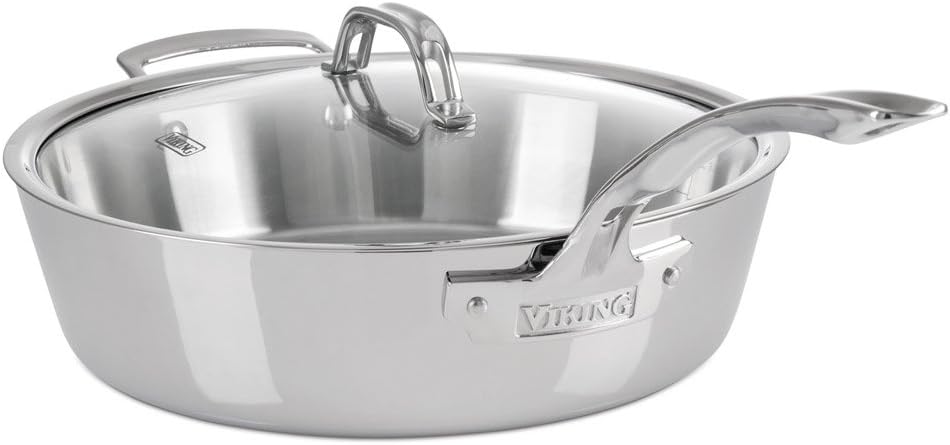
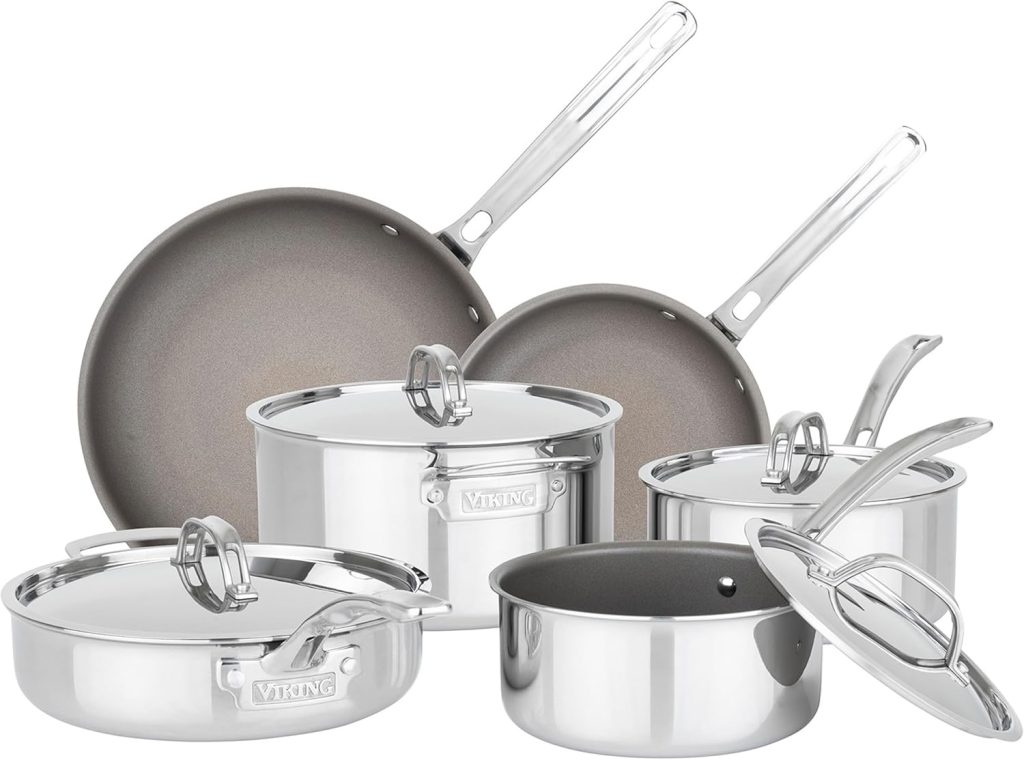
Viking’s plain stainless steel cookware (the 5-Ply Professional and 3-Ply lines) is non-toxic under normal cooking conditions.
Its newer nonstick lines, PureGlide Pro and Hybrid Plus, are also made without PFAS, PTFE, or PFOA, according to Viking’s own product pages. Its older nonstick lines, Hard Anodized and Contemporary Eterna, are only marketed as PFOA-free, which is a narrower and weaker claim than PFAS-free.
Enameled cast iron falls in the same low-risk category as stainless steel, as long as the enamel surface isn’t chipped.
What “non-toxic” actually means for cookware
“Non-toxic cookware” refers to cooking surfaces that don’t release meaningful amounts of harmful chemicals or metals into food under normal use.
For metal cookware, that mostly means checking whether the alloy is stable and inert, so it doesn’t leach lead, cadmium, or excess nickel.
For coated cookware, it means checking what the coating is made of and whether it breaks down under heat, since older nonstick chemistry (PTFE made with PFOA) and its replacements behave very differently at the stove.
Why the answer depends on which Viking line you own
Viking’s catalog spans at least six distinct cooking surfaces: plain 18/10 stainless steel, PTFE-based traditional nonstick, titanium-based PFAS-free nonstick, ceramic-based PFAS-free nonstick, enameled cast iron, and ceramic-coated bakeware.
Each has a different safety profile, so a single yes-or-no answer for “Viking cookware” glosses over real differences.
A reader with the 5-Ply stainless set and a reader with a decade-old Hard Anodized nonstick pan are, chemically speaking, cooking on two different products that happen to share a logo.
Viking Stainless Steel (5-Ply & 3-Ply): Composition and Safety
Viking’s stainless steel cookware uses 18/10 stainless steel for the cooking surface, an alloy that is chemically stable and does not react with most foods.
This is the same grade used across most premium stainless cookware brands, and it’s the material most food-safety guidance points to as a safe default for people avoiding coated nonstick entirely.
What 18/10 stainless steel is made of
18/10 stainless steel contains 18% chromium and 10% nickel by weight. Chromium gives the alloy its corrosion resistance and forms a thin, stable oxide layer on the surface.
Nickel adds shine and helps the metal resist pitting. The two elements together make the surface non-reactive, meaning it doesn’t readily exchange ions with acidic or alkaline foods the way some reactive metals (like plain aluminum or copper) can.
Viking’s stainless lines, including the 5-Ply Professional and 3-Ply, use this same 18/10 surface, typically bonded over an aluminum or copper core for heat conduction.
Nickel and chromium leaching: what the evidence shows
Stainless steel does release trace amounts of nickel and chromium into food, but the amounts are small under normal cooking conditions.
Leaching increases with prolonged contact with highly acidic foods (tomato sauce simmered for hours, for example) and with new pans that haven’t developed a stable surface layer yet.
For most people, the trace amounts involved are well within the range considered safe by food-safety agencies.
The exception is people with diagnosed nickel allergies or sensitivities, who may want to avoid extended acidic cooking in any stainless pan, Viking included, and consider a nickel-free alternative for those specific dishes.
Prop 65 warnings on stainless steel, explained
California’s Prop 65 requires a warning label on products that expose consumers to any of roughly 900 listed chemicals above a set threshold, and stainless steel cookware sometimes carries one because of trace metal content, not because of a coating or chemical additive.
A Prop 65 warning on a stainless pan is not the same signal as a warning on nonstick coating; it typically reflects the same nickel and chromium content discussed above, tested against a stricter California-specific threshold than federal food-safety limits use.
We found one historical Prop 65 enforcement notice tied to the Viking name (a 2007 notice over lead in brass pepper mills sold under Viking Culinary Arts Centers and Viking Range Corporation), but that involved a decorative kitchen accessory, not cookware, and predates the current Clipper Corporation-manufactured cookware line by seven years.
We found no Prop 65 notice specific to Viking pots or pans in our research.
Viking Nonstick Cookware: Does It Contain PFAS?
Whether Viking’s nonstick cookware contains PFAS depends entirely on which collection you’re looking at, since Viking currently sells both older PTFE-style nonstick and newer PFAS-free nonstick side by side.
Before buying any nonstick pan by brand name alone, it’s worth learning how to check any pan for PFAS using the label language manufacturers actually use.
PureGlide Pro and Hybrid Plus (made without PFAS, PTFE, or PFOA)
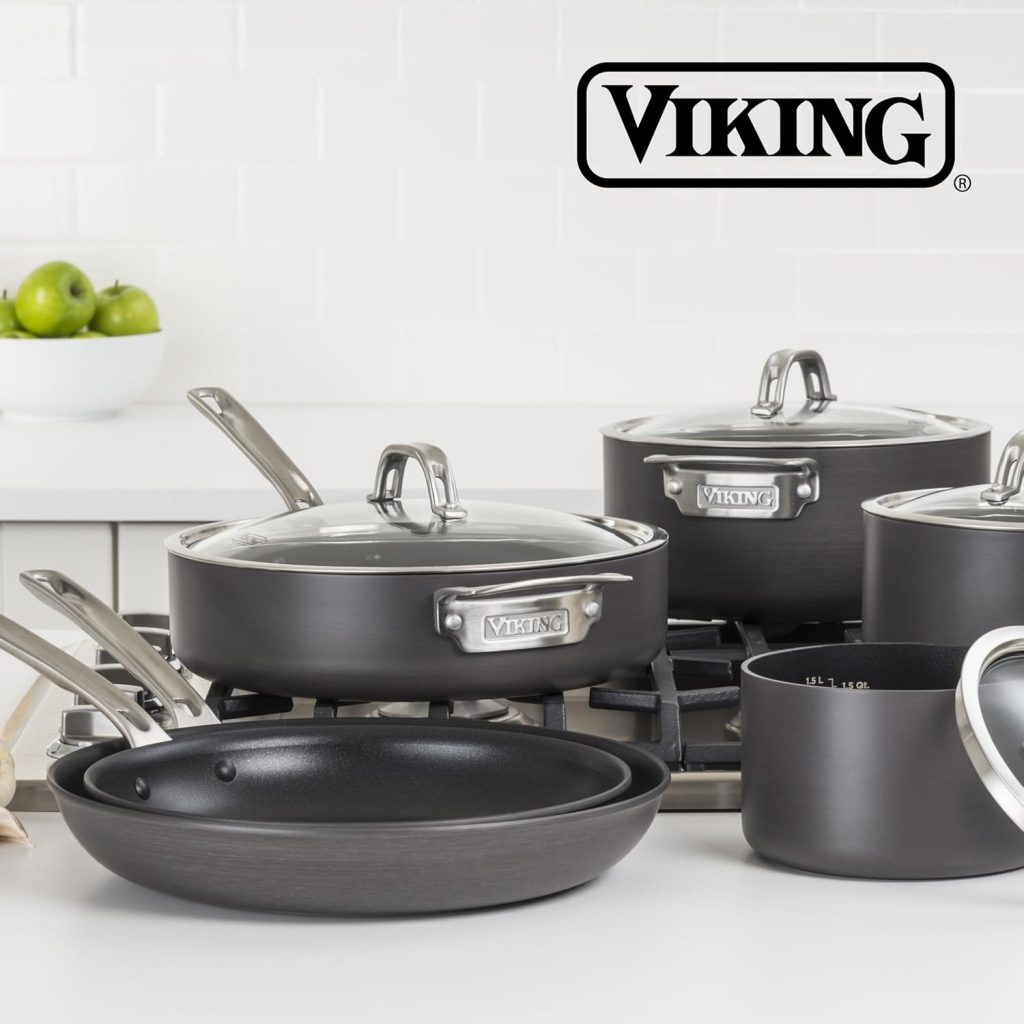
Viking’s PureGlide Pro line uses a laser-clad titanium surface, and its Hybrid Plus line uses a ceramic nonstick coating.
Viking markets both with the specific claim “made without PFAS, PTFE, or PFOA,” language that appears directly on the brand’s own product pages and retail listings.
PureGlide Pro is rated oven-safe to 600°F and is designed to withstand metal utensils, as its titanium surface is harder than stainless steel.
This is a meaningfully different chemistry from traditional nonstick coatings, and it’s the category worth choosing if avoiding PFAS entirely is the priority.
For more on how this compares to other PFAS-free coatings, see our guide to whether ceramic cookware is actually safe.
Hard Anodized and Contemporary Eterna nonstick (PFOA-free, but still PTFE-based)
Viking’s older Hard Anodized line and its Contemporary line’s Eterna coating are both marketed only as “PFOA-free,” language that appears on Viking’s own listings for those collections.
That claim is narrower than “PFAS-free.” PFOA was a specific processing chemical once used to manufacture PTFE coatings, and manufacturers phased it out of production years ago, but the resulting coating is typically still PTFE, a member of the broader PFAS chemical family.
Viking doesn’t use “made without PFAS” or “made without PTFE” language for these two lines the way it does for PureGlide Pro and Hybrid Plus, and that absence is itself informative.
Readers who want a coating with no PFAS compounds at all should look at PureGlide Pro or Hybrid Plus specifically rather than assume “Viking nonstick” is one uniform product.
What happens if nonstick coating overheats or is scratched
- Traditional PTFE coatings can begin releasing fumes when a pan is left empty on high heat above roughly 500°F, a temperature that’s easy to hit accidentally by preheating an empty nonstick pan on a high burner.
- Scratched or flaking nonstick surfaces can shed small coating particles into food, which is a durability and ingestion concern separate from the chemical-safety question.
- Titanium and ceramic PFAS-free coatings, including PureGlide Pro and Hybrid Plus, don’t carry the same fume risk at high heat because they aren’t fluoropolymer-based, though any coated pan should still be replaced once the surface is visibly damaged.
- Metal utensils are more likely to damage traditional PTFE coatings over time than titanium-reinforced surfaces, which is part of why Viking markets PureGlide Pro specifically as metal-utensil-safe.
Where Is Viking Cookware Made, and Does It Matter for Safety?
Manufacturing origin doesn’t determine toxicity on its own, since the coating and alloy matter more than the country stamped on the box, but it’s a common source of confusion for this brand specifically because Viking’s answer isn’t the same across product lines.
Where is Viking cookware made?
Viking’s Professional 5-Ply stainless steel collection is the line the brand and its manufacturing licensee, Clipper Corporation, market as made in the USA using globally sourced materials.
Sourcing investigations differ on the exact facility location tied to that claim; some connect it to Clipper’s operations in Los Angeles, and Viking’s own site references domestic manufacturing without naming a specific city.
The rest of Viking’s catalog, including 3-Ply, 5-Ply Hard Stainless, 7-Ply Titanium, Copper Clad, Hard Anodized Nonstick, Contemporary, cast iron, carbon steel, cutlery, bakeware, and accessories, is manufactured in China.
Viking doesn’t prominently disclose this on most of those product pages, and the country of origin usually only becomes clear through retailer listings, a stamp on the product itself, or a direct question to customer service.
Who actually owns and manufactures Viking cookware (Clipper Corp vs. Viking Range/Middleby)
The confusion around where Viking cookware is made traces back to a licensing structure most shoppers never see.
Viking Range, LLC, the company that makes Viking’s well-known ranges and ovens in Greenwood, Mississippi, is a subsidiary of The Middleby Corporation, which acquired it in 2013.
That company does not make the cookware. In 2014, Viking entered an exclusive licensing agreement with Clipper Corporation, and Clipper became the sole manufacturer and distributor of every pot, pan, knife, and cutting board sold under the Viking Culinary name.
So when a shopper sees “Made in Mississippi” associated with the Viking brand, that’s almost always describing the appliance factories, not the cookware, and the two products come from entirely separate supply chains despite sharing a logo.
Viking Cast Iron and Bakeware: Coating Safety
Cast iron and bakeware use different coatings than Viking’s pots and pans, so it’s worth breaking their safety out separately, especially since ceramic vs. cast iron cookware comparisons often lump every “non-reactive” material together without distinguishing the coatings involved.
Enameled cast iron composition and safety
Viking’s cast iron pieces use a glossy enamel coating over the cast iron base rather than a bare seasoned surface.
The enamel is a glass-like coating fused to the metal at high heat, and it’s non-reactive with food in the same way stainless steel is, which is why enameled cast iron doesn’t need the seasoning that bare cast iron does.
The main safety consideration with any enameled cookware, Viking included, is chip damage: a cracked or chipped enamel surface can expose the cast iron underneath and, depending on age and formulation, older or lower-quality enamels have occasionally been found to contain trace lead in pigments.
We found no reporting or testing data specific to lead content in Viking’s current enamel line, so this should be treated as a general enamelware consideration rather than a documented issue with this brand.
Ceramic-coated bakeware vs. traditional PTFE bakeware
Viking’s ceramic-coated bakeware line is marketed as PFOA- and PTFE-free, using a sol-gel ceramic coating rather than a fluoropolymer one.
That puts it in a similar category to PureGlide Pro and Hybrid Plus rather than the older Hard Anodized cookware line.
Traditional PTFE-coated bakeware carries the same high-heat fume risk described earlier, though baking temperatures for most recipes stay below the point where that becomes a practical concern for well-maintained pans.
Ceramic coatings tend to lose their nonstick performance faster with repeated use than PTFE does, which is a durability tradeoff rather than a safety one.
How Viking Compares to Other Non-Toxic Cookware Brands
Viking isn’t positioned as a dedicated non-toxic brand the way Caraway and GreenPan are; it’s a broad cookware line where some collections happen to meet non-toxic criteria, and others don’t.
Viking vs. All-Clad, construction and origin compared
Both brands sell 18/10 stainless steel cookware built around a similar multi-ply, bonded-metal construction, and both are non-reactive in the same way for plain stainless lines.
The clearer difference is manufacturing transparency: All-Clad manufactures its core stainless lines in Canonsburg, Pennsylvania, and states this consistently across its product listings, while Viking’s origin varies by collection and isn’t always disclosed on the page.
For buyers who want origin to be verifiable at a glance rather than something they have to research separately, that’s a meaningful practical difference even though the base alloy safety is comparable.
Viking vs. Carote: Is the budget nonstick alternative actually safer?
Not necessarily, and the comparison depends on which specific pans are being compared rather than the brand name alone.
Carote markets several of its nonstick lines as PFOA-free using granite or ceramic-style coatings at a lower price point than Viking’s PureGlide Pro or Hybrid Plus.
Whether that makes Carote “safer” depends on whether its specific coating is genuinely PFAS-free (not just PFOA-free) and how it holds up to scratching over time, the same two questions worth asking about any nonstick pan.
See our full breakdown of whether Carote cookware is non-toxic for coating-by-coating detail before assuming a lower price means a lower safety standard, or the reverse.
If price and coating chemistry both matter to your decision, our best non-toxic cookware guide compares current picks across budgets, including several brands that publish full third-party lab testing for every collection they sell, not just their newest one.
FAQ
Is Viking cookware safe for everyday cooking?
Yes, for the stainless steel and PFAS-free nonstick lines specifically.
Viking’s 5-Ply and 3-Ply stainless steel cookware uses a stable, non-reactive 18/10 alloy that’s suitable for daily use, and its PureGlide Pro and Hybrid Plus nonstick lines are made without PFAS, PTFE, or PFOA according to Viking’s own product listings.
The older Hard Anodized and Contemporary nonstick lines are only marketed as PFOA-free, a narrower claim, so if avoiding PFAS entirely matters to you, check which specific line you own before assuming the whole brand qualifies.
Does any Viking cookware still contain PFOA?
No current Viking cookware is marketed as containing PFOA; manufacturers phased that specific chemical out of nonstick production years ago industry-wide.
The more useful question for Viking specifically is whether a given line is PFAS-free, not just PFOA-free.
PureGlide Pro and Hybrid Plus carry the broader “made without PFAS, PTFE, or PFOA” claim, while Hard Anodized and Contemporary Eterna only carry the PFOA-free claim, which typically still indicates a PTFE-based coating even without PFOA in the manufacturing process.
Is Viking cookware made in the USA or China?
Both, depending on the line. Viking’s Professional 5-Ply stainless steel collection is marketed as made in the USA using globally sourced materials, produced under license by Clipper Corporation.
Every other current Viking cookware collection, including 3-Ply, 7-Ply, Hard Anodized Nonstick, Contemporary, cast iron, and bakeware, is manufactured in China.
Viking’s own famous factories in Greenwood, Mississippi make the brand’s kitchen appliances, not its cookware, which is a separate supply chain entirely.
Is Viking cookware safe for babies and toddlers?
Viking’s plain stainless steel and PFAS-free nonstick lines are reasonable choices for preparing baby food, since neither involves coatings linked to PFAS exposure concerns.
Avoid using the older Hard Anodized or Contemporary nonstick pans at high heat for this purpose, since any PTFE-based coating carries more risk if overheated or scratched, which matters more when cookware is used daily for pureeing and reheating.
For a dedicated comparison across brands built specifically around this use case, see our guide to non-toxic cookware for baby food.