Lead free dinnerware means the dishes contain no detectable lead at all, while “lead-safe,” a label you’ll see almost as often, means the dishes still contain lead, just below a regulatory threshold.
That one-word difference changes what you’re actually bringing into your kitchen, and most buying guides never explain it clearly enough to act on.
If you’re shopping for non-toxic dinnerware right now, the fastest way to protect your household is to know exactly which label you’re looking at, which materials make lead contamination unlikely in the first place, and how to verify a safety claim instead of taking it on faith.
Lead-Free vs. Lead-Safe: The Label Difference Almost No One Explains
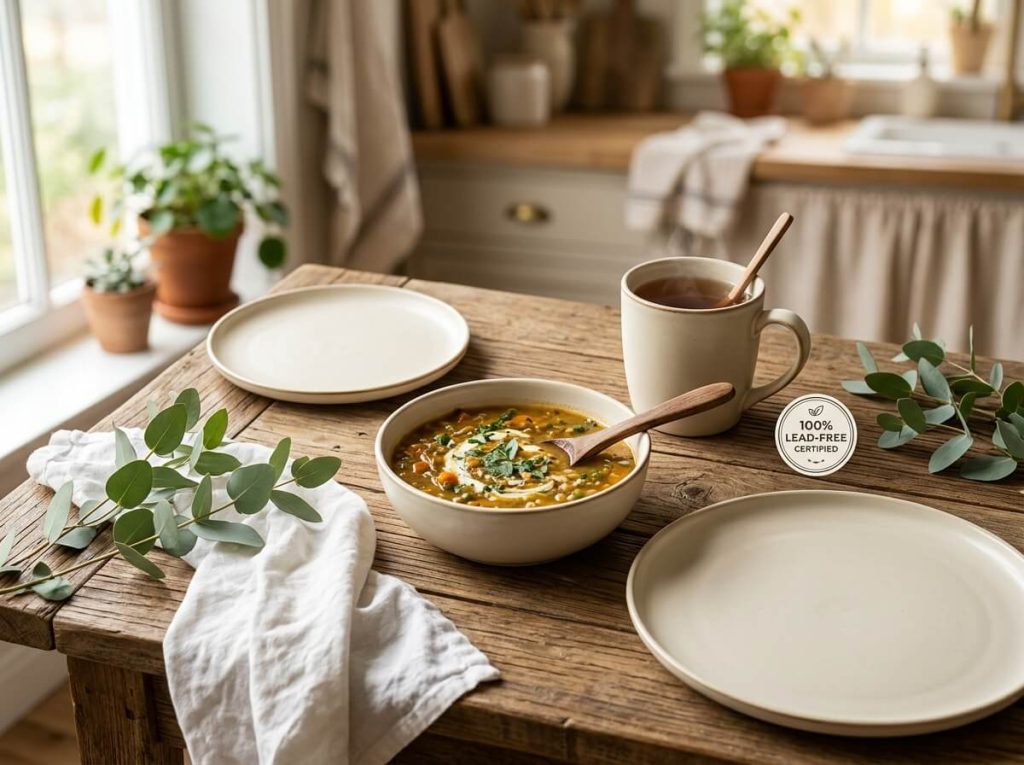
“Lead-free” and “lead-safe” sound like marketing synonyms, but they describe two different things, and only one of them means what most shoppers assume it means.
Understanding this distinction before you look at a single product listing will save you from buying something that technically passes inspection but still contains lead.
What “Lead-Free” Actually Means
Lead-free dinnerware contains no lead at all, not in the clay body, the glaze, or any decorative decal or trim.
Nothing to leach, nothing to accumulate, nothing to worry about regardless of how the dish is used or how many times it goes through the dishwasher.
This is the standard worth holding out for, particularly for anything used daily by children or during pregnancy, since there’s no established safe level of lead exposure at any age.
What “Lead-Safe” Actually Means (And Why It’s a Lower Bar)
Lead-safe dinnerware does contain lead, but the amount that can leach into food stays under the limit set by California’s Proposition 65, a limit that’s stricter than most international standards but is not zero.
The California Department of Public Health draws this distinction explicitly in its own consumer guidance: lead-free means no lead is present, while lead-safe means lead is present but controlled.
In practice, a product page or listing that only says “compliant,” “meets safety standards,” or “Prop 65 passed” is very likely describing a lead-safe product, not a lead-free one.
If a brand doesn’t specifically use the word “lead-free,” it’s worth assuming lead-safe until they confirm otherwise directly.
The Safest Dinnerware Materials
Material matters more than brand name when you’re trying to avoid lead, because some materials make contamination structurally unlikely while others depend entirely on how carefully a specific manufacturer controls their glaze and firing process.
To learn more about these dinnerware materials, read our guide on the various non-toxic dinnerware materials.
| Material | Lead risk | Why |
|---|---|---|
| Tempered glass | Very low | Inert material with no glaze layer to carry lead |
| High-fired porcelain | Low | Dense, vitrified surface from high kiln temperatures (2,200°F+) |
| Certified lead-free stoneware | Low, if verified | Safe when the glaze is confirmed lead-free; risk depends entirely on the specific brand |
| Untreated bamboo | Moderate | Not a lead risk itself, but often bound with formaldehyde-based resins |
| Melamine | Avoid for hot food | Can release formaldehyde-related compounds when heated |
Tempered Glass (Corelle-Style Vitrelle, Borosilicate)
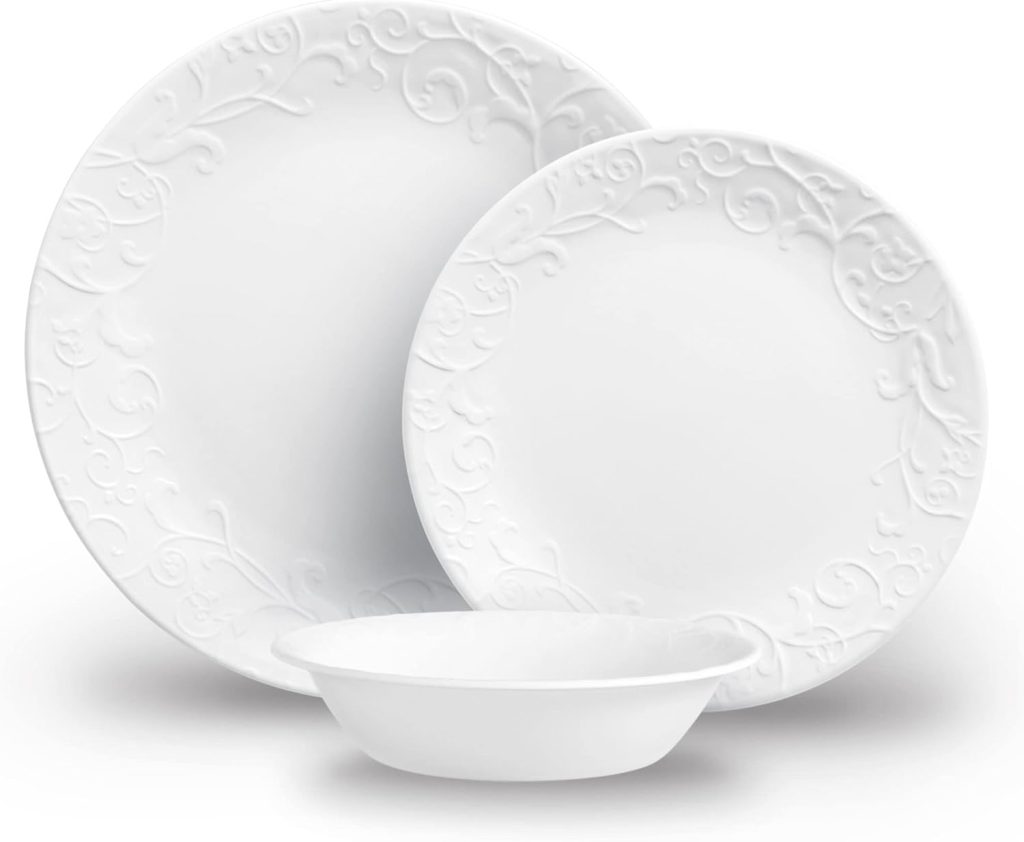
Tempered glass dinnerware, including three-layer glass products like Corelle’s Vitrelle line, carries the lowest structural risk of any common dinnerware material because there’s no glaze layer where lead compounds would typically be introduced.
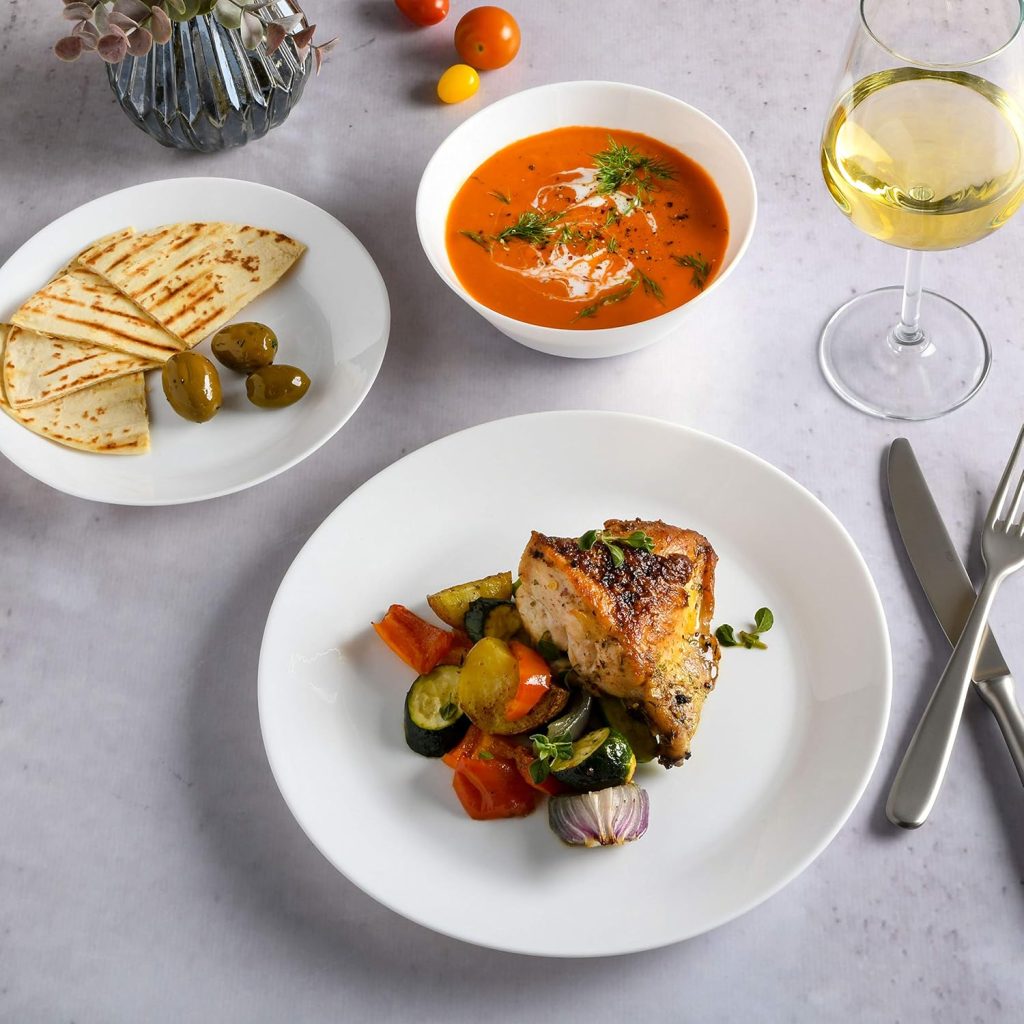
Borosilicate glass in particular is chemically inert and doesn’t react with acidic foods the way some ceramic glazes can.
The one caveat: colored or decorated glass, especially anything resembling leaded crystal, should be checked separately, since decorative glass is manufactured differently than plain tempered glass.
High-Fired Porcelain
Porcelain made by a reputable manufacturer and fired at high kiln temperatures is generally safe, because the extreme heat vitrifies the surface into a dense, non-porous layer that seals in whatever pigments or minerals were used in the glaze.
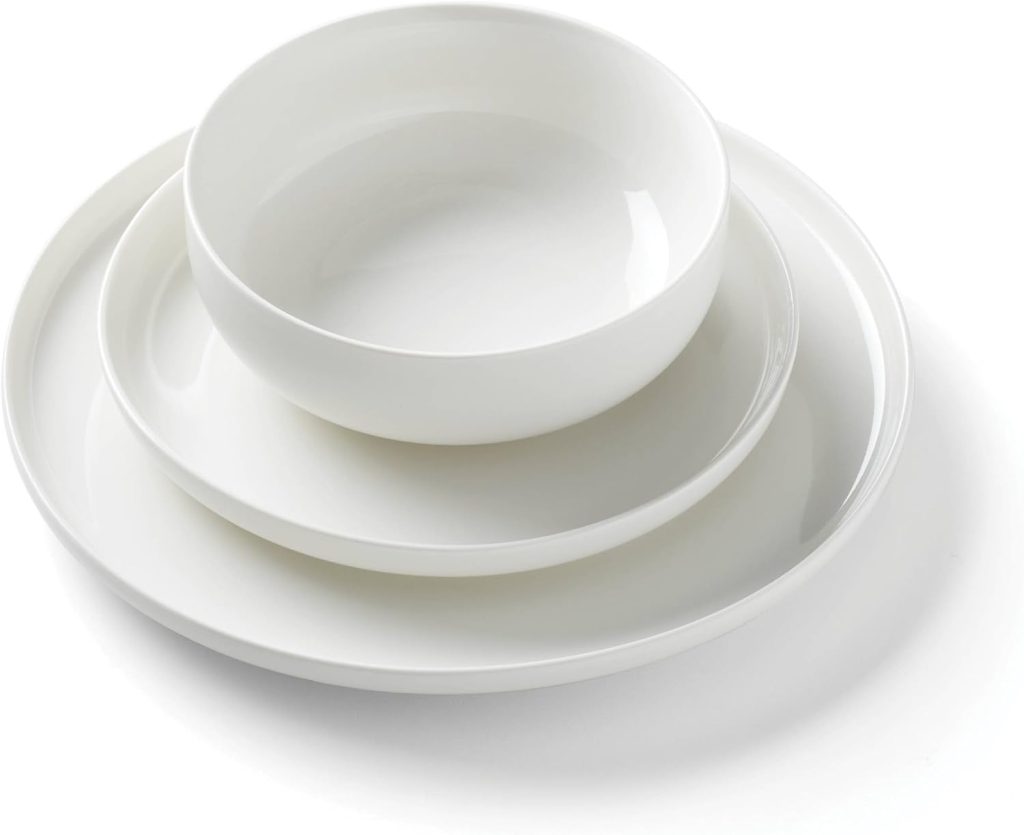
The risk with porcelain isn’t the material itself; it’s inconsistent firing or lower-quality production, which is why brand transparency about firing temperature and glaze testing matters more here than with plain glass.
Certified Lead-Free Stoneware
Stoneware sits in a middle tier: it can be completely safe, but unlike glass, its safety depends entirely on the glaze recipe and firing process a specific manufacturer uses.
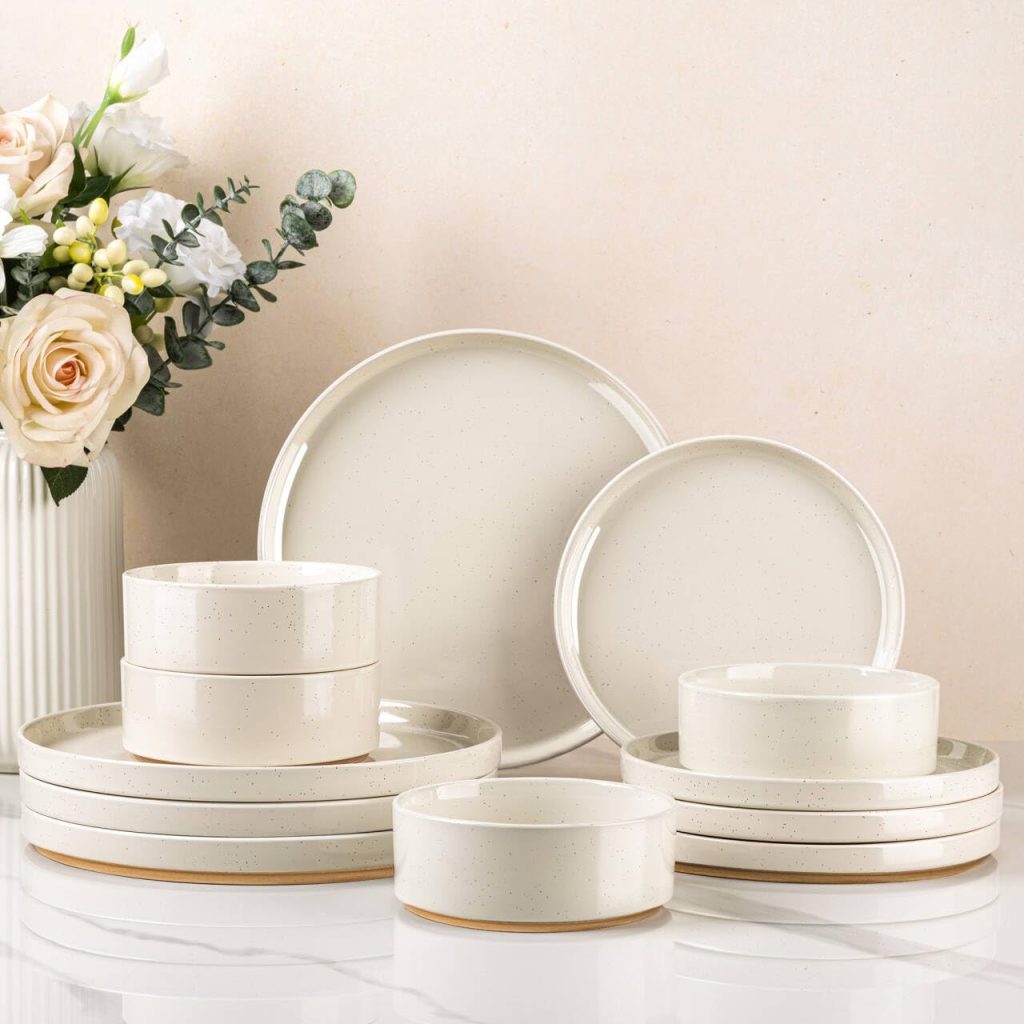
Look specifically for stoneware that carries third-party lead-free verification rather than a general “food safe” claim, since stoneware has historically been one of the more common categories where lead glazes showed up, particularly in imported or handcrafted pieces.
For a more detailed guide on the best non-toxic ceramic brands, see our dedicated guide to lead-free ceramic dinnerware.
Materials to Avoid or Use With Caution
- Melamine dinnerware doesn’t typically contain lead, but it’s heat-sensitive and can release formaldehyde-related compounds when exposed to hot food or a microwave, making it a poor choice for daily hot-food use despite being marketed heavily toward families with young children.
- Vintage or handmade terra cotta, particularly Latin American-style glazed pottery, has a well-documented history of lead glazes used to achieve bright colors and a glossy finish.
- Any dinnerware labeled “decorative use only” or without documented food-contact testing should stay off the table entirely, regardless of how attractive the price or design.
- Recycled or unspecified colored glass, common in low-cost imported glassware, can occasionally carry trace contamination if the source material wasn’t carefully sorted.
How to Spot Risk on the Dish in Front of You
You can’t determine whether a dish contains lead just by looking at it, but certain visual and physical characteristics reliably correlate with higher risk, and knowing them lets you flag questionable pieces before you ever need a test kit.
- Check whether decoration sits on top of the glaze rather than sealed beneath it — if you can feel raised brushstrokes or rough texture when you run a finger over the design, the decoration likely wasn’t fired under a protective glaze layer.
- Look closely at bright red, orange, and yellow glazes and decals, since these colors have historically required lead or cadmium compounds to achieve their vibrancy.
- Pay extra attention to decoration on the interior rim or inside surface of cups and bowls, since that’s the area with the most direct, repeated contact with food and drink.
- Treat any wear or fading on painted decoration as a higher-risk signal, since a worn glaze surface is more likely to release whatever it was sealing in.
- Favor plain, undecorated pieces when you’re uncertain about a specific set’s history, since minimal decoration inherently limits where lead could be hiding.
Warning Signs in Color and Decoration
Beyond the general checklist above, decorative gold, silver, and metallic trims deserve specific caution, since these accents have historically used lead or cadmium-based compounds to achieve their metallic sheen.
This applies even on dinnerware that’s otherwise made from a genuinely safe base material like porcelain or glass; the trim itself can be the contamination source, independent of what the plate underneath it is made from.
Why Vintage and Thrifted Dishware Is Higher Risk
Dinnerware manufactured before roughly 1970, when the FDA began meaningfully regulating lead in tableware, carries substantially higher risk than anything produced today, and this applies even to plain white pieces that show no obvious decoration.
Popular vintage lines like pre-1986 Fiestaware are well documented as containing lead in their glazes, while post-1986 production from the same brand is not, which means the manufacturing date matters as much as the brand name itself.
Thrift store and estate sale dinnerware carries an added layer of uncertainty because there’s typically no way to confirm manufacturing date or country of origin, so the safest approach is to treat any unverified secondhand piece as a display item rather than daily tableware unless you’re willing to test it first.
Regulatory Standards to Check Against — FDA and Prop 65
Two U.S. regulatory frameworks govern lead in dinnerware, and understanding the actual numbers behind them, not just the fact that a product “passed” — tells you how meaningful a given safety claim really is.
| Standard | Threshold | Scope |
|---|---|---|
| California Prop 65 safe harbor (lead) | 0.5 micrograms per day | Applies to any product sold in California, but widely used as a de facto national benchmark |
| FDA interim reference level (lead) | 12.5 micrograms per day for adults | Federal guidance for total dietary lead exposure across all food sources |
What Prop 65’s 0.5 Microgram Threshold Actually Means
Proposition 65 sets its “safe harbor” level for lead exposure from a single product at 0.5 micrograms per day, a figure published by California’s Office of Environmental Health Hazard Assessment (OEHHA) as part of its broader chemical exposure regulations.
Products that exceed this threshold can still legally be sold, but only with a visible warning label, which is why the absence of a Prop 65 warning on a product page is a reasonably strong (though not absolute) signal of low lead content.
Because Prop 65 applies to any product sold into California regardless of where the manufacturer is based, many brands apply it as their working standard nationwide rather than maintaining separate formulations by state.
How FDA Action Levels Differ From Prop 65
The FDA’s interim reference level for total dietary lead exposure sits at roughly 12.5 micrograms per day for adults, a figure meant to account for lead intake across an entire diet rather than a single product, which makes it a fundamentally different kind of measurement than Prop 65’s per-product threshold.
The FDA also maintains specific action levels for lead in tableware and food-contact surfaces through its Food Code guidance, and products that exceed those levels cannot legally be sold in the United States at all, regardless of state.
In practice, this means Prop 65 is the stricter, more product-specific standard, while FDA regulation functions as the federal floor beneath which no dinnerware compliant with California law or not is allowed to fall.
Testing Your Own Dishes for Lead
If you already own dinnerware you’re unsure about, testing it directly is more reliable than trying to judge safety from appearance alone, though the method you choose determines how much confidence you can actually place in the result.
- Start with a home swab test kit, such as one of the three currently recognized by the EPA for accuracy, and swab both the glaze and any decorative areas separately.
- Repeat the test two to three times on the same spot, since swab kits can occasionally produce false positives or false negatives and a repeated result is more trustworthy than a single pass.
- Treat any positive result as a reason to stop using the piece immediately, since a positive swab reliably indicates surface lead is present.
- If you need a precise reading rather than a yes/no result — for a valuable vintage set, for example — send the piece to a lab for XRF (X-ray fluorescence) testing, which measures actual lead concentration rather than simply detecting its presence.
Home Swab Test Kits — What They Can and Can’t Tell You
A home lead test kit works by applying a chemical reagent to the surface of the dish that changes color when it reacts with lead, giving you a fast yes/no read on surface-level contamination.
What it can’t do is quantify how much lead is present or confirm the absence of lead with full certainty, since these kits are calibrated for detection rather than precise measurement and can occasionally miss lead that’s present at low concentrations or sealed beneath a very even glaze.
A negative result is a reasonably good sign, but it’s not the same as a certified lead-free confirmation.
When to Send Dishware to an XRF Lab Instead
XRF testing uses X-ray fluorescence to measure the actual concentration of lead in a material, reported in parts per million, which makes it the only method that gives you a quantitative answer rather than a simple presence/absence result.
This level of testing is most worth the cost for dinnerware you’re genuinely unsure about and want to keep using — an inherited set, a valuable vintage collection, or a bulk purchase you’d rather verify once than replace unnecessarily.
For everyday shopping decisions, though, choosing dinnerware from brands that already publish their own third-party lead-free verification is a more practical starting point than testing every new purchase yourself.
Best Lead-Free Dinnerware Picks by Category
Once you know what to look for, narrowing a shortlist comes down to matching material and verified certification to how you actually plan to use the dinnerware day to day.
| Category | What to prioritize |
|---|---|
| Everyday set (tempered glass) | Post-2005 production, documented lead-free glaze process, dishwasher- and microwave-rated |
| Porcelain set | High firing temperature, minimal or underglaze-only decoration, third-party lead testing disclosed |
| Budget-friendly certified option | Explicit “lead-free” (not just “compliant”) labeling, published Restricted Substance List or equivalent chemical policy |
| Kids and toddlers | Unbreakable or shatter-resistant construction, plain or minimally decorated surface, brand-confirmed lead-free status |
Best Everyday Set (Tempered Glass)
For daily use, tempered three-layer glass dinnerware from manufacturers with a documented, post-2005 lead-free production process offers the lowest ongoing risk with the least maintenance: no glaze to wear down over years of dishwasher cycles, and no decorative layer to monitor for chipping.
This is the category to default to if you want to stop thinking about the issue entirely once you’ve made the purchase.
Best Porcelain Set
If you prefer the look and weight of porcelain over glass, prioritize brands that are specific about firing temperature and glaze composition rather than ones that simply state the product is “food safe,” since that phrase alone doesn’t confirm lead-free status.
Minimal or underglaze-only decoration further reduces risk, since it removes the raised, unsealed decoration that’s most associated with lead exposure.
Best Budget-Friendly Certified Option
Lower-cost dinnerware isn’t automatically riskier, but it does require more scrutiny of the actual language a brand uses.
Some mass-market retailers maintain internal restricted substance policies that explicitly prohibit lead at any stage of production, not just at a level below Prop 65’s threshold — which puts them closer to genuinely lead-free than their price point might suggest.
The key is confirming that policy directly on the brand’s own documentation rather than assuming it from general reputation.
Best for Kids and Toddlers
Dinnerware for children carries the highest stakes of any category here, since young children absorb a larger percentage of ingested lead than adults and are still in active neurological development.
Shatter-resistant tempered glass or plain, undecorated stoneware confirmed lead-free by the manufacturer are the safest starting points for this age group.
For a full breakdown of specific picks and what to check before buying for a toddler or baby, see our full guide to lead-free dinnerware for kids and toddlers.
Knowing which materials and certifications to trust is only half the picture; the other half is checking your specific brand against what it actually discloses, since even reputable-looking dinnerware can turn out to be lead-safe rather than lead-free once you dig into the manufacturer’s own documentation.
If you’re not sure where your current dishes stand, check whether your current brand is lead-free before assuming a “non-toxic” label on the box tells the whole story.
Frequently Asked Questions
Is Corelle dinnerware lead-free?
Corelle’s modern production, specifically post-2005 Vitrelle collections, is documented as lead-free, but earlier Corelle dinnerware manufactured before the mid-2000s is known to contain lead in its glaze and decorative elements.
If you own an older Corelle set, particularly one with painted or decorated patterns, treat it as a candidate for testing before continuing daily use.
For a full pattern-by-pattern breakdown, see our dedicated guide on whether Corelle dinnerware is lead-free.
Does the dishwasher make lead leaching worse?
Yes, repeated dishwasher cycles can gradually damage a glazed surface, and a worn or micro-cracked glaze is more likely to leach lead into food than an intact one.
This risk is specific to glazed ceramics and doesn’t meaningfully apply to plain tempered glass, which has no glaze layer to degrade.
If you own older glazed dinnerware, hand-washing can help preserve the glaze surface and reduce this specific risk over time, though it won’t correct contamination that’s already present in the glaze itself.
Is stainless steel dinnerware a safe lead-free alternative?
Stainless steel is a genuinely lead-free option and a reasonable alternative for households wanting to avoid ceramic and glass entirely.
The main consideration with stainless steel isn’t lead but nickel content, since some people have nickel sensitivities; steel marked 18/0 contains no nickel, while 18/8 or 18/10 grades do.
For lead-free purposes specifically, stainless steel is a solid, low-risk choice regardless of grade.
Can dinnerware be lead-free but still contain cadmium?
Yes, lead and cadmium are regulated and tested separately, so a product can be genuinely lead-free while still containing cadmium, which is most commonly found in red, yellow, and orange ceramic glazes used to achieve vibrant color.
Cadmium carries its own health risks, including kidney and bone effects with long-term exposure, so a “lead-free” claim alone doesn’t confirm a product is free of all heavy metal concerns.
Checking for a combined lead-and-cadmium-free claim, rather than a lead-free claim in isolation, gives a more complete picture of a product’s safety.