Xtrema’s ceramic contains trace amounts of lead, and that part isn’t actually in dispute; even Xtrema doesn’t deny it.
What’s disputed is whether that lead migrates into your food during cooking, and the independent testing on that specific question consistently shows it doesn’t, at levels far below California’s strict Prop 65 limits.
The controversy exists because two different testing methods answer two different questions, and most sources online only tell you about one of them.
What Is the Xtrema Lead Controversy?
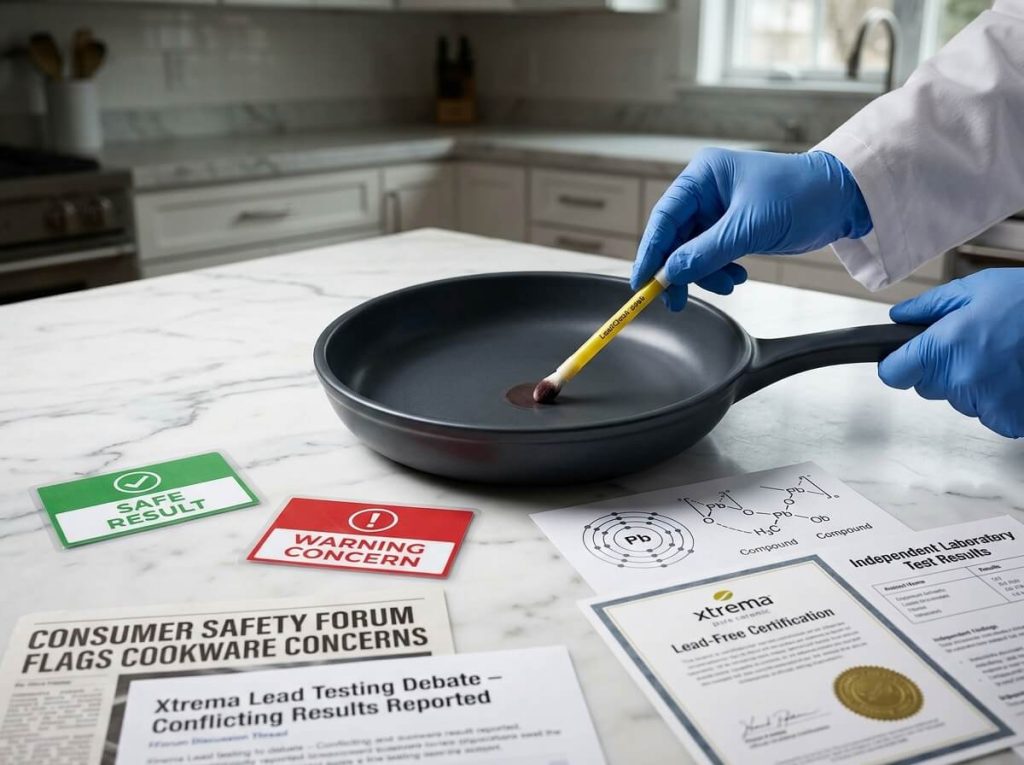
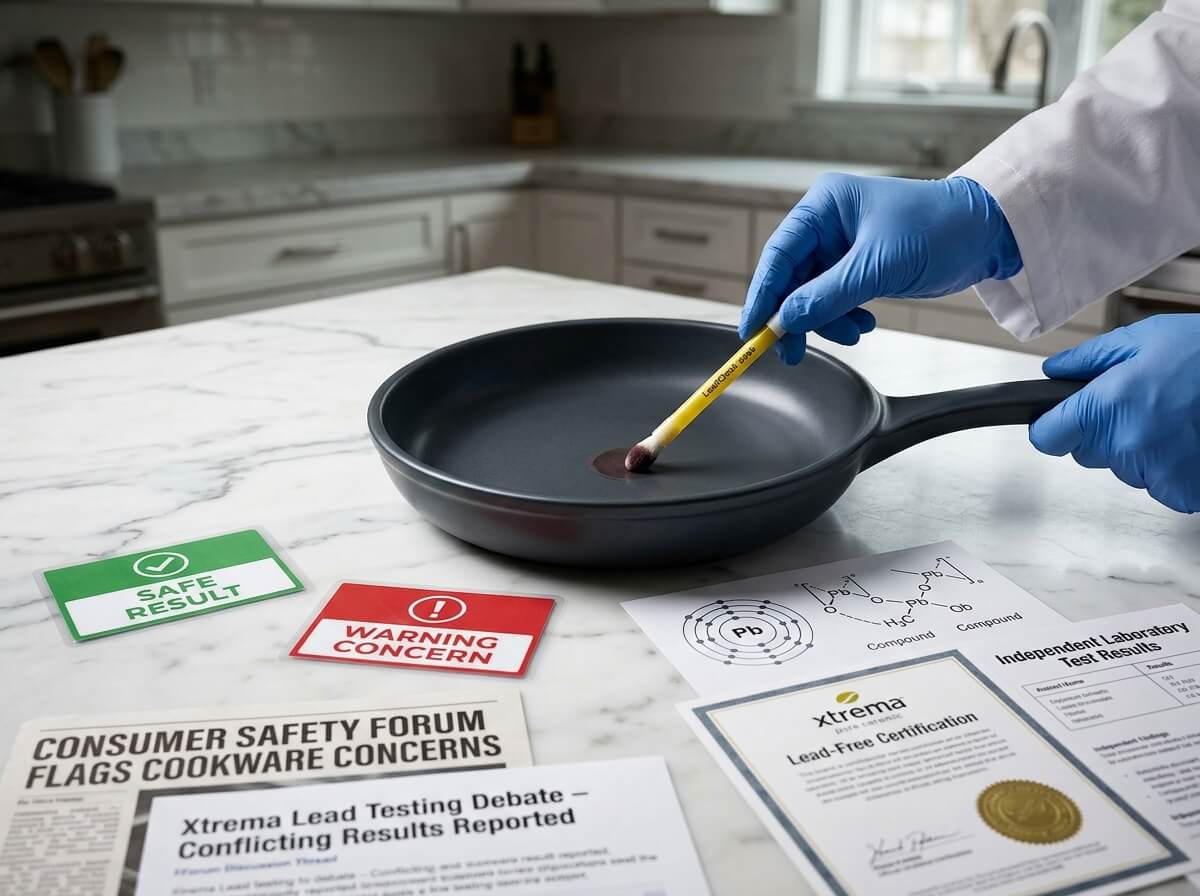
The controversy started when an independent tester used a handheld XRF device to check a broken Xtrema pan and found lead present in the material.
Xtrema, meanwhile, has published over a decade of third-party leach testing showing that lead doesn’t come out of its cookware in meaningful amounts during normal use. Both findings are technically accurate.
The disagreement is over which test actually tells you something useful about your risk from cooking dinner.
Timeline: How the Controversy Started in 2017
- 2017 — Blogger and lead-poisoning-prevention advocate Tamara Rubin (Lead Safe Mama) tests a Ceramcor/Xtrema pan with an XRF instrument and reports lead in the material.
- 2018 — Rubin publishes a follow-up test on another Xtrema saucepan, again finding lead along with cadmium, cobalt, nickel, and chromium via XRF.
- 2019 — Xtrema sends a letter to its resellers pushing back on Rubin’s findings; Rubin publishes the letter along with her rebuttal.
- 2020–2022 — Rubin continues periodic XRF testing on additional Xtrema pieces, including a teapot and a saucepan purchased directly from the company, with similar results.
- 2022 — Consumer-testing site Mamavation reviews the available evidence and lists Xtrema as its recommended ceramic cookware brand, while noting the XRF findings and explaining why it still recommends the brand based on leach results.
- 2024 — Mamavation sends two Xtrema pieces to an EPA-certified lab for independent acid-bath (leach) testing, funded by its own ad and affiliate revenue rather than by Xtrema, to settle the leaching question directly.
- Ongoing — Xtrema continues to publish quarterly third-party Prop 65 leach test results on its own site, while adjusting its marketing away from blanket “metals-free” language.
Who’s Involved: Lead Safe Mama, Mamavation, and Xtrema’s Response
Three parties have driven this story, and each has a different scope of expertise.
Tamara Rubin’s Lead Safe Mama tests consumer products with XRF equipment, which measures total elemental content in a material; it doesn’t test whether anything actually transfers into food.
Mamavation, a separate consumer-testing outlet, sent Xtrema cookware to an EPA-certified laboratory for acid-bath leach testing, which measures what actually comes out of the product under simulated food-contact conditions.
Xtrema, for its part, has responded by publishing its own quarterly third-party leach test results and by softening earlier “metals-free” marketing language, while maintaining that no lead or cadmium leaches out of its products in unsafe amounts.
XRF Testing vs. Leach Testing: Why the Results Conflict
The two testing methods aren’t measuring the same thing, which is why they can both be accurate and still seem to disagree.
XRF testing tells you what’s physically present in a material. Leach testing tells you what actually comes out of that material and into your food.
A product can contain trace metals and still be safe to cook with if those metals stay locked inside the ceramic matrix instead of migrating out.
What XRF Testing Actually Measures
XRF (X-ray fluorescence) testing uses a handheld device to identify the elemental composition of a material by bombarding it with X-rays and reading the fluorescent signature that bounces back.
It can detect the presence of lead, cadmium, and other metals anywhere in a sample — including metals bound tightly inside a fired ceramic glaze that have no realistic path into food.
XRF cannot measure how much of a detected substance, if any, would transfer out of the product under normal use.
What Prop 65 Leach Testing Actually Measures
Leach testing, the method required under California’s Proposition 65, exposes a product to an acidic solution for a set period to simulate years of food contact, then measures how much lead or cadmium ends up in that solution.
This is the test that actually approximates real-world exposure from cooking and eating.
California’s Prop 65 limits for lead are among the strictest in the world, and a product that fails this test is legally required to carry a warning label.
XRF vs. Leach Testing at a Glance
| Question | XRF Testing | Leach (Prop 65) Testing |
|---|---|---|
| What does it measure? | Total elemental content in the material | Amount that migrates into food/liquid |
| Equipment | Handheld device, usable in the field | Lab-based acid-bath extraction |
| Tells you if metal is present? | Yes | No (not directly) |
| Tells you if metal transfers to food? | No | Yes |
| Legally required for cookware? | No | Yes, under Prop 65 in California |
| Best used for | Flagging materials worth investigating further | Estimating real-world exposure risk |
What the Independent Lab Data Actually Shows
Rather than take either side’s word for it, it’s worth putting the actual findings from all three parties side by side.
No single source in this controversy is lying; they’re each reporting real results from a real test, on a different question.
Mamavation’s EPA-Certified Lab Results
| Source | Test type | What it found |
|---|---|---|
| Lead Safe Mama (Tamara Rubin) | XRF, multiple pieces, 2017–2022 | Detected lead, cadmium, and other metals present in the ceramic material and glaze of several Xtrema products, including one reading of roughly 16,400 ppm lead and 766 ppm cadmium on a cracked Versa Pot. |
| Mamavation | EPA-certified lab, 24-hour acid-bath leach test, 2024 | Lead and cadmium leached from the tested Xtrema pieces at levels well below the amount that would trigger a California Prop 65 warning. |
| Xtrema (self-reported, third-party lab) | Quarterly Prop 65 leach testing, ongoing since inception | Reports passing every Prop 65 lead and cadmium leach test to date across more than a decade of published results. |
The pattern across all three data sets is consistent, not contradictory: lead is present in the raw material (confirmed by XRF), and that lead is not migrating out in dangerous amounts under normal food-contact conditions (confirmed independently by two separate leach-testing efforts, one of them run by a source with no financial relationship to Xtrema).
Xtrema’s Own Published Prop 65 Results
Xtrema publishes its quarterly leach test results directly on its website, going back more than a decade, and states that no lead or cadmium has ever leached from its products above the Prop 65 threshold.
That’s a meaningful claim, but it’s worth being precise about what it does and doesn’t cover: it applies to batches tested at the time of manufacture, not to how an individual pan behaves years later, especially if the glaze is chipped or heavily worn.
If that changes, for example, if a Prop 65 warning-letter notice ever appears in California’s public database for an Xtrema product, or if an independent leach test on a chipped or aged unit turns up elevated results that would be a real reason to revisit this recommendation.
As of this writing, no such warning notice or contradictory leach result exists in the public record.
Is Trace Lead in Cookware Actually Dangerous?
Trace lead in a material is not automatically dangerous; what matters is whether it can reach your body.
There is no safe blood-lead level, which is exactly why the leaching question, not the presence question, is the one that determines real-world risk.
Why “Contains Lead” and “Leaches Lead” Are Different Claims
A cookware brand can honestly say a product “contains no extractable lead” while an XRF test still detects lead in the raw material, because “extractable” specifically refers to what a leach test measures.
Stainless steel is a useful comparison: XRF testing on stainless steel routinely detects nickel and chromium, both of which are structural components of the alloy, not evidence that your stainless pan is leaching those metals into your dinner.
Xtrema has moved away from unqualified phrases like “metals-free” in its marketing for exactly this reason: the material does contain metals, even though those metals aren’t shown to migrate out under normal use.
What FDA and Prop 65 Actually Regulate
- The FDA does not set a specific federal leaching limit for lead in cookware, but it has issued warnings about imported metal cookware (including certain aluminum alloys) known to leach lead into food.
- California’s Prop 65 sets its own leaching limits for lead and cadmium in consumer products, including cookware, and requires a visible warning label on any product that exceeds them.
- A product that passes Prop 65 leach testing is not required to disclose the total elemental content of its raw materials, which is why XRF findings and Prop 65 compliance can coexist without contradiction.
- Neither regulation requires ongoing testing of individual units after manufacture, so leach-test guarantees apply to tested batches, not to every pan in every kitchen indefinitely.
Is Xtrema Safe for Babies, Toddlers, and Pregnant Women?
For most households, the independent leach-testing data supports normal use of undamaged Xtrema cookware.
For households with an infant, a pregnant person, or anyone else in a higher-risk category, it’s reasonable to be more conservative, since there is no safe threshold of lead exposure for a developing child.
Extra Precautions for High-Risk Households
- Check for chips or cracks first. Damaged glaze is the one scenario where the manufacturer’s leach-test guarantees no longer clearly apply, since the tests are run on intact products.
- Avoid daily use with highly acidic foods in older or heavily used pieces. Acidic ingredients are the mechanism leach testing simulates, so this is where any real-world leaching risk would concentrate.
- Replace cookware showing surface wear rather than continuing to use it. Xtrema’s own 10-year warranty program exists partly for this reason.
- If there’s an infant or pregnant person in the household, consider reserving Xtrema for lower-acid, less frequent use and leaning on other independently leach-tested options for daily high-acid cooking until you’re comfortable with the tradeoffs.
How Xtrema Compares to Other Non-Toxic Options for Babies
If you want additional reassurance before feeding a baby or toddler from ceramic cookware, it helps to see how Xtrema stacks up against other brands people consider for the same reason; see our picks for the safest cookware for babies and toddlers.
Xtrema’s advantage over many other ceramic brands is that it skips the nanoparticle coatings used by some competitors, but it isn’t the only option with strong independent safety data.
If you’re weighing it against other popular picks, you can compare other popular non-toxic cookware brands side by side before deciding.
If you already own Xtrema and it’s undamaged, the evidence supports continuing to use it normally — the controversy is real, but it doesn’t point toward an active safety hazard for intact cookware used as directed.
Frequently Asked Questions
Does Xtrema cookware contain lead?
Yes, trace lead has been detected in Xtrema’s raw ceramic material through independent XRF testing, and Xtrema itself doesn’t dispute this.
What matters more is whether that lead leaches into food, and independent acid-bath leach testing, including a 2024 test by Mamavation using an EPA-certified lab, found lead levels well below California’s Prop 65 limit, which is one of the strictest lead-leaching standards in the world.
Has Xtrema ever failed a Prop 65 test?
No public record shows Xtrema failing a Prop 65 leach test or receiving a Prop 65 warning-letter notice.
Xtrema publishes its own quarterly third-party leach test results going back more than a decade, and an independent 2024 lab test commissioned by Mamavation also found lead and cadmium levels below the Prop 65 threshold.
If that record changes, it would be a meaningful reason to revisit any recommendation of the brand.
Is XRF testing more accurate than leach testing?
Neither test is more accurate than the other — they measure different things.
XRF testing is more accurate for identifying what elements are physically present in a material, while leach testing is more accurate for estimating what would actually transfer into your food during cooking.
For assessing real-world exposure risk from cookware, leach testing is the more directly relevant measurement, which is why it’s the method required under Prop 65.
Is there an active recall or lawsuit against Xtrema?
No confirmed formal recall or class-action lawsuit against Xtrema was found in publicly available records as of this writing.
Online chatter referencing an “Xtrema lawsuit” appears to stem from social media speculation and reader comments rather than any documented legal action or regulatory recall notice, so that specific claim shouldn’t be treated as fact.
If you’re still deciding what to buy, our full guide to the best non-toxic cookware breaks down every leading brand’s safety data in one place.