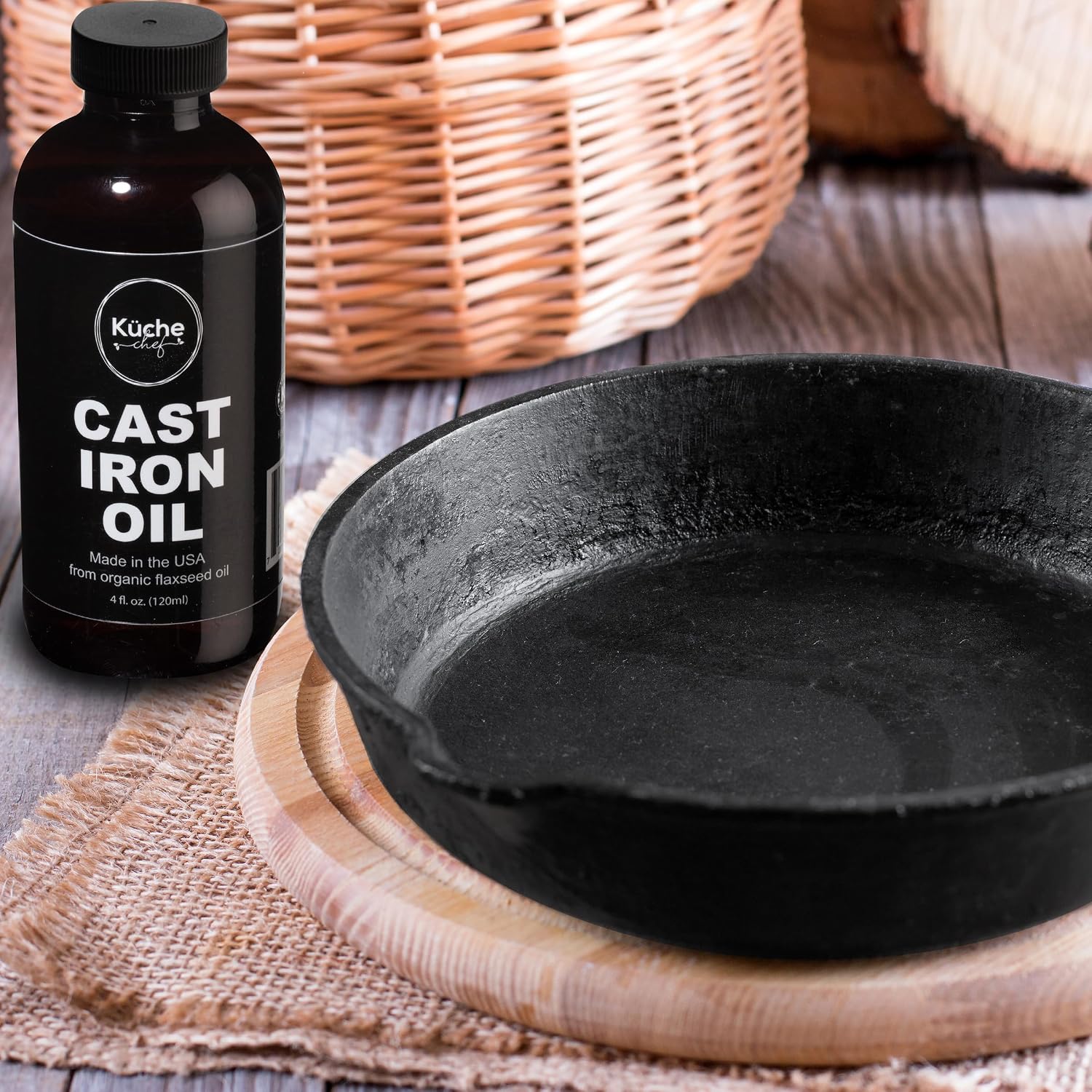
Seasoning cast iron means baking a thin layer of oil into the metal until it hardens into a smooth, non-stick surface, and getting it right comes down to three things: the right oil, a hot enough oven, and thin layers applied over several rounds rather than one thick coat.
What Does It Mean to “Season” Cast Iron?
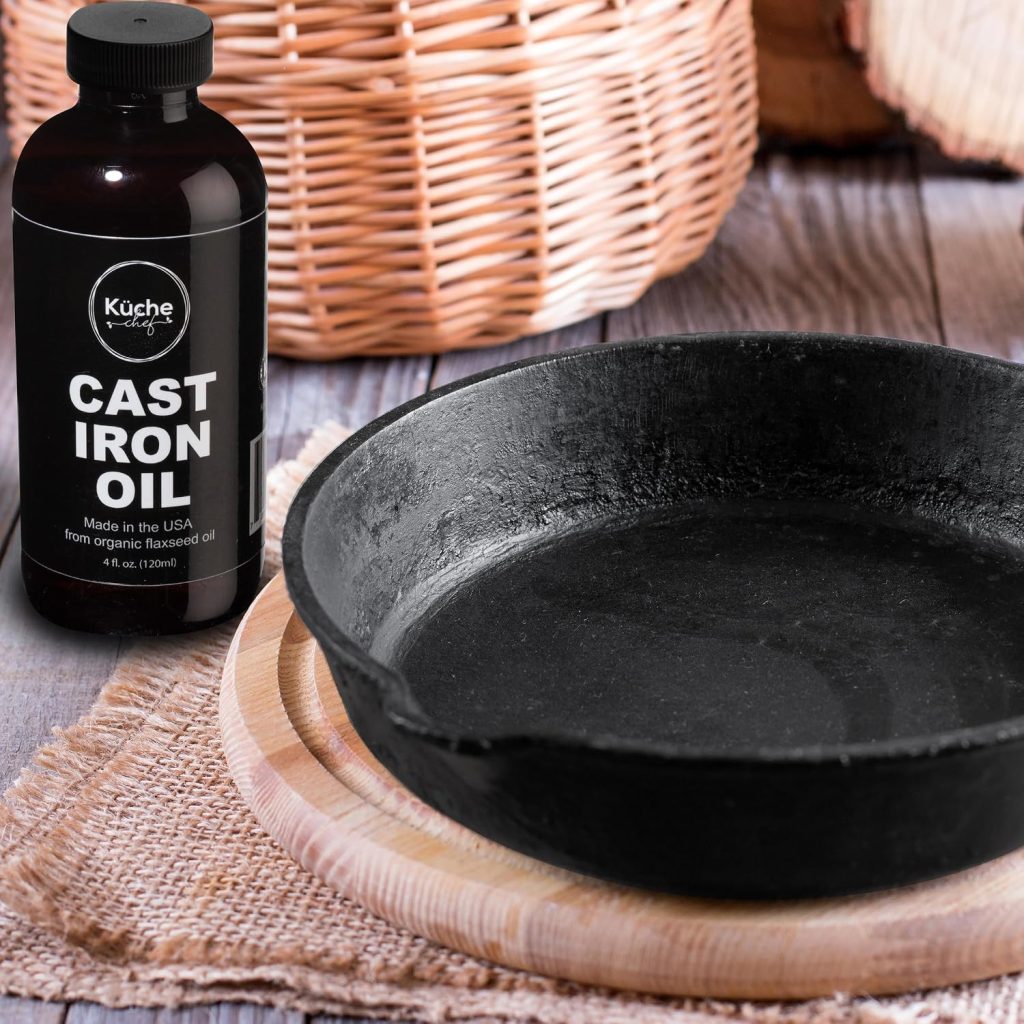
Seasoning is the process of building up a hard, slick layer of polymerized oil on bare cast iron so that food releases easily and the metal doesn’t rust.
It isn’t a coating added at a factory in the way a nonstick pan gets its Teflon layer; it’s oil that has chemically transformed under heat, bonding directly to the iron itself.
The science of polymerization, explained simply
Polymerization is the chemical reaction that turns liquid oil into a hard, plastic-like layer.
When oil is heated past its point of breakdown, its fatty acid molecules link together into long chains, forming a solid film that clings to the microscopic pores of the cast iron surface.
The more unsaturated the oil (meaning it has more double bonds available for those chains to form), the harder and more durable the resulting seasoning.
Why seasoning matters for non-stick and rust prevention
- A well-seasoned surface keeps food from sticking, so eggs, fish, and pancakes release cleanly without needing excess fat.
- The polymerized oil layer physically blocks moisture and oxygen from reaching the iron, which is what prevents rust.
- Seasoning improves with every cook, since fats and oils from normal cooking add thin new layers over time.
- A properly seasoned pan requires far less added oil during cooking, which matters if you’re trying to control how much fat ends up in a dish.
If you’re comparing cast iron to other non-toxic materials before you commit to seasoning one, our full ceramic vs. cast iron comparison breaks down how the two hold up over time.
What You’ll Need Before You Start
Seasoning cast iron doesn’t require anything specialized; a bottle of oil, a lint-free cloth, and an oven are enough for most pans.
Before you check your stove, check induction compatibility here if you’re planning to cook on an induction range, since it affects which pans are worth seasoning in the first place.
Choosing your oil
| Oil | Smoke Point | Polyunsaturated Fat % | Good for Seasoning? |
|---|---|---|---|
| Flaxseed oil | ~225°F | ~68% | Yes — hardest finish, but temperamental |
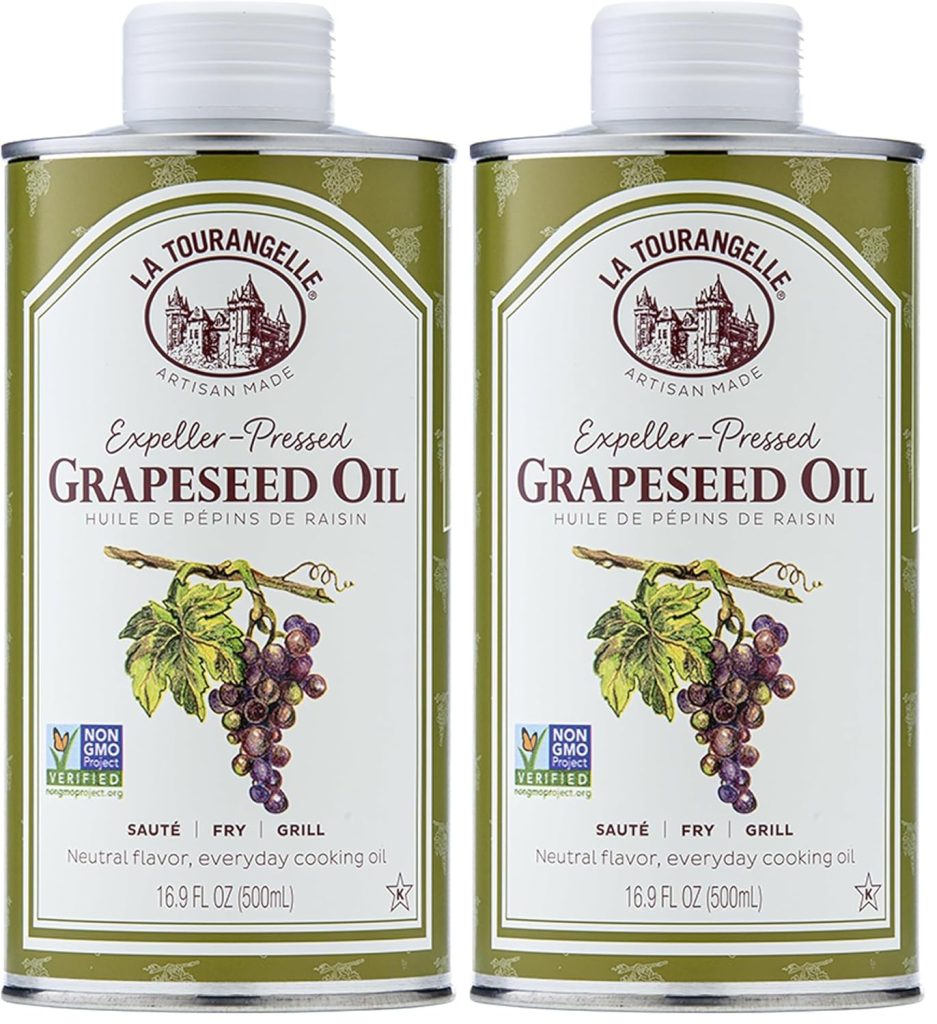
| Grapeseed oil | ~420°F | ~70% | Yes — reliable, widely available |
| Sunflower oil | ~440°F | ~68% | Yes — good everyday choice |
| Vegetable oil (soybean blend) | ~400–450°F | ~58% | Yes — what most factories use |
| Canola oil | ~400°F | ~28% | Acceptable — softer, needs more layers |
| Refined coconut oil | ~450°F | ~2% | No — too saturated to polymerize well |
Tools and materials checklist
- A neutral cooking oil from the table above, ideally fresh rather than close to its expiration date.
- A lint-free cloth or paper towel for applying and wiping off oil.
- Aluminum foil to place on the oven’s lower rack and catch drips.
- Dish soap and a stiff brush or chainmail scrubber are needed only if the pan has rust or old, damaged seasoning to remove first.
How to Season a Cast Iron Skillet, Step by Step
Step-by-step instructions
- Wash the pan with warm, soapy water and a stiff brush, even if it looks clean, to remove any factory residue or dust.
- Dry the pan completely with a cloth, then set it on a burner over low heat for a minute or two so any remaining moisture evaporates.
- Apply a very thin layer of oil to the entire pan, inside and out, including the handle, using a cloth to rub it in and then wipe away any visible excess.
- Place a sheet of aluminum foil on the oven’s lowest rack, then set the pan upside down on the rack above it.
- Bake the pan according to the temperature and time for your chosen oil in the table below.
- Turn off the oven and let the pan cool inside it completely before touching it.
- Repeat steps 3 through 6 two to three more times to build up multiple thin layers.
Temperature and timing by oil type
| Oil | Oven Temperature | Bake Time | Recommended Rounds |
|---|---|---|---|
| Flaxseed oil | 350–400°F | 1 hour | 4–6 |
| Grapeseed or sunflower oil | 450–500°F | 1 hour | 3–4 |
| Vegetable oil | 450°F | 1 hour | 3–4 |
| Canola oil | 400–425°F | 1 hour | 4–5 |
The Smoke-Point Myth (and What Actually Matters)
The oil that seasons cast iron best isn’t the one with the highest smoke point; it’s the one with the highest polyunsaturated fat content, because that’s what determines how completely the oil polymerizes into a hard layer.
Why high smoke point isn’t the right criterion
A high smoke point simply means an oil resists breaking down at high heat, which is a useful trait for frying but is close to irrelevant for seasoning.
Seasoning depends on the oil breaking down; that’s the whole point of baking it past its smoke point in the first place.
What actually determines the strength of the resulting layer is the oil’s degree of unsaturation: fatty acid chains with more double bonds cross-link more completely when heated, producing a harder, more durable polymer.
A refined oil marketed for its high smoke point but low unsaturation, like refined coconut oil, will resist breaking down at all and leave you with a soft, unstable seasoning even after repeated rounds in the oven.
Oils ranked by polymerization potential
| Oil | Polyunsaturated Fat % | Polymerization Strength |
|---|---|---|
| Flaxseed oil | ~68% | Highest — hardest, most durable finish |
| Grapeseed oil | ~70% | Highest — comparable to flaxseed, more forgiving |
| Sunflower oil | ~68% | High |
| Soybean/vegetable oil | ~58% | Moderate |
| Canola oil | ~28% | Lower — usable, but needs more coats |
| Refined coconut oil | ~2% | Very low — not recommended |
Is Seasoned Cast Iron Actually Non-Toxic?
Seasoned cast iron is one of the simplest non-toxic cookware options available, because the seasoning layer is nothing more than oil transformed by heat rather than a manufactured chemical coating.
If you’re weighing it against how ceramic cookware safety compares, the core difference is that ceramic coatings are applied and cured at the factory, while cast iron’s seasoning is a layer you build and maintain yourself using ordinary cooking oil.
How seasoning compares to PTFE/PFAS coatings
| Feature | Seasoned Cast Iron | PTFE Nonstick | Enameled Cast Iron |
|---|---|---|---|
| Contains PFAS/PTFE | No | Yes, in traditional formulations | No |
| Coating source | Polymerized cooking oil, built by the user or factory | Manufactured fluoropolymer coating | Fused glass enamel applied at the factory |
| Risk if overheated | Seasoning can degrade and needs to be reapplied | Coating can break down and release fumes above roughly 500°F | Enamel is heat-stable but can chip if dropped |
| Maintenance to stay non-stick | Requires periodic re-seasoning | None — degrades over the pan’s life instead | None |
| Third-party verified PFAS-free brands | Lodge and other major cast iron makers state their cookware is made without PFOA and PTFE | Varies by brand; look for explicit PFAS-free labeling | Made In has published third-party lab testing showing its enameled cast iron passed all PFAS screening |
The flaxseed oil additive pitfall to avoid
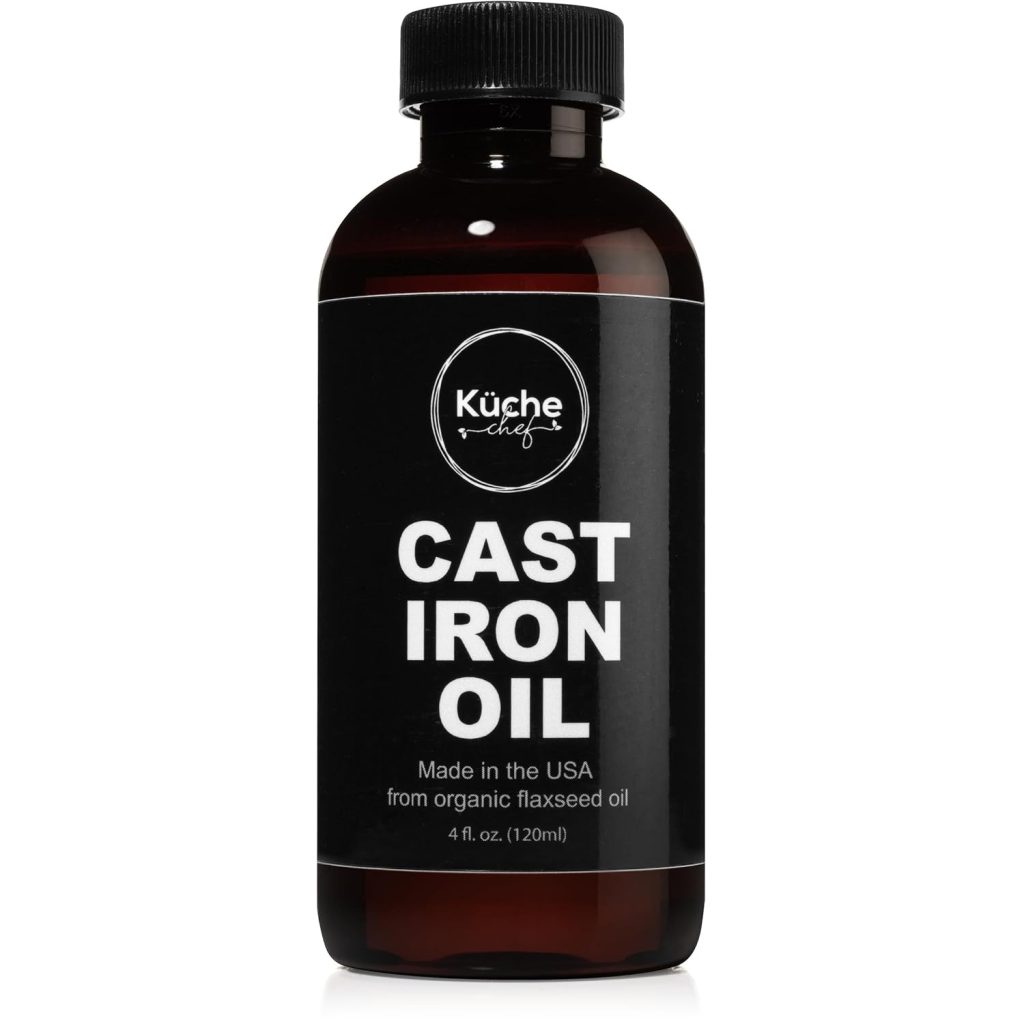
- Check the ingredient label for anything beyond “flaxseed oil” — additives like vitamin E, rosemary extract, or other antioxidants are added specifically to prevent oxidation, which is the same chemical process seasoning depends on.
- Look for oil sold refrigerated in a dark bottle, since flaxseed oil is unstable at room temperature and light exposure speeds up the degradation that ruins its seasoning performance.
- Confirm the label says cold-pressed and unrefined, since heavily processed flaxseed oil loses some of the fatty acid structure that makes it polymerize well.
- Buy a size you’ll use within a few months, because rancid flaxseed oil won’t season properly even before it starts to smell off.
If PFAS-free labeling is the main thing you’re checking for when you shop, ” How to check any pan for PFAS“ walks through what those claims actually mean on a product label.
Troubleshooting Common Seasoning Problems
Sticky or gummy seasoning
- Confirm the cause: a tacky, gummy surface almost always means too much oil was applied before baking, or the oven never reached a high enough temperature to fully polymerize it.
- Scrub the pan with hot water and a stiff brush or chainmail scrubber to remove the unpolymerized residue.
- Dry the pan completely and reapply oil in a noticeably thinner layer than before, wiping until the surface looks dry rather than glossy.
- Rebake at the correct temperature for your oil, and check that your oven thermometer is accurate if the problem keeps recurring.
Flaking or peeling the seasoning
- Confirm the cause: flaking usually follows cooking acidic foods like tomatoes or vinegar-based sauces before the seasoning is fully established, or from overly aggressive scrubbing.
- Remove any loose flakes with warm water and a scrub brush, since they won’t reattach on their own.
- Do two to three full rounds of oven seasoning to rebuild a solid base before cooking anything acidic again.
- Once the color looks even and dark, resume normal cooking, saving acidic dishes for a pan with well-established seasoning.
How Often to Re-Season Cast Iron
Most cast iron needs a full re-seasoning only a few times a year, while lighter maintenance seasoning happens naturally every time you cook with a bit of oil.
Signs it’s time to re-season
- Food starts sticking noticeably more than it used to, even when you’re using enough oil.
- The surface looks dull, gray, or matte instead of dark and slightly glossy.
- You notice bare, silvery patches where the iron itself is visible.
- Rust has started to form after the pan was left wet or stored in a humid space.
Maintenance seasoning vs. a full reseason
Cooking with a bit of fat adds a thin new layer of seasoning every time, which is why pans used daily often need a full reseason only once every month or two, while occasional-use pans might go stretches of six months or longer between full sessions.
A full reseason stripping the pan back with a scrub and running it through several oven cycles is only necessary when the surface has visibly degraded rather than as routine upkeep.
Between seasoning sessions, “ How to clean non-toxic cookware without damaging it” covers the day-to-day washing and drying habits that keep a seasoned layer intact for longer.
Once your cast iron is properly seasoned, it becomes one of the lowest-maintenance, most durable pieces in a non-toxic kitchen, and it’s worth seeing how it stacks up against your other cookware.
Our full non-toxic cookware picks round up the materials and brands that meet the same PFAS-free, additive-free standard as a well-seasoned cast iron pan.
Frequently Asked Questions
Do you need to season cast iron that comes pre-seasoned?
Yes, most people benefit from adding one or two extra rounds of seasoning even to a pre-seasoned pan, since factory seasoning is usually a single thin layer meant to prevent rust in shipping rather than provide full non-stick performance.
Brands like Lodge apply a layer of vegetable oil baked on at the foundry, which is enough to use the pan safely right away, but building a second or third layer at home before your first cook creates a noticeably better non-stick surface from day one.
Can you use olive oil to season cast iron?
Olive oil can be used, but it’s a weaker choice than flaxseed, grapeseed, or sunflower oil because its lower polyunsaturated fat content produces a softer, less durable seasoning layer.
It will still work in a pinch, especially for a quick maintenance layer between cooks, but if you’re seasoning a brand-new pan from scratch, a more polymerization-friendly oil will get you to a hard, slick finish in fewer rounds.
If you’re seasoning cookware you plan to use for family cooking, our picks for baby-safe cookware cover other non-toxic options worth considering alongside cast iron.
Can you over-season a cast-iron pan?
Yes, applying too much oil in a single round is the most common seasoning mistake, and it produces a sticky, gummy surface rather than a harder one.
More layers over time are good, but each layer needs to be thin enough that no visible oil remains before the pan goes into the oven.
If a pan feels tacky after seasoning, the fix is a good scrub followed by a thinner reapplication, not simply adding yet another thick coat on top.
Is it safe to season cast iron with vegetable oil?
Yes, vegetable oil is one of the most common and reliable seasoning oils, and it’s what most cast iron manufacturers use for their factory seasoning.
It has a moderate smoke point and a decent polyunsaturated fat content, making it a dependable, widely available choice that doesn’t require the extra care flaxseed oil does.
It won’t produce quite as hard a finish as flaxseed or grapeseed oil, but for most home cooks, the difference isn’t noticeable in day-to-day use.