Most non toxic cookware is damaged by habits that have nothing to do with soap, it’s thermal shock, metal utensils, abrasive scrubbing, and aerosol cooking spray buildup that shorten a pan’s life, not the dish soap sitting under your sink.
What Actually Damages Non-Toxic Cookware?
Non-toxic cookware, whether ceramic, stainless steel, or cast iron, is rarely damaged by ordinary cleaning products.
The real risks come from a small set of physical habits that stress the surface or coating directly, and once you know what they are, cleaning stops feeling like a minefield.
The real culprits — thermal shock, abrasive tools, and cooking spray
- Running cold water over a hot pan causes thermal shock, which can warp the metal base and crack a ceramic coating in a single moment.
- Metal spatulas, forks, and whisks scratch ceramic and enamel surfaces, creating grooves where food and residue can build up over time.
- Steel wool and abrasive scouring powders wear down ceramic and enamel coatings and can strip cast iron seasoning back to bare metal.
- Aerosol cooking sprays like Pam contain lecithin and other additives that build up into a gummy film on ceramic surfaces, and this residue is much harder to remove than ordinary cooking oil.
- Stacking pans without a protective layer between them lets the bottom of one pan scratch the cooking surface of the one beneath it.
What dish soap and baking soda actually do (and don’t do)
Ordinary dish soap is safe on every non-toxic cookware material, including ceramic, stainless steel, and seasoned cast iron, because its job is simply to break down grease through mild surfactants rather than through abrasion.
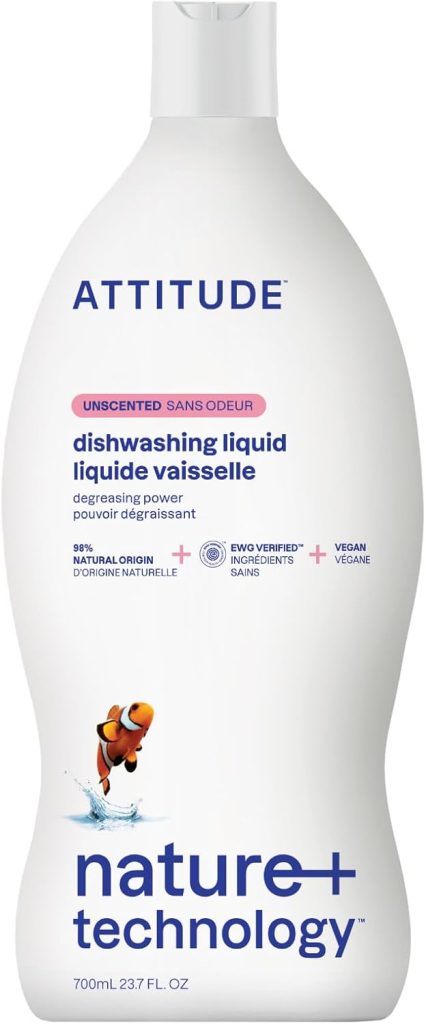
Baking soda is similarly gentle when made into a paste with water: it works as a mild mechanical abrasive that lifts stuck-on residue without scratching the coating underneath, which is why brands from Made In to The Kitchn recommend it for stain removal on ceramic pans.
The one exception worth knowing is soap on cast iron, where the concern isn’t damage to the metal itself but the fact that repeated hard soap use can strip a thin, still-developing seasoning layer faster than it can rebuild a light touch with regular dish soap on a well-seasoned pan is fine, but heavy scrubbing with soap on a brand-new pan will slow down how quickly it builds a strong non-stick surface.
If you’re trying to figure out whether a specific pan’s coating includes anything you’re trying to avoid in the first place, how to check any pan for PFAS covers what to look for on a label before it ever reaches your sink.
The Daily Cleaning Routine for Any Non-Toxic Pan
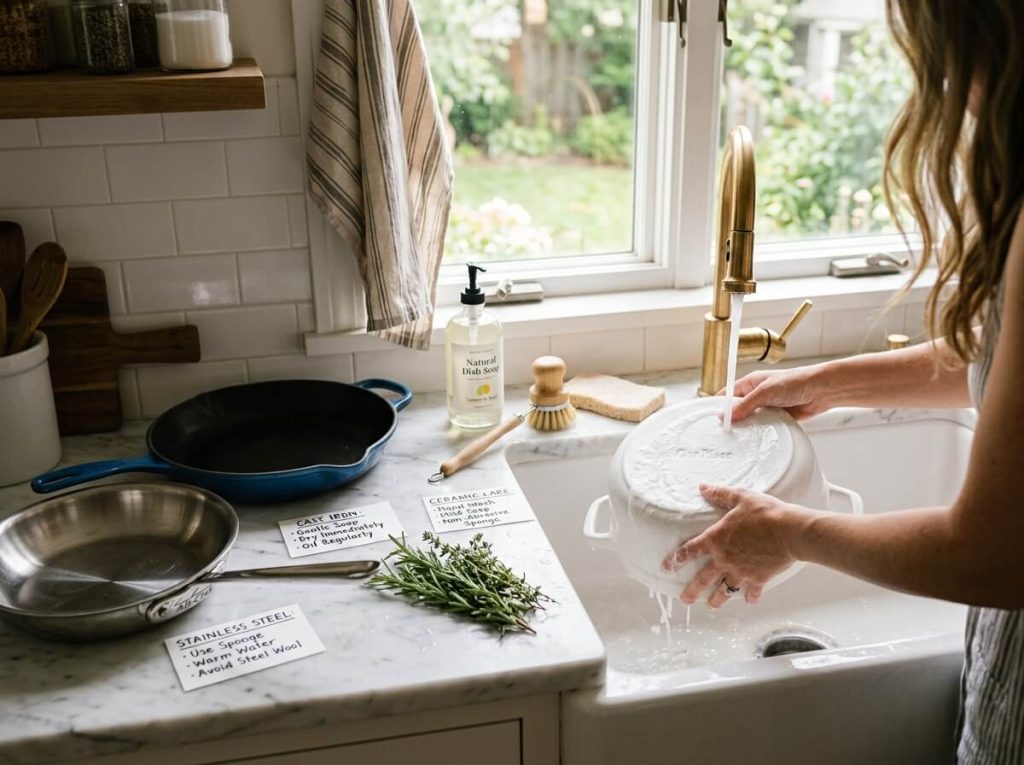
A simple hand-wash routine right after cooking is enough to keep almost any non-toxic pan performing well for years, and it takes only a couple of minutes longer than tossing something in the dishwasher.
Step-by-step basic wash
- Let the pan cool to room temperature before washing it, since plunging a hot pan into cold water risks thermal shock regardless of material.
- Fill the pan with warm water and a small amount of dish soap, and let it sit for a few minutes if there’s any stuck-on food.
- Wash the surface with a soft sponge or non-abrasive cloth, using gentle circular motions rather than hard scrubbing.
- Rinse thoroughly with clean water to remove any soap residue.
- Dry the pan completely with a towel immediately after rinsing, rather than letting it air-dry, to prevent water spots and mineral buildup.
Drying and storage habits that extend cookware life
- Store pans with a cloth, paper towel, or silicone liner between them if they need to be stacked, so surfaces don’t scratch against each other.
- Hang pans when possible, since this avoids stacking pressure altogether and is the gentlest storage option for ceramic and enamel coatings.
- Keep cast iron and carbon steel pans lightly oiled between uses, especially if they’ll sit unused for more than a few days, to prevent rust from forming.
- Avoid storing any pans while still slightly damp, since trapped moisture is what leads to water spots on stainless steel and rust on cast iron.
If bakeware is part of your non-toxic kitchen too, our non-toxic bakeware picks cover which materials hold up best to the higher, drier heat that baking sheets and pans typically see.
How to Clean Each Material the Right Way
The basic routine above works for daily upkeep, but each non-toxic material has a few specific things worth knowing before you clean it for the first time.
Ceramic-coated and 100% ceramic cookware
Ceramic cookware is one of the more delicate non-toxic options, and before you commit to a cleaning habit, it’s worth knowing whether ceramic cookware is safe long-term, so you understand how the coating is meant to hold up over years of use.
- Let the pan cool completely before washing, since ceramic is especially prone to cracking from sudden temperature changes.
- Wash with warm water, a few drops of dish soap, and a soft sponge, using light pressure rather than scrubbing.
- For stuck-on residue, make a paste of baking soda and a small amount of water, apply it to the affected area, and let it sit for 10 to 20 minutes before wiping with a soft sponge.
- Rinse thoroughly and dry immediately with a soft towel to avoid water spots on the coating.
- Skip aerosol cooking sprays entirely, and use a small amount of butter or oil instead to protect the coating from residue buildup.
Stainless steel cookware
- Wash with warm water, dish soap, and a soft sponge for routine cleaning, since stainless steel doesn’t need special products for everyday use.
- For stuck-on food, fill the pan with hot water and let it soak for 15 to 30 minutes to loosen debris before scrubbing.
- For burnt-on residue, bring a mixture of equal parts water and white vinegar to a simmer in the pan, then remove from heat and let it cool before scrubbing with a non-abrasive pad.
- For discoloration, simmer tomato sauce or crushed tomatoes in the affected area for about 10 minutes, then rinse clean.
- Dry the pan immediately and completely after washing, since stainless steel is especially prone to visible water spots if left to air-dry.
Cast iron and carbon steel cookware
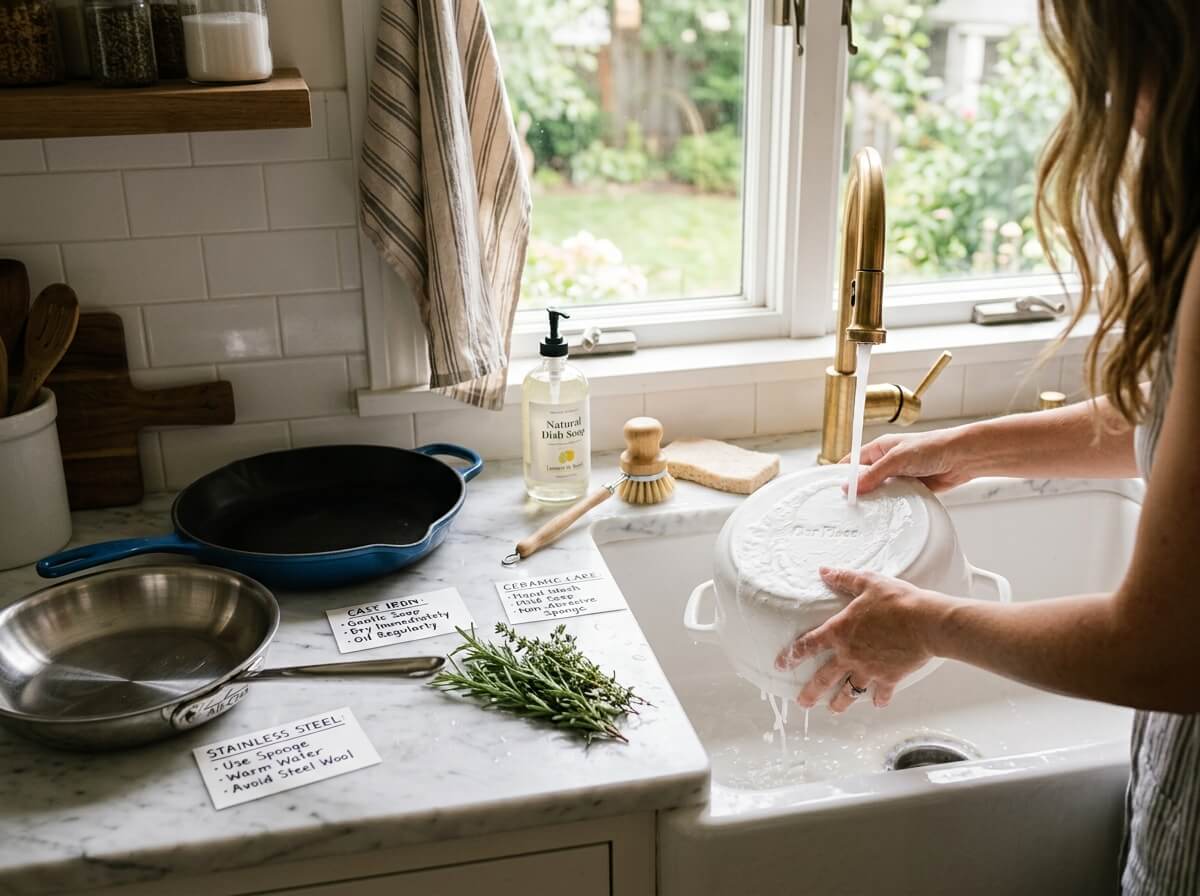
Cleaning cast iron looks different from ceramic or stainless steel because the goal is protecting the seasoning layer rather than a manufactured coating.
For a fuller picture of how the two compare, our ceramic vs. cast iron comparison is worth a look before you settle on a long-term care routine.
- Wash the pan with warm water and a stiff brush or chainmail scrubber right after cooking, while it’s still warm.
- Use a small amount of dish soap if needed — this is safe for well-seasoned cast iron and won’t strip a healthy seasoning layer with normal use.
- For stuck-on food, sprinkle coarse salt onto the surface and scrub with a damp cloth or scrubber instead of reaching for steel wool.
- Dry the pan completely, either with a towel or by setting it on a warm burner for a minute, since any leftover moisture invites rust.
- Rub a very thin layer of cooking oil over the surface before storing it, which maintains the seasoning between cooking sessions.
Once a pan is clean and dry, keeping the seasoning strong is really a separate skill from cleaning it — how to season cast iron cookware walks through building and maintaining that layer from scratch.
Removing Burnt-On Food and Stains
Burnt-on food and discoloration look worse than they are, and nearly every case can be resolved with a household ingredient already sitting in your kitchen rather than a specialized product.
Baking soda and vinegar methods
- For general burnt residue, add water and a splash of vinegar to the pan, bring it to a boil, then remove from heat and stir in a cup of baking soda to create a loosening paste.
- Let the mixture sit for several minutes so the reaction can lift debris away from the surface.
- Scrub gently with a non-abrasive sponge or nylon brush, focusing on the affected areas rather than the whole pan.
- Rinse thoroughly and dry immediately, repeating the process if any residue remains.
- For lighter jobs, a simple baking soda and water paste applied directly to a cooled pan and left for 10 to 20 minutes is often enough on its own.
When to reach for a specialty cleaner
| Cleaner | Best For | Avoid On | Notes |
|---|---|---|---|
| Dish soap | All materials | None | Safe as a daily cleaner across ceramic, stainless, and cast iron. |
| Baking soda paste | Ceramic, stainless, cast iron | Nothing when used gently | Mild abrasive; safe for regular stain lifting. |
| White vinegar | Stainless steel | Cast iron seasoning | Effective for burnt residue and mineral spots; can dull raw cast iron seasoning with repeated use. |
| Bar Keeper’s Friend-style oxalic acid cleaner | Stainless steel | Ceramic and enamel coatings | Strong on burnt-on stains and discoloration, but too abrasive for coated surfaces. |
| Coarse salt scrub | Cast iron and carbon steel | Ceramic and enamel coatings | Traditional method for lifting stuck food without soap or steel wool. |
| Brand-specific ceramic cleaner (e.g., Made In’s CeramiClad Cleaner) | Ceramic-coated cookware | Bare cast iron | Formulated specifically for ceramic coatings as an alternative to dish soap. |
Can You Put Non-Toxic Cookware in the Dishwasher?
Dishwashers are generally not recommended for non-toxic cookware, even when a product is labeled dishwasher-safe, because the combination of high heat, harsh detergent, and long cycles wears down coatings and seasoning faster than hand washing does.
Why dishwashers shorten coating lifespan
Dishwasher detergents are formulated to be more aggressive than dish soap, often containing citric acid and abrasive agents designed to cut through baked-on residue on ordinary dishes.
On ceramic and enamel coatings, that same aggressiveness gradually degrades the surface, while the dishwasher’s high-heat drying cycle adds thermal stress on top of it.
Cast iron and carbon steel face a different problem in the dishwasher: prolonged exposure to water and detergent strips the seasoning and invites rust, since neither material has a manufactured coating to protect it in the first place.
Material-by-material dishwasher rules
| Material | Dishwasher Safe? | Why / Why Not |
|---|---|---|
| Ceramic-coated cookware | No | Detergent and heat degrade the coating faster than hand washing. |
| 100% ceramic cookware | Sometimes, per manufacturer | Some solid ceramic pieces tolerate it better than coated versions, but hand washing still extends lifespan. |
| Stainless steel cookware | Generally yes | More durable than coated surfaces, though hand washing preserves shine longer. |
| Cast iron and carbon steel | No | Water exposure and detergent strip seasoning can cause rust. |
| Enameled cast iron | Manufacturer-dependent | Some enamel is dishwasher-rated, but hand washing avoids the risk of movement in the machine. |
Now that you know how to keep each material in good shape, it’s worth taking stock of what’s actually in your kitchen.
Our full non-toxic cookware picks round up the ceramic, stainless, and cast iron options that hold up best to the cleaning routines above.
Frequently Asked Questions
Is dish soap safe for ceramic non-stick cookware?
Yes, dish soap is safe for ceramic cookware and is actually the recommended everyday cleaner by most ceramic cookware brands, including Made In and Our Place.
Its surfactants break down grease and food residue through chemistry rather than abrasion, so it doesn’t scratch or wear down the coating the way a steel wool pad or abrasive powder would.
The habits that actually shorten a ceramic pan’s life are thermal shock from sudden temperature changes, metal utensils, and aerosol cooking spray buildup, not the soap itself.
Can you use baking soda on all non-toxic cookware?
Yes, baking soda is safe across ceramic, stainless steel, and cast iron when it’s used as a paste with water rather than sprinkled dry and scrubbed hard.
It functions as a mild mechanical abrasive, gentle enough to lift stuck-on food and light stains without scratching a coating, which is why it shows up as a recommended method across nearly every major cookware brand’s care instructions.
The key is patience: let the paste sit for 10 to 20 minutes before wiping, rather than trying to scrub a stain away immediately.
Why does my ceramic pan look dull or discolored?
A dull or discolored ceramic pan almost always means invisible oil residue has built up and carbonized from repeated heating, rather than any flaw in the coating itself.
Every time you cook, a thin layer of oil can remain even after washing, and heating that residue again turns it into a baked-on film that dulls the surface over time.
A baking soda paste left to sit for 10 to 20 minutes before a gentle scrub typically restores the pan’s original color, and switching from aerosol cooking spray to poured oil prevents the buildup from recurring.
What household items should never touch non-toxic cookware?
Steel wool, abrasive scouring powders, and metal utensils are the items to keep away from ceramic, enamel, and even well-seasoned cast iron, since all three physically scratch or strip protective surfaces.
Bleach and other harsh chemical cleaners should also be avoided, as they can degrade ceramic and enamel coatings over repeated use, even without visible scratching.
Aerosol cooking sprays are a less obvious offender: their additives build up into a sticky film on ceramic surfaces that’s harder to remove than the residue from regular cooking oil.