Caraway’s “free of PFAS” claim holds up under scrutiny, but its comparative safety marketing does not, and those are two different things that most coverage of this brand lumps together.
Three separate bodies of evidence exist on this: Caraway’s own published lab panel, a 2025 regulatory ruling on its advertising, and independent testing that found something the brand’s panel wasn’t designed to catch.
Here’s what each one actually shows, and how you can check all three yourself.
What “PFAS-Free” Actually Means on a Label
“PFAS-free” is not a single, legally defined claim; it’s shorthand that can mean anything from “we tested for a specific list of compounds and found none” to “we removed one notorious chemical and stopped there.”
PFAS is a family of roughly 15,000 synthetic compounds, and a brand that tests for a few hundred of them is not making the same claim as one that tests for all of them.
This is the gap that causes most of the confusion around cookware marketing.
PFOA-Free vs. PTFE-Free vs. Total PFAS-Free
| Claim | What it actually covers | What it doesn’t cover |
|---|---|---|
| PFOA-free | Absence of one specific legacy PFAS compound, perfluorooctanoic acid | Other PFAS chemicals, including replacement compounds like PTFE or GenX |
| PTFE-free | Absence of polytetrafluoroethylene, the polymer used in Teflon-style coatings | Other fluorinated compounds not classified as PTFE |
| Total PFAS-free | A lab panel screening for a defined list of PFAS compounds, with results below the lab’s detection limit | Any PFAS compound outside that specific list, since no panel tests for all 15,000 |
A product can be legitimately PFOA-free while still containing other PFAS.
That distinction is why California and Colorado both passed laws restricting brands from calling a product “free of” one PFAS compound if it contains a different one.
Why a Self-Declared Claim Isn’t the Same as a Verified One
A brand printing “PFAS-free” on its own packaging is making a claim about itself, with no outside party checking the work.
Verification requires three things: a named independent lab, a specific list of tested substances, and a published detection limit for each one.
Without those three details, “PFAS-free” is a marketing position, not a tested result check any pan for PFAS using that same three-part standard before trusting a label.
Caraway’s Own Testing Program
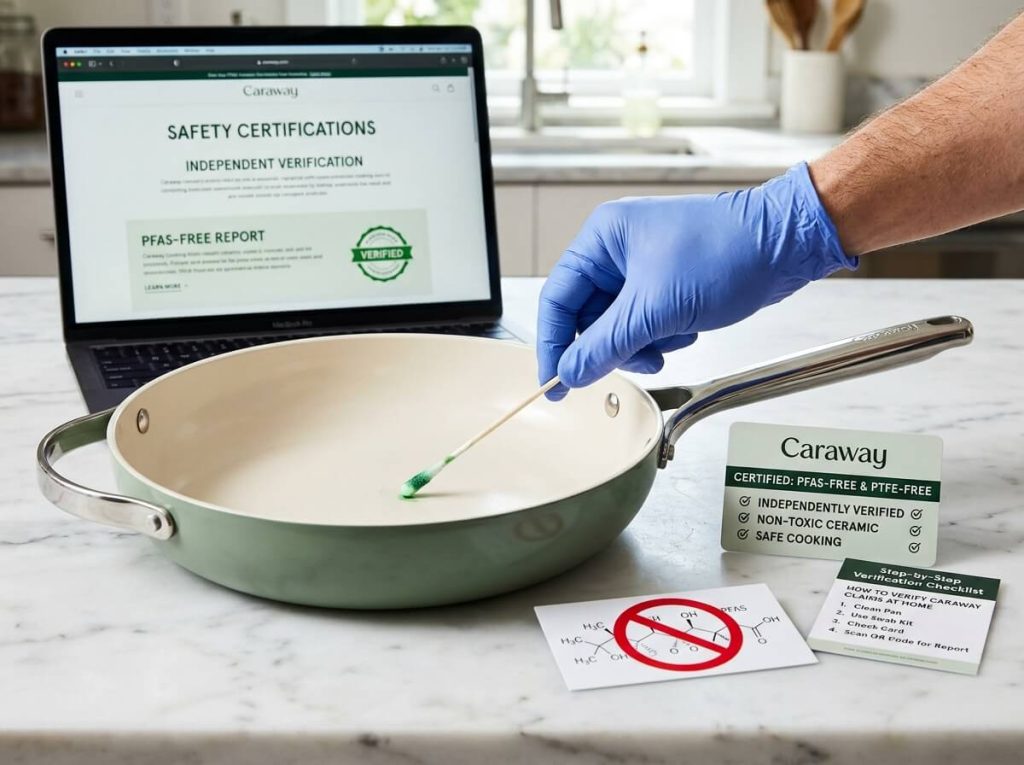
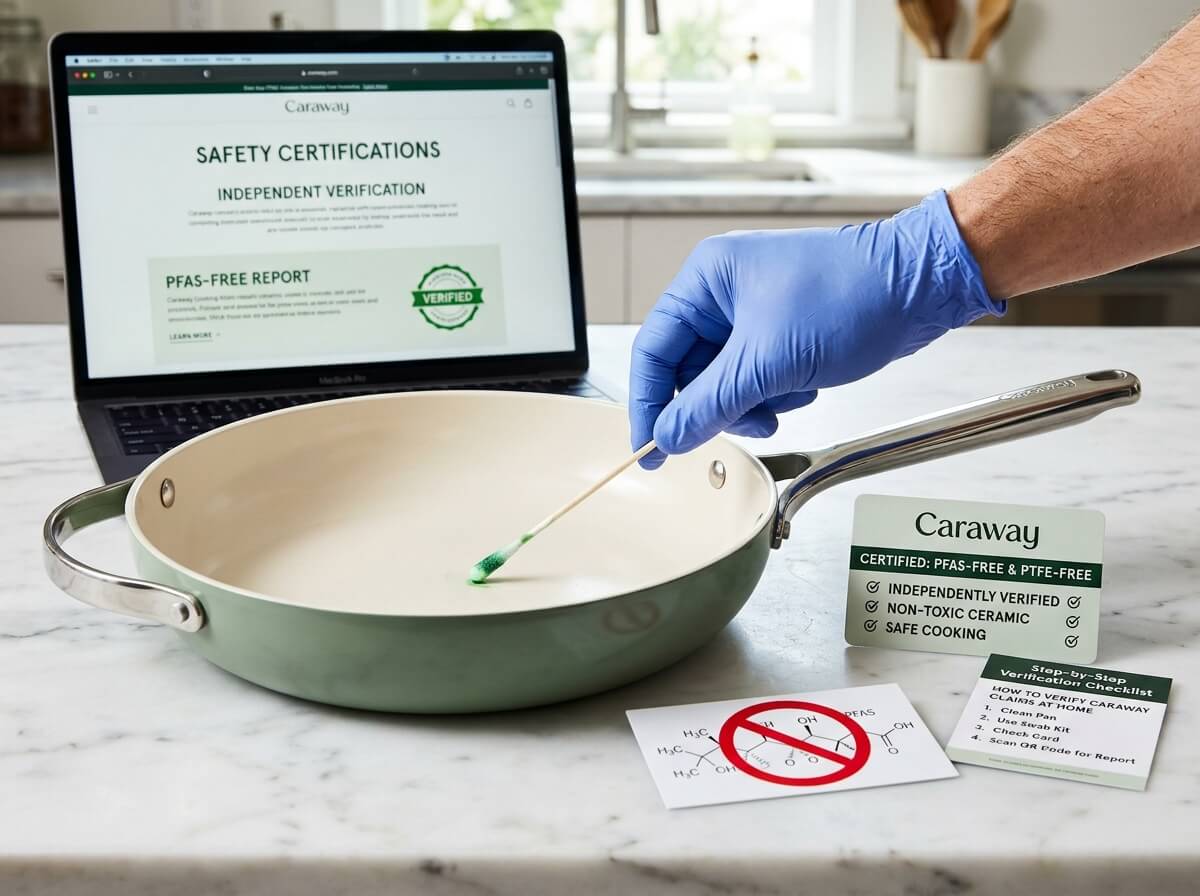
Caraway publishes third-party lab results for its cookware and bakeware, and this is the strongest part of its safety claim: the reports name an independent lab, list what was tested, and state the results, rather than asking customers to take the brand’s word for it.
What the Panel Actually Covers
| Category tested | What the lab checks for |
|---|---|
| PFAS (broad panel) | Over 200 individual PFAS compounds, including PFOA and other legacy fluorinated chemicals |
| Heavy metals | More than 20 metals, including lead and cadmium |
| Migration/leach testing | Food-simulating solutions, including acidic conditions meant to mimic tomato sauce or citrus |
| Regulatory compliance | California Proposition 65 limits for lead and cadmium |
Every report lists the methods used and the detection limits reached, which is the level of detail that separates an actual test from a marketing claim.
How to Pull Up the Reports Yourself
- Go to Caraway’s published third-party testing page and locate the product line you own or are considering.
- Open the linked report for that specific collection — cookware, bakeware, and other product lines are tested and reported separately.
- Check the report for three things: the name of the testing lab, the exact list of substances screened, and the stated detection limit for each result.
- Compare that list against what you’re specifically worried about — a report that screens for PFAS and heavy metals says nothing about, for example, titanium, unless titanium is named on the list.
- Repeat the same four-step check for any other brand’s published testing page — see how Caraway’s testing stacks up against GreenPan’s using this same checklist.
The 2025 NAD Ruling — What Was Actually Confirmed
In August 2025, the National Advertising Division of BBB National Programs ruled that Caraway had a reasonable basis for its “free of PFAS” and “non-toxic” claims, but not for the comparative claims in its advertising that named competing products as unsafe.
The challenge came from the Cookware Sustainability Alliance, a coalition of cookware manufacturers whose members include brands using PTFE-based coatings.
Claims NAD Upheld vs. Claims It Told Caraway to Drop
| Claim type | NAD’s finding |
|---|---|
| “Our cookware is free of PFAS” | Supported — Caraway provided a reasonable basis for this claim |
| “Our cookware is non-toxic” | Supported — Caraway provided a reasonable basis for this claim |
| “Competing nonstick cookware is toxic” | Not supported — NAD found insufficient evidence for this comparative claim |
| “Non-Toxic Swaps” campaign messaging | Recommended for discontinuation as an express comparative claim |
Why the Ruling Is Evidence For the PFAS-Free Claim, Not Against It
The Cookware Sustainability Alliance’s challenge was an opportunity for a self-regulatory body to reject Caraway’s core safety claim, and it didn’t.
NAD specifically separated the two types of claims Caraway was making: what its own cookware contains, and how its cookware compares to competitors’.
The first claim survived scrutiny from an industry group with a direct financial interest in tearing it down. The second claim did not, and Caraway agreed to pull the comparative advertising language NAD flagged.
The Counter-Evidence: Independent XRF Testing
Caraway’s lab panel and an independent researcher’s testing don’t fully agree, and understanding why requires knowing what each method actually measures the same question worth asking about whether ceramic cookware is safe overall, since this isn’t unique to one brand.
What Lead Safe Mama’s Testing Found
Tamara Rubin, who runs the consumer-testing site Lead Safe Mama and has conducted XRF testing on consumer products since 2009, reported detecting titanium along with trace levels of other metals including mercury, cobalt, and antimony in Caraway cookware using XRF instrumentation.
Separate reporting on quasi-ceramic cookware, broadly the category Caraway, GreenPan, and Our Place all belong to, noted that independent testing across these brands has pointed to titanium dioxide nanoparticles in the coating, a substance a 2016 study found can migrate into food under certain conditions.
Why XRF Results and Lab-Panel Results Don’t Always Agree
XRF (X-ray fluorescence) testing detects the presence of an element in a material’s surface composition.
Caraway’s published panel, by contrast, is largely built around migration testing, checking whether a substance leaches out of the coating into food under cooking conditions, not whether the element is present in the coating at all.
A material can contain titanium and still report “no detectable leaching” if the titanium stays locked inside the cured coating rather than transferring into food. Both results can be accurate at the same time; they’re answering different questions.
This is also why Caraway’s panel, built around PFAS and a defined list of heavy metals, doesn’t directly speak to titanium one way or the other unless titanium is named on the report you’re reading.
The Group SEB Lawsuit and What It Does (and Doesn’t) Change
In February 2026, Group SEB — a cookware manufacturer whose products include PTFE-coated lines — filed a lawsuit against Caraway in New York federal court, marking what legal observers have described as the first instance of one cookware company filing a PFAS-related greenwashing claim against a competitor.
What the Lawsuit Actually Alleges
- Group SEB’s complaint concedes that its own products use PTFE, a type of PFAS, for nonstick performance.
- The suit alleges Caraway’s marketing describes competitor products as toxic and capable of releasing harmful fumes, and that this messaging is false and misleading.
- It cites the 2025 NAD ruling as evidence that Caraway was told to stop similar comparative claims and, according to the complaint, continued running some of them regardless.
- The complaint argues that PTFE is chemically stable at normal cooking temperatures and that regulatory bodies, including the FDA and the Consumer Product Safety Commission, have not required warning labels on PTFE cookware.
- It also alleges that a hyperlink in Caraway’s marketing labeled as pointing to the American Cancer Society actually directed to an unrelated source that does not support a cancer-risk claim.
The Difference Between “We’re PFAS-Free” and “We’re Safer Than Them”
Group SEB’s lawsuit, like the NAD case before it, is built entirely around Caraway’s comparative marketing claims about what happens when you cook with a competitor’s pan, not around whether Caraway’s own cookware actually contains PFAS.
No party in either proceeding has disputed Caraway’s third-party test results showing its coating is free of detectable PFAS.
The legal risk sitting over Caraway right now is about how it talks about other companies’ products, which is a separate question from whether its own “PFAS-free” label is accurate.
If you’re deciding whether to trust the PFAS-free claim specifically, our full list of vetted non-toxic cookware brands applies this same three-source verification standard: a named lab, a specific substance list, and independent confirmation to every brand on it, not just Caraway.
FAQ
Is Caraway cookware actually PFAS-free?
Based on Caraway’s published third-party lab reports, its cookware coating tests below the detection limit for the specific panel of PFAS compounds screened, and this claim was separately upheld by the National Advertising Division in 2025.
No published testing — including independent XRF testing that found other metals — has contradicted the PFAS result specifically.
The claim is well-supported for the compounds actually tested, which is the standard any “PFAS-free” label should be held to.
Can I see Caraway’s real test reports myself?
Yes, Caraway publishes its third-party lab reports directly on its website, organized by product collection, with the testing lab named and the specific substances and detection limits listed for each result.
This is more transparency than most cookware brands offer, since many simply state “PFAS-free” without linking to any underlying report.
Checking the report yourself takes a few minutes and tells you exactly what was and wasn’t tested.
Is PFOA-free the same thing as PFAS-free?
No. PFOA is one specific compound within the much larger PFAS family of roughly 15,000 chemicals, so a product can be legitimately PFOA-free while still containing other PFAS compounds like PTFE.
This distinction matters enough that California and Colorado have both passed laws restricting “PFOA-free” marketing that implies a broader PFAS-free status.
Always check whether a claim names PFOA specifically or the full PFAS category before treating the two as interchangeable.
Should the Group SEB lawsuit change my buying decision?
Not on its own — the lawsuit challenges Caraway’s marketing about competitor products, not the accuracy of Caraway’s own “PFAS-free” claim about its own cookware.
The NAD reached the same conclusion in 2025: Caraway’s core safety claim held up, while its comparative advertising did not.
If your concern is specifically whether Caraway’s cookware contains detectable PFAS, the lawsuit doesn’t introduce new evidence on that question either way.