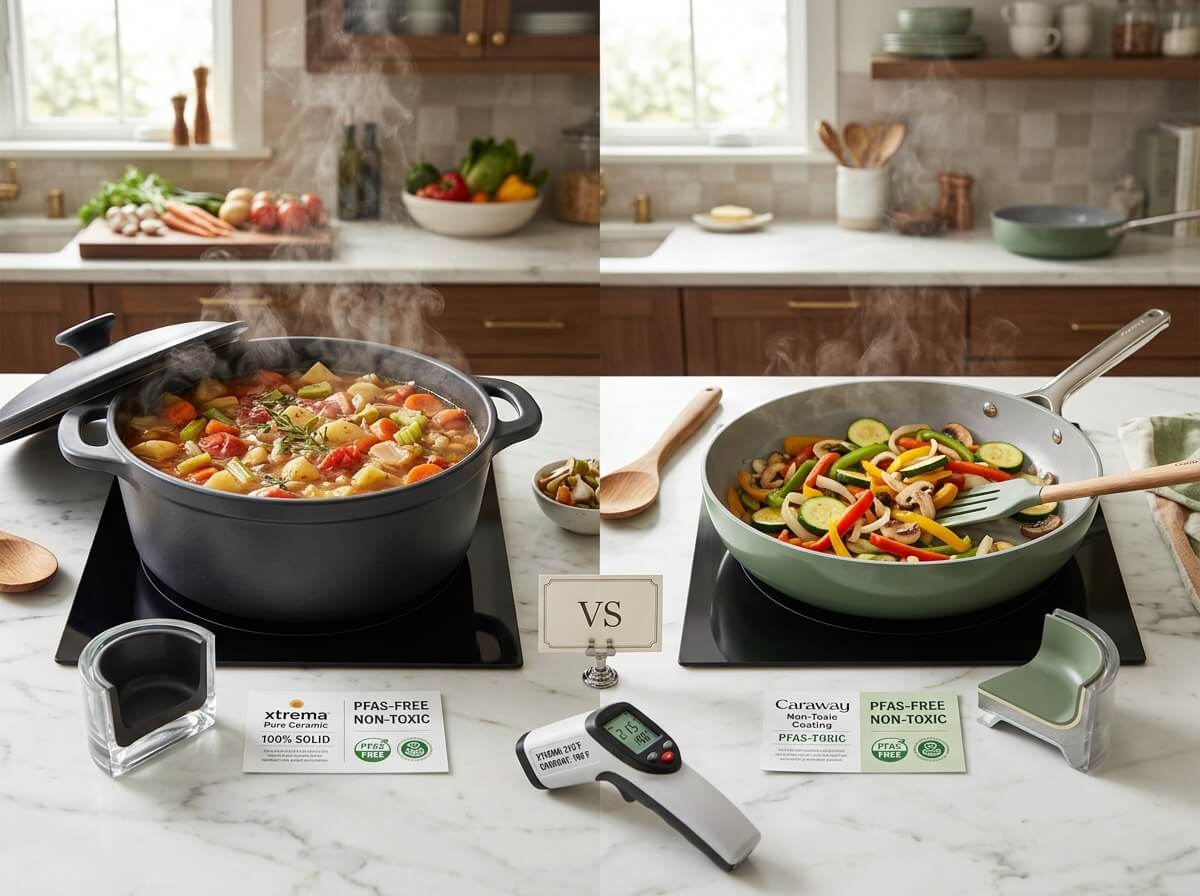
Xtrema is 100% solid ceramic with no metal core, while Caraway is a ceramic-coated aluminum pan, and that single construction difference is what drives nearly every other difference between them, from price to durability to how each brand proves its safety claims.
If you’re choosing between the two, the short version is this: Xtrema is built for buyers who want zero-metal construction and decades of use and are willing to pay more and cook more patiently for it, while Caraway is built for buyers who want fast, even heating and modern design at a lower price and are comfortable with a coating that eventually wears.
Xtrema vs Caraway: Key Differences at a Glance
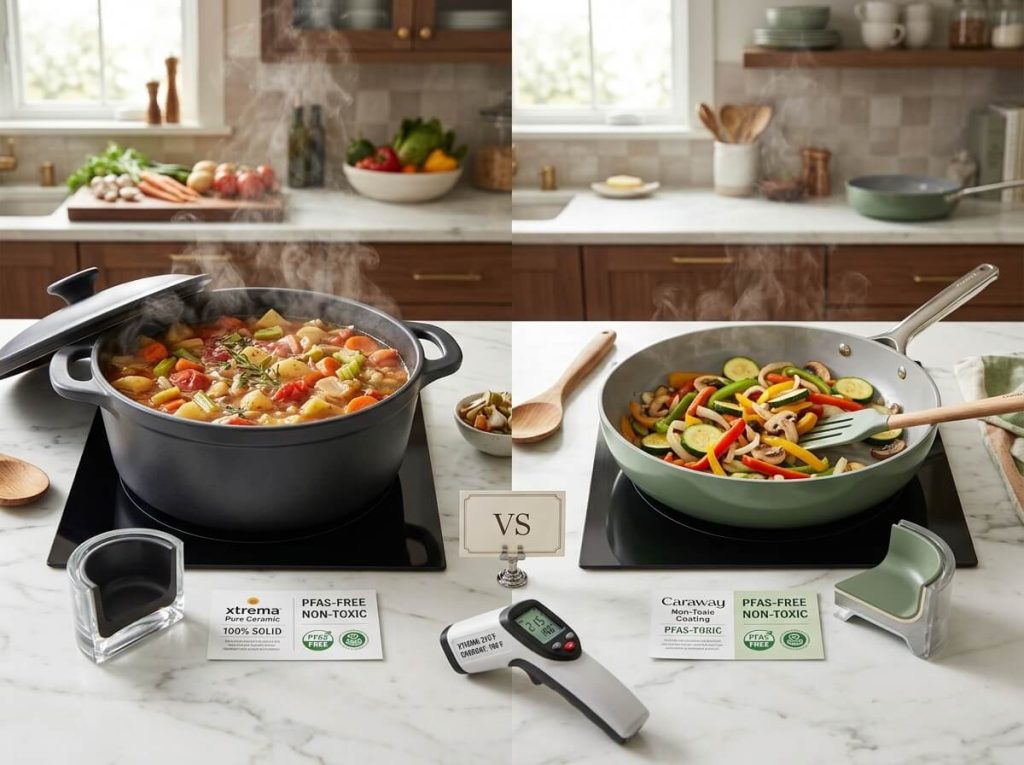
Before going deep on materials and testing, here’s how the two brands compare across the factors that matter most for a non-toxic cookware purchase.
For a wider set of options beyond these two brands, see our full list of the best non-toxic cookware.
| Factor | Xtrema | Caraway |
| Core material | 100% solid ceramic, no metal | Aluminum core with ceramic coating |
| Founded | 2007, by Rich Bergstrom | 2018, by Jordan Nathan |
| Oven-safe temperature | Up to 2,500°F | Up to 550°F |
| Broiler-safe | Yes | No |
| Induction-compatible | Not without an adapter | Yes |
| Typical set price | Roughly $270–$453 | Roughly $300–$550 (frequently discounted) |
| Warranty | 10-year warranty plus a forever replacement program | Standard limited warranty |
| Best for | Health purists, high-heat cooking, long-term durability | Everyday convenience, faster heating, design-forward kitchens |
What Are Xtrema and Caraway Made Of?
The core distinction between these two brands isn’t style or price; it’s what’s actually touching your food.
Xtrema is ceramic all the way through, while Caraway is a metal pan with a ceramic layer applied to the cooking surface.
That structural difference is why the two brands market themselves so differently and why they’re tested differently, too.
Xtrema’s 100% Ceramic Construction
Xtrema’s cookware contains no aluminum, no steel, and no other metal core; the entire vessel, from the outer wall to the cooking surface, is fired ceramic.
For background on how ceramic cookware safety is actually determined, it helps to know that “ceramic” cookware falls into two very different categories: solid ceramic, like Xtrema, and metal cookware with a thin ceramic-based coating, like Caraway.
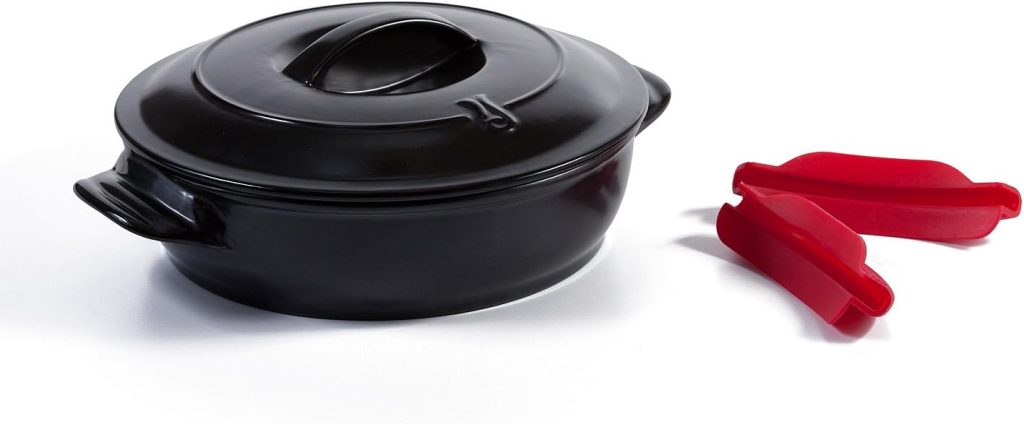
Xtrema is kiln-fired at temperatures up to 2,500°F, which is part of why it tolerates broiler heat and open-flame cooking that would damage a coated pan.
Because there’s no coating to wear away, the cooking surface a buyer gets on day one is, materially, the same surface they’ll have a decade later assuming the pan isn’t dropped or cracked.
Caraway’s Ceramic-Coated Aluminum Core
Caraway’s pans start with an aluminum body for fast, even heat conduction, then add a mineral-based, sand-derived ceramic coating over the cooking surface to create a non-stick finish, with stainless steel handles and a base plate.
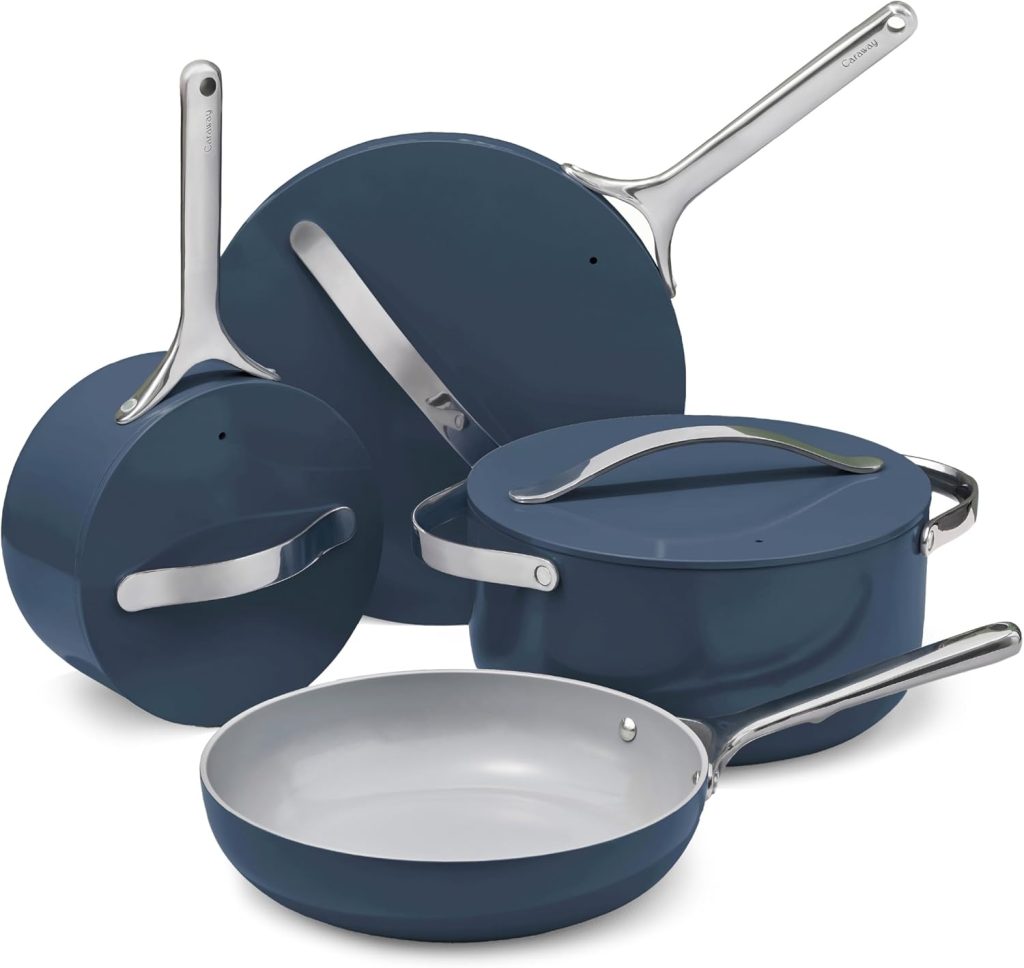
This construction is why Caraway heats up faster and responds more quickly to temperature changes than Xtrema; the aluminum core conducts, and the ceramic layer is only a thin, non-stick top layer rather than the entire structure of the pan.
The tradeoff is that, unlike Xtrema’s solid ceramic, this coating is a separate material bonded to the metal beneath it, and coatings are the part of any pan that eventually degrades with heat, scratching, and repeated use.
Is Xtrema Cookware Actually Non-Toxic?
Xtrema cookware does not leach detectable, unsafe levels of lead or cadmium into food under standard leach testing, though independent surface scans have detected trace heavy metals present in the glaze itself.
That distinction between metals that are present in a material and metals that actually leach out of it during cooking is the single most misunderstood part of the Xtrema safety conversation, and it’s worth walking through both sides of the evidence.
How Xtrema Tests for Lead and Cadmium
For the full picture, including lab methodology and results, see Xtrema’s full lead testing results.
Xtrema states that every shipment is tested for extractable lead and cadmium in accordance with California’s Proposition 65 standards, which the company describes as its baseline safety benchmark, with testing conducted by third-party laboratories in the U.S., Hong Kong, and China before products reach its Maryland warehouse.
In 2024, the independent research group Mamavation went a step further and sent Xtrema cookware to an EPA-certified laboratory for acid-bath leach testing — a 24-hour test designed to simulate years of normal cooking use and measure exactly how much lead, if any, comes out of the cookware into food.
Mamavation funded this testing itself through ad and affiliate revenue rather than accepting payment from Xtrema, and Xtrema’s only involvement was donating cookware for the test.
Why XRF Testing Results Differ From Leach Testing
XRF (X-ray fluorescence) testing and leach testing answer two different questions, and confusing them is why Xtrema’s safety reputation looks contradictory online.
XRF testing is a surface scan: it can detect that a heavy metal like lead is present somewhere in a material, including in a glaze or a printed logo, but it cannot measure how much of that metal actually comes out of the product during normal use.
Leach testing does the opposite: it exposes cookware to acidic conditions similar to cooking and then measures what transfers into the liquid, which is the exposure that actually matters for food safety.
Critics using at-home or third-party XRF devices have found detectable lead in parts of Xtrema’s glaze and printed labeling, and those findings are accurate as far as they go.
But presence is not the same as exposure: multiple rounds of accredited leach testing, including Mamavation’s independent lab work, have found Xtrema’s cooking surfaces pass Prop 65 leaching limits.
If you’re evaluating any ceramic cookware brand’s safety claims, the practical takeaway is to ask specifically which type of test backs up the claim, since a “lead-free” marketing statement and a “passes leach testing” statement are not interchangeable.
Is Caraway Cookware Really PFAS-Free?
Caraway’s cookware and bakeware are formulated without PFAS, including PFOA and PTFE, and third-party lab testing supports that claim, though a 2025 regulatory decision required Caraway to stop implying its cookware is safer than competitors’ without stronger evidence for that specific comparison.
How Caraway Verifies Its PFAS-Free Claims
Caraway states that independent, accredited labs test the materials that touch food for over 200 types of PFAS as well as more than 20 heavy metals, including lead and cadmium, and that it publishes these test reports on its website rather than only summarizing the results.
The company also states its products meet Prop 65 and relevant food-contact standards for heavy metals under normal cooking conditions.
Reviewers who have contacted Caraway directly, including sites unaffiliated with the brand, report receiving copies of third-party lab results showing no PFAS or heavy metals detected in the tested products.
For anyone who wants to check this rather than take a brand’s word for it, here’s how to verify Caraway’s PFAS-free claims yourself.
What the 2025 NAD Ruling Means for Caraway’s Safety Claims
In August 2025, the National Advertising Division, a self-regulatory body operated by BBB National Programs, reviewed a challenge brought by the Cookware Sustainability Alliance.
This coalition includes traditional non-stick manufacturers.
NAD’s conclusion was two-sided: it found Caraway had a reasonable basis to claim its own cookware is free of PFAS and non-toxic, but it did not find sufficient evidence to support Caraway’s comparative claims suggesting that competitor cookware, including traditional PTFE-coated pans, is unsafe.
NAD recommended that Caraway discontinue or modify that comparative messaging.
Separately, in February 2026, Groupe SEB and Meyer — the companies behind brands like All-Clad, T-fal, and Farberware — filed a federal lawsuit against Caraway over related marketing claims, a dispute that was still unresolved as of this writing.
None of this changes the underlying test data on Caraway’s own products; it does mean shoppers should treat Caraway’s claims about its own cookware and its claims comparing itself to competitors as two separate things with different levels of supporting evidence.
Durability: Which Cookware Lasts Longer?
Xtrema’s solid ceramic construction generally outlasts Caraway’s ceramic coating, but it fails differently: Xtrema can crack or shatter if dropped, while Caraway’s non-stick performance gradually degrades with scratching and heat over years of normal use.
| Durability factor | Xtrema | Caraway |
| Failure mode | Cracking or shattering from impact | Gradual coating wear and non-stick loss |
| Expected lifespan with care | Decades | Several years, depending on use |
| Scratch resistance | High (no coating to scratch through) | Moderate; can chip or scratch over time |
| Sudden temperature changes | Not recommended (risk of thermal shock) | Better tolerated due to aluminum core |
Xtrema’s Shatter Risk vs. Caraway’s Coating Wear
Xtrema’s biggest durability weakness is impact, not wear: because it’s solid ceramic rather than a metal pan, dropping it on a hard floor or knocking it hard against another pan can crack or shatter it, in a way that a metal-core pan simply won’t.
Short of physical impact, though, Xtrema’s cooking surface doesn’t degrade the way a coating does, since there’s no separate coating layer to scratch through or wear off.
Caraway’s failure mode is the opposite: the pans themselves are structurally durable thanks to the aluminum core, but the ceramic coating that gives them their non-stick performance is a wear item, and even with careful use, the right utensils, moderate heat, and gentle cleaning, coatings degrade gradually and eventually need replacing.
Warranty and Replacement Policies
| Policy | Xtrema | Caraway |
| Trial period | 30-day trial | Standard return window |
| Warranty length | 10-year warranty | Limited warranty (shorter than Xtrema’s) |
| Replacement program | Ongoing “forever replacement” program referenced by the brand | Standard warranty replacement process |
Cooking Performance and Heat Compatibility
Caraway heats faster and responds more quickly to temperature changes because of its aluminum core, while Xtrema takes longer to heat but holds and radiates heat more evenly once it gets there, and tolerates far higher temperatures.
| Performance factor | Xtrema | Caraway |
| Heating speed | Slower to heat | Faster to heat |
| Heat responsiveness | Low (thick ceramic retains heat) | High (aluminum responds quickly) |
| Max oven temperature | 2,500°F | 550°F |
| Broiler-safe | Yes | No |
| Induction-compatible | No, without an adapter | Yes |
Stovetop Heat Responsiveness
Because Xtrema’s walls are thick, solid ceramic, the cookware takes longer to come up to temperature and cools down more slowly once removed from heat, which makes it less ideal for quick tasks like sautéing garlic or cooking eggs where fast, precise temperature control matters.
That same thickness, however, means Xtrema holds and distributes heat very evenly once hot, which is well suited to searing, braising, and long, steady cooking.
Caraway’s aluminum core does the opposite: it heats and cools quickly, which is convenient for fast weeknight cooking, but that responsiveness comes from the same metal core that the ceramic coating exists to cover and protect.
Oven and Broiler Safety
Xtrema’s ceramic construction tolerates oven and broiler heat up to 2,500°F, well beyond what any home appliance produces, which is why it’s rated broiler-safe.
Caraway’s cookware is oven-safe up to 550°F but is not rated for broiler use, since the coating and aluminum construction aren’t built to withstand direct high-intensity heat the way solid ceramic is.
Price and Value Comparison
Caraway is the lower-cost option for most buyers, with sets typically starting cheaper than Xtrema’s, but Xtrema’s higher price is tied directly to a construction method and warranty designed to make individual pieces last far longer.
| Price factor | Xtrema | Caraway |
| Typical set price | About $270–$453 | About $300–$550, often discounted |
| Price per piece | Higher | Lower |
| What you’re paying for | Solid ceramic construction, 10-year warranty | Design, aluminum core, faster everyday convenience |
Cost Per Piece and Set Options
Xtrema’s individual pans and small sets tend to run more expensive than Caraway’s comparable pieces, and building a full kitchen of Xtrema cookware, since it’s typically sold in smaller sets, can mean piecing together multiple purchases.
Caraway sells larger all-in-one sets, frequently discounted from list price, that outfit a kitchen in a single purchase at a lower overall cost than doing the same with Xtrema.
Is the Extra Cost of Xtrema Worth It?
Xtrema is worth the extra cost specifically for buyers who plan to keep their cookware for a decade or more and who prioritize zero-metal construction over convenience for anyone buying cookware to replace every few years anyway, or who values fast everyday cooking over maximum heat tolerance, Caraway’s lower price is the better value.
The clearest way to frame it: Xtrema’s price reflects a one-time investment backed by a 10-year warranty, while Caraway’s price reflects a shorter-lifespan product bought at a lower cost per use.
Which Should You Buy: Xtrema or Caraway?
Instead of asking which brand is the “overall winner,” it’s more useful to work through three questions in order, since the answer changes depending on what you weigh most heavily:
- Decide whether zero-metal construction matters more to you than everyday convenience. If you want cookware with no metal core at all, Xtrema is the only one of the two that offers that. If you’re comfortable with a coated metal pan as long as it’s independently tested and PFAS-free, Caraway qualifies.
- Decide which type of safety evidence you find more convincing. If leach testing — measuring what actually transfers into food — is the standard you trust, both brands have supporting data. If you’re uneasy about any detectable heavy metals showing up in XRF scans regardless of leaching results, that consideration weighs more heavily against Xtrema than Caraway.
- Decide based on how you actually cook. If you sear, broil, or cook at very high heat, Xtrema’s temperature tolerance is a real functional advantage. If you cook on induction, want faster everyday heating, or need a larger set at a lower price, Caraway fits better.
Choose Xtrema If…
- You want cookware with no metal core anywhere in its construction.
- You cook at high heat, sear frequently, or use your broiler regularly.
- You plan to keep the same pans for a decade or longer and want a long warranty behind that.
- You’re comfortable with slower heating in exchange for even, high-heat performance.
Choose Caraway If…
- You want faster, more responsive everyday heating for weeknight cooking.
- You cook on an induction stovetop.
- You want a complete cookware set at a lower total price.
- You’re comfortable with a coating that will eventually need replacing after several years of use.
If you’re shopping specifically for a household with young kids, it’s also worth checking our picks for best non-toxic cookware for babies, since feeding-age considerations can shift this decision in either direction.
Whichever direction you lean, the safety evidence for both brands is genuinely stronger than most cookware on the market; the choice between them comes down to construction philosophy and how you cook, not one brand being unsafe and the other safe.
If you want to see how Xtrema and Caraway stack up against other non-toxic options beyond these two, our full non-toxic cookware guide breaks down the rest of the field the same way.
FAQ
Is Xtrema or Caraway safer?
Both brands have third-party test data supporting their non-toxic claims, so neither is clearly “safer” in an absolute sense; they pass different, relevant tests for different reasons.
Xtrema has no metal core at all and passes independent leach testing for lead and cadmium, though XRF surface scans have detected trace heavy metals in its glaze.
Caraway’s aluminum-core, ceramic-coated construction has passed third-party testing for PFAS and heavy metals, though a 2025 regulatory ruling limited how it can compare itself to competitor brands.
The more useful question is which type of evidence and which construction approach you personally find more reassuring, since both have real safety data behind them.
Does Caraway’s cookware really contain no PFAS?
Yes, based on the third-party lab testing Caraway has published, its cookware and bakeware test negative for PFAS, including PFOA and PTFE, within the reporting limits of the testing methods used.
Independent reviewers who have contacted Caraway directly report receiving the same third-party lab reports the company publishes on its site, which cover a large panel of PFAS compounds and heavy metals.
Where Caraway has run into regulatory scrutiny is not on this underlying claim about its own products, but on comparative marketing suggesting competitor cookware is unsafe, which a 2025 advertising review found wasn’t adequately supported.
Can Xtrema cookware go on an induction stovetop?
Not directly; Xtrema’s cookware is 100% ceramic with no metal core, and induction cooktops require a magnetic metal base to generate heat, so Xtrema pans won’t work on induction without a separate interface disk or adapter.
This is one of the clearest functional differences between the two brands: Caraway’s aluminum-core construction is induction-compatible out of the box, while Xtrema’s solid-ceramic design, which is the same feature that gives it zero-metal purity, is what makes it incompatible with induction cooking.
Is Xtrema worth the higher price than Caraway?
Xtrema is worth the higher price specifically if you value zero-metal construction, extreme heat tolerance, and long-term durability enough to accept slower everyday heating and a smaller set size for the money.
If your priorities are faster stovetop performance, induction compatibility, or outfitting a full kitchen at a lower up-front cost, Caraway delivers more practical value for that spending, even though it will likely need replacing sooner than a well-cared-for set of Xtrema.
Ready to compare current prices and set options for both brands before you buy? Check the latest availability directly from Xtrema and Caraway to see which fits your kitchen and budget.