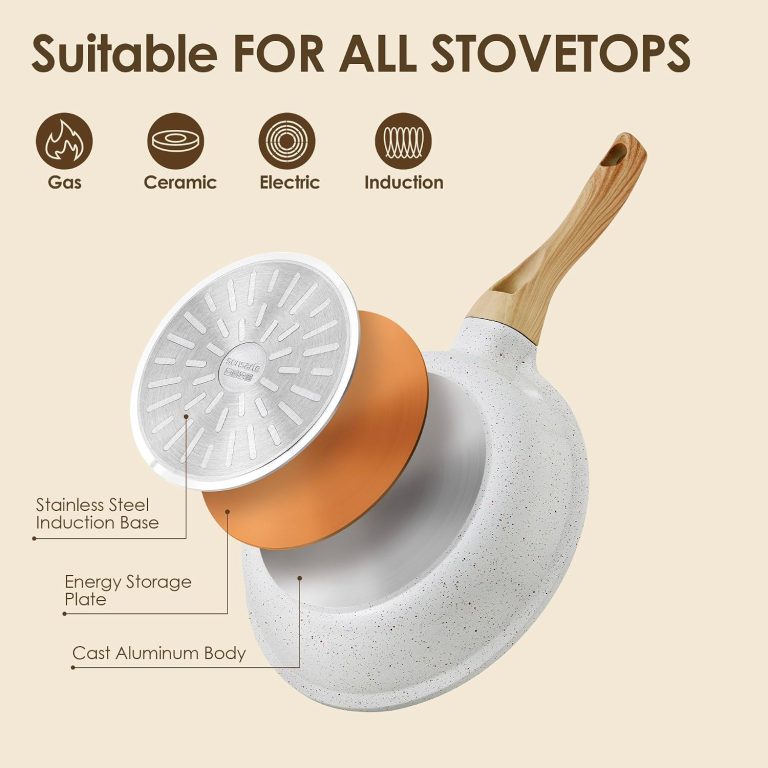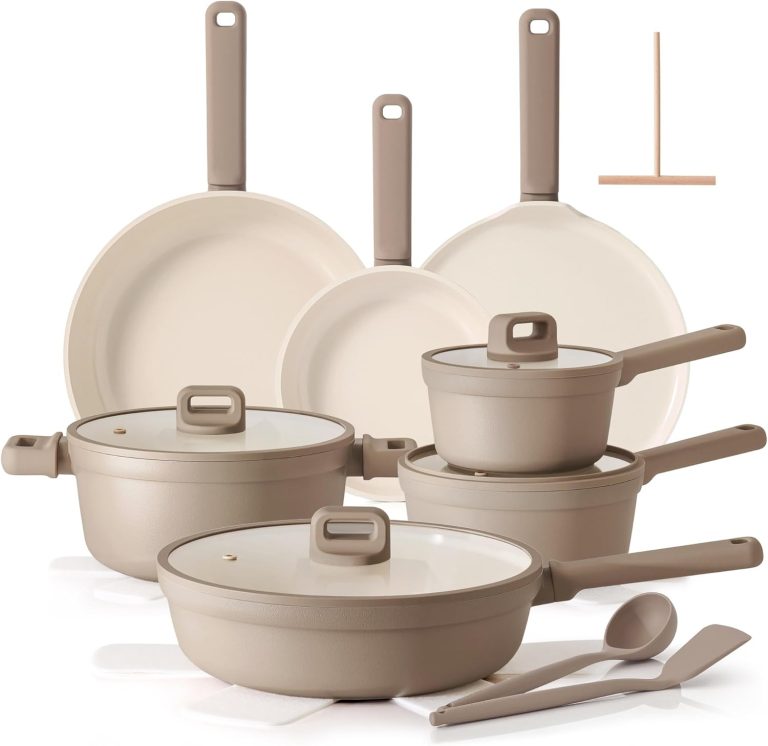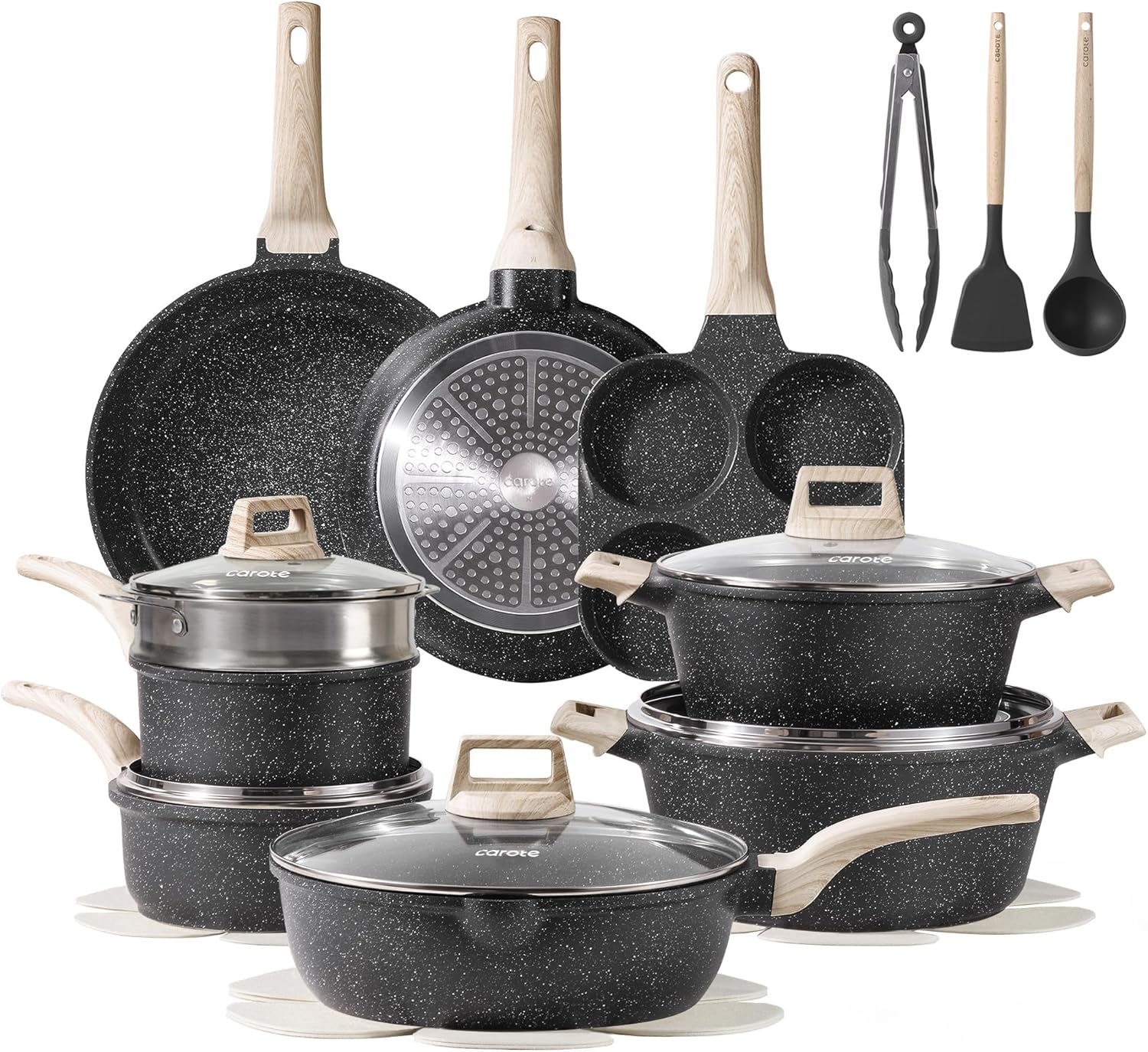
“Granite cookware” isn’t a material at all; it’s a marketing name for a speckled, stone-look finish, and that finish gets applied to three different coatings with three different safety profiles.
Some granite pans are traditional PTFE reinforced with mineral flecks.
Some are genuine PFAS-free ceramic. A few are porcelain enamel fused over metal. The name on the box won’t tell you which one you’re holding, but the checks below will.
Is Granite Cookware Non-Toxic?
Whether a specific granite pan is non-toxic depends entirely on which of three coatings it actually uses, not on the word “granite” itself.
PTFE-based granite coatings carry the same overheating and PFAS considerations as any Teflon-style nonstick.
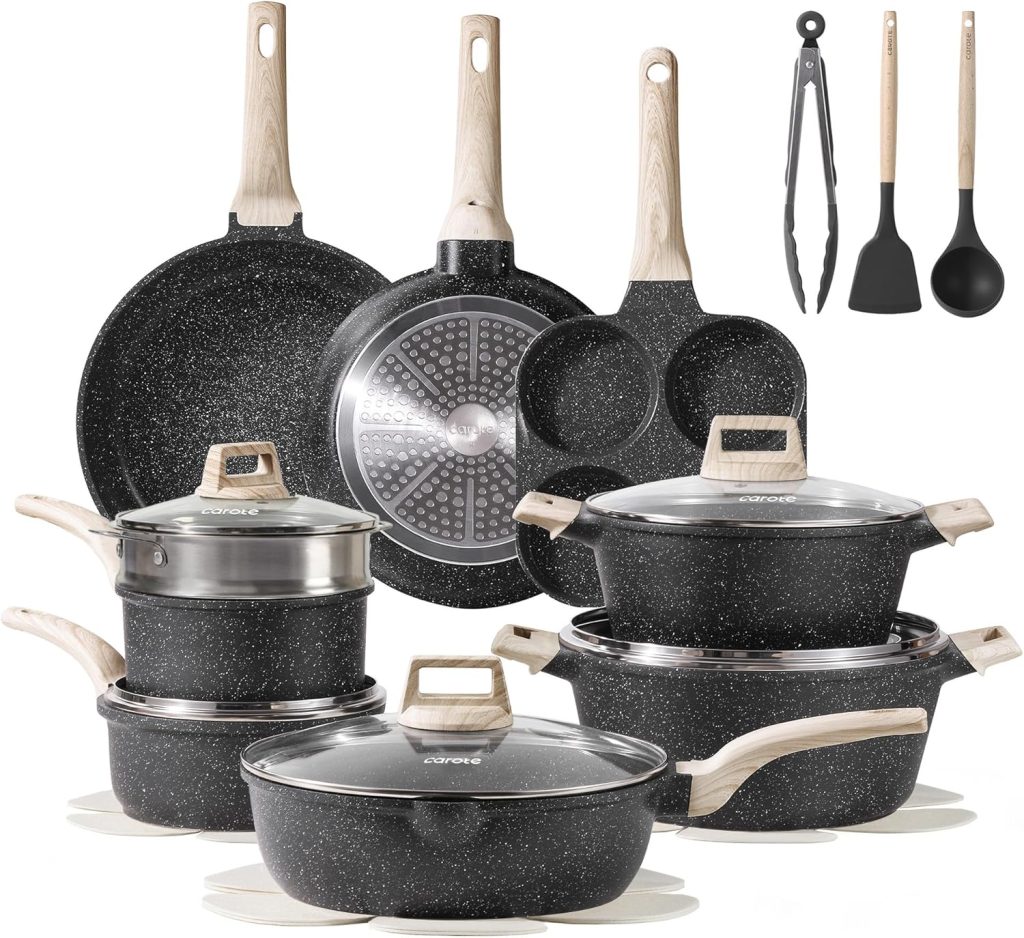
Genuine ceramic sol-gel granite-finish coatings are PFAS-free when made correctly.
Porcelain enamel granite cookware is chemically inert as long as the enamel surface isn’t chipped.
All three get sold under the same “granite” branding, sometimes by the same retailer in adjacent listings, so the product name gives you no information on its own.
“Granite” describes a look, not a material
Granite cookware is a marketing term for pots and pans with a speckled, mottled finish designed to resemble polished granite stone.
It is not made from actual granite. The term describes the visual pattern applied to the cooking surface, which can be created through several completely different manufacturing processes: adding mineral particles to a PTFE coating for texture and scratch resistance, applying a ceramic sol-gel coating with a similar speckled look, or finishing a metal pan with a mottled porcelain enamel glaze.
None of these processes are related to each other chemically, and none involve actual stone.
Why the same name covers three different coatings
Manufacturers use “granite” because it signals durability and a premium, stone-like feel, not because it describes a specific ingredient list.
That’s why a $30 granite-branded skillet from one manufacturer and a $30 granite-branded skillet from another can have entirely different coatings underneath the same marketing language.
The practical result is that “is granite cookware safe” doesn’t have one universal answer.
The real question is which coating a specific pan uses, and that requires checking the product’s own PFOA, PFAS, or PTFE claims directly rather than trusting the word “granite” to mean anything on its own.
What Granite Cookware Is Actually Made Of
Granite-branded cookware sold in the US market breaks down into three coating categories, and identifying which one you have starts with reading the specific chemical claims on the packaging or listing, not the general “non-toxic” marketing language.
PTFE-based granite coatings, the most common type
The most common type of granite cookware on the market uses a traditional PTFE coating reinforced with mineral or stone particles for added scratch resistance.
Manufacturers add these particles because bare PTFE scratches relatively easily, and the reinforcement extends the coating’s working life.
This type is often labeled “PFOA-free,” which is accurate and reflects a real change in how PTFE is manufactured since 2013, but PFOA-free does not mean PFAS-free.
PTFE itself is a member of the broader PFAS chemical family, so a PFOA-free granite pan can still be a PTFE-based product with the same high-heat fume considerations as any other Teflon-style coating.
Ceramic sol-gel granite-look coatings
Some granite-branded cookware uses a genuine ceramic sol-gel coating, built from a silica-based liquid that cures into a hard, glass-like surface, with mineral particles added for the speckled granite look rather than for reinforcing a fluoropolymer.
When manufactured correctly and marketed with a specific “PFAS-free” or “PTFE-free” claim rather than just “non-toxic,” this type is chemically comparable to any other ceramic nonstick coating on the market, and it’s worth reading whether ceramic cookware is actually safe in more depth to understand the tradeoffs of this coating family in general, since durability and heat tolerance vary by brand even within the ceramic category.
Porcelain enamel granite cookware
A smaller category of granite cookware uses porcelain, or vitreous, enamel fused onto a metal core, usually cast aluminum or carbon steel, at high temperature.
This is the same basic coating technology used on enameled cast iron and Dutch ovens: a glass-like layer that’s chemically stable and non-reactive with food when the surface is intact.
The main risk with this type isn’t chemical leaching under normal conditions; it’s mechanical damage.
A chipped or cracked enamel surface exposes the metal core underneath, which changes the safety picture the same way it does for ceramic versus cast iron cookware more broadly.
Is GraniteStone Cookware Safe? A Documented Example of the Confusion
One specific, well-known granite cookware brand illustrates exactly why checking the coating claim matters more than checking the brand name.
Before trusting any brand’s non-stick claims, it helps to know how to check any pan for PFAS directly from the product’s own specifications rather than its marketing name.
What independent sourcing found about GraniteStone’s coating
TheRationalKitchen, an independent site that tracks whether specific nonstick cookware products use PTFE or ceramic coatings, has identified GraniteStone, one of the more widely sold granite-branded cookware lines, as using a PTFE coating rather than a ceramic one.
That finding runs counter to what a lot of buyers assume when they see a stone-textured finish marketed as an alternative to old-fashioned Teflon.
To be clear about what this does and doesn’t mean: it’s one documented finding from an independent source tracking a specific product line at a specific point in time, not a first-party lab result, and coatings can change between product runs or across a brand’s different collections.
It’s a real, sourced example, not a blanket claim about every product GraniteStone currently sells.
Why this matters beyond one brand
The GraniteStone example matters less as a verdict on one brand and more as proof that the “granite equals safer than Teflon” assumption doesn’t hold up even for well-known, widely available products.
If a major, heavily marketed granite brand can carry a PTFE coating behind stone-look branding, the same is true, or more likely, for the many smaller and unbranded granite sets sold directly through Amazon and Walmart listings.
The lesson transfers directly: check the specific PFOA, PFAS, or PTFE claim on each listing rather than assuming the granite name itself signals anything about the coating.
What Happens If Granite Cookware Overheats or Gets Scratched?
What actually happens to a granite pan under heat or physical damage depends entirely on which of the three coating types it uses, not on how the pan is marketed.
Overheating risk depends entirely on coating type
A PTFE-based granite coating can begin releasing fumes when a pan is left empty on high heat above roughly 500°F, the same threshold that applies to any traditional Teflon-style nonstick.
A genuine ceramic sol-gel granite coating is generally more heat-stable and doesn’t carry that same fume risk, since it isn’t a fluoropolymer.
A porcelain enamel granite pan doesn’t degrade chemically at normal cooking temperatures at all, since enamel is a fired glass coating rather than a polymer, but it can crack under sudden extreme temperature changes, like running a hot pan under cold water.
When to replace a granite pan
- Replace a PTFE-based granite pan once the coating shows any flaking, peeling, or deep scratching, since damaged PTFE coatings can shed particles and lose their protective barrier over the metal underneath.
- Replace a ceramic granite pan once its nonstick performance drops off noticeably even with adequate oil, which is the typical sign that the ceramic surface has worn thin, rather than waiting for visible damage.
- Replace an enamel granite pan as soon as any chip or crack exposes the metal core underneath, since that’s the point where the coating no longer fully separates food from the base metal.
- If you can’t confirm which coating type your pan actually uses, treat it as PTFE-based for heat-safety purposes, meaning avoid preheating it empty on high heat, until you’ve checked the manufacturer’s specific claim.
Granite vs. Other “Reinforced” Nonstick Coatings
Granite isn’t the only cookware category where a marketing name obscures the actual coating chemistry underneath, and understanding the pattern once makes it easier to evaluate similar categories.
Granite vs. ceramic cookware
| Feature | Granite-branded cookware | Ceramic-branded cookware |
| What the name describes | A speckled, stone-look finish | A specific coating chemistry (sol-gel, silica-based) |
| Coating chemistry | Varies: PTFE-reinforced, ceramic, or enamel | Consistently ceramic sol-gel |
| PFAS status | Depends entirely on the specific product | Genuinely PFAS-free when correctly made and labeled as such |
| How to verify | Check the product’s specific PFOA/PFAS/PTFE claim | Check for a specific PFAS-free or PTFE-free claim, since “ceramic” alone is also sometimes misused in marketing |
Granite vs. diamond coating, same naming problem, different marketing
“Diamond coating” cookware has the identical structural issue as granite: the name describes a texture or reinforcement additive, not a base chemistry.
Diamond-branded pans come in at least three forms: PTFE reinforced with diamond particles, ceramic reinforced with diamond particles, and vacuum-brazed cookware where actual diamond crystals are bonded directly to bare metal with no polymer coating at all.
Those three versions have meaningfully different safety profiles, and “diamond” in the product name doesn’t distinguish between them any more than “granite” does.
For a closer look at how these compare, see our breakdown of diamond coating pan vs ceramic coating.
Granite vs. titanium, checking the coating, not the name
“Titanium cookware” carries a similar ambiguity, though the underlying question is slightly different.
Some titanium-labeled cookware is genuinely titanium, either solid titanium or a titanium-stabilized stainless steel base, which is inert and doesn’t involve a coating at all.
Other titanium-labeled cookware is really a standard nonstick coating with titanium particles added for hardness and scratch resistance, which puts it back in the same PTFE-versus-ceramic question as granite and diamond coatings.
Our guide to whether titanium cookware is non-toxic breaks down how to tell these two very different products apart before buying.
Granite vs. stainless steel, coated surface vs. no coating at all
Stainless steel sidesteps the entire granite naming problem because it isn’t a coating in the first place.
A genuine 18/10 stainless steel pan has no applied nonstick layer to identify or degrade over time, so there’s no PTFE-versus-ceramic question to answer for it the way there is for every granite, diamond, or titanium-coated product.
The tradeoff is performance rather than safety: stainless steel requires more oil and technique to avoid sticking than any nonstick coating, granite included.
For a full side-by-side look at how these two categories actually compare in daily cooking, see our guide to granite cookware vs stainless steel.
If you’d rather skip the guesswork on coating chemistry entirely, our best non-toxic cookware guide highlights brands that make a specific, verifiable PFAS-free claim on every product line, so you’re checking one clear label instead of decoding what “granite” means for a given pan.
FAQ
Is granite cookware the same as Teflon?
Sometimes, but not always. Granite is a marketing term for a speckled, stone-look finish, and one of the most common ways manufacturers achieve that look is by adding mineral particles to a traditional PTFE coating, which is the same base chemistry as Teflon.
Other granite-branded pans use a genuine ceramic coating instead, which is chemically unrelated to PTFE.
The only way to know which type a specific pan uses is to check its stated PFOA, PFAS, or PTFE status directly, since the word “granite” alone doesn’t indicate either one.
Is granite cookware safe if it’s scratched?
It depends on the coating type, and the risk level is different for each one.
A scratched PTFE-based granite coating can flake and lose its protective barrier over the metal base, similar to any damaged Teflon pan.
A scratched ceramic granite coating typically loses nonstick performance before it poses a direct safety concern, though continued use on a worn surface isn’t ideal.
A chipped enamel granite pan is the most direct concern, since a crack exposes the metal core underneath immediately.
If you’re not sure which coating your pan uses, treat visible damage as a reason to replace it rather than keep using it.
Is ceramic cookware safer than granite cookware?
Ceramic cookware that’s specifically labeled PFAS-free is generally a safer bet than granite cookware in general, simply because “ceramic” as a marketing term is more consistently tied to one coating chemistry than “granite” is.
Granite-branded cookware can be PTFE-based, ceramic-based, or enamel-based depending on the specific product, so buying “ceramic” narrows the range of possibilities more reliably than buying “granite” does.
That said, a genuine ceramic-coated granite pan and a standard ceramic pan are chemically comparable, so the safer choice really comes down to checking the specific coating claim rather than choosing between the two category names.
Is granite cookware safe for baby food?
A granite pan with a confirmed PFAS-free ceramic coating or an intact porcelain enamel surface is a reasonable choice for preparing baby food, since neither involves the fume risk associated with overheated PTFE.
A PTFE-based granite pan is a less ideal choice for this specific use case, particularly if it’s used daily for reheating and pureeing at higher heat than the coating is rated for.
Since granite branding alone doesn’t confirm which coating you have, check the specific PFAS or PTFE claim before choosing a granite pan for this purpose, or see our dedicated guide to non-toxic cookware for baby food for options with a confirmed coating type from the start.