Plain white Corelle is lead free, but not every piece with the Corelle name on it is.
Independent lab testing shows a clear pattern: the glass itself has consistently tested clean across decades of production, while anything printed, painted, or glazed on top of that glass, including some pieces sold today, has produced very different results.
If you’re trying to figure out whether your specific set is safe, the material and the decoration matter more than the brand name alone.
For a broader view of how other manufacturers stack up, our full brand-by-brand lead safety guide covers more than 20 dinnerware brands, all using the same standard.
Plain White Corelle Is Lead Free — Here’s Why
Undecorated white Corelle has tested negative for lead, cadmium, arsenic, and mercury in independent lab testing, and that result holds across both older and current production.
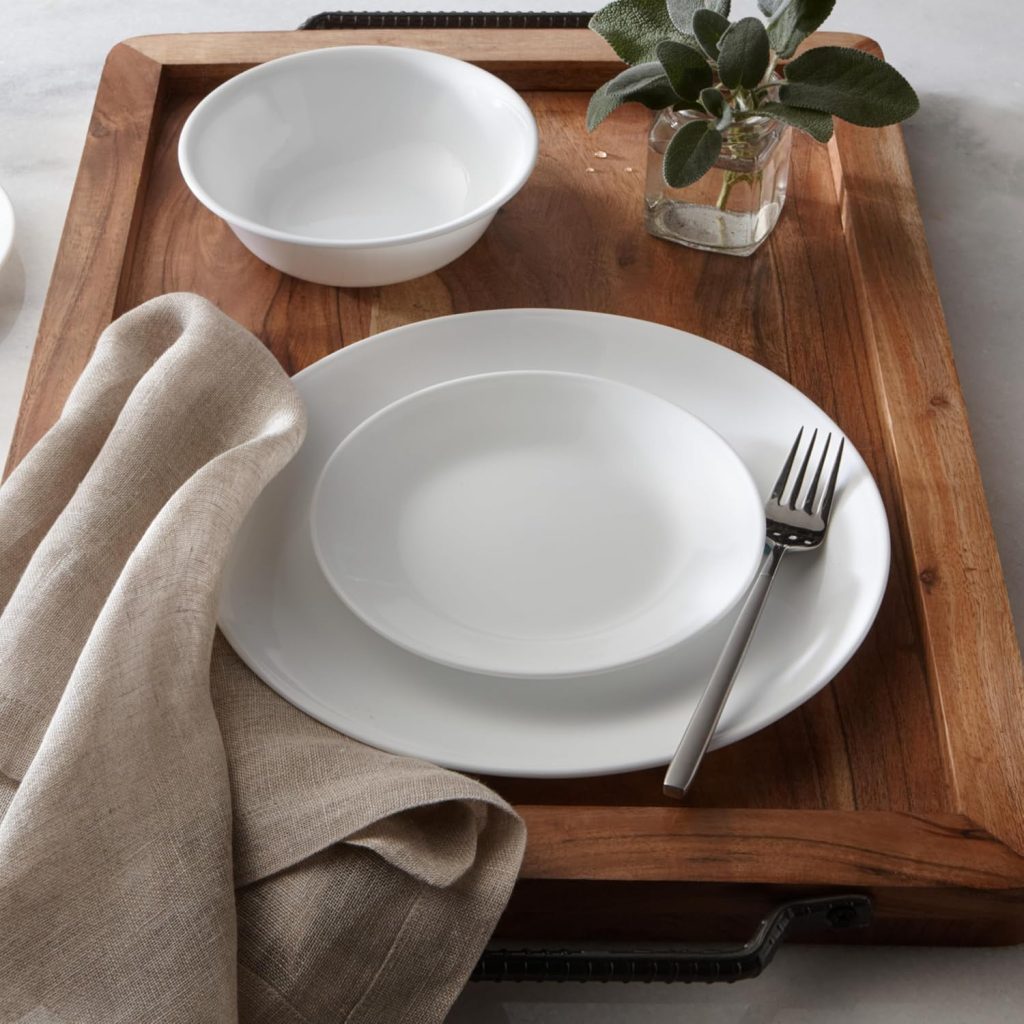
The reason comes down to what the white color actually is. Corelle’s white isn’t a paint or glaze sitting on top of the glass; it’s the color of the glass itself.
For more on how this compares to other materials, see how glass, ceramic, and stoneware compare for lead risk, which explains why glass-based dinnerware tends to have a more consistent safety profile than painted ceramics.
What Vitrelle Glass Actually Is
Vitrelle glass is a laminated glass material Corning developed in the late 1960s, built from three fused layers: an opaque colored core sandwiched between two thin, clear outer layers.
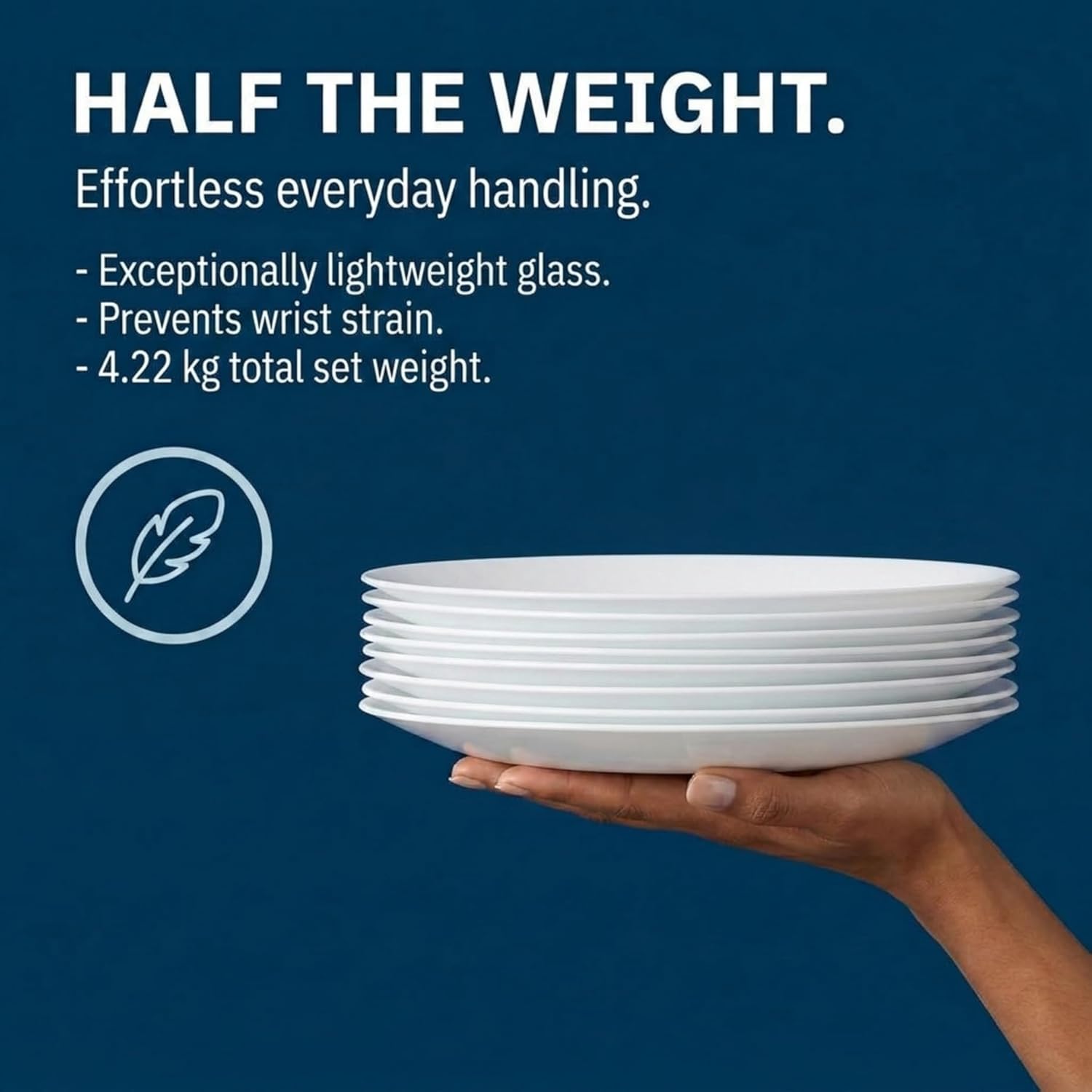
The lamination process fuses all three layers at high temperature, which is what gives Corelle dishes their signature combination of light weight and chip resistance.
Because the white (or other base color) comes from the core layer of the laminate rather than a surface coating, there’s no separate glaze or paint layer for lead to hide in on an undecorated piece.
That’s structurally different from a ceramic plate, where a clear or colored glaze is applied over a clay body and fired separately, creating a distinct layer where lead-based pigments have historically been used.
Independent Test Results on Plain White Corelle
| Piece Tested | Era | Lead / Cadmium / Arsenic / Mercury Result | Verdict |
|---|---|---|---|
| Plain white Corelle plate, current logo | 2019–2020 production | Negative for all four metals | Safe by all standards |
| Plain white Corelle medium bowl, current logo | 2019–2020 production | Negative for all four metals | Safe by all standards |
| Corelle Coordinates plain white porcelain mug | Current production | 24 ppm lead | Safe by all standards |
A “negative” or “non-detect” result means the testing instrument found no measurable amount of that metal, which is the cleanest possible outcome a lab test can return.
These results are specific to plain, undecorated pieces; once a pattern, stripe, or colored band is added, the material changes from pure Vitrelle glass to glass plus an applied decoration, and that decoration needs to be evaluated separately.
Corelle Confirmed Lead in Pre-2005 Patterned Dishes — Here’s What They Said
Corelle’s parent company has publicly confirmed that lead was used in the decorating process for its patterned dishware before the mid-2000s, and it made this confirmation directly to customers rather than through a third party.
This is one of the more clearly documented brand admissions in the dinnerware industry, which makes it worth understanding precisely rather than relying on a secondhand summary.
The Statement, and What It Actually Covers
In December 2019, a customer inquiry about lead in older Corelle patterns became public after the company’s response was shared and went viral.
Corelle’s customer service reply stated plainly that before the 1990s, virtually all glass and ceramic ware made anywhere in the world contained lead as an ingredient in decorating fluxes and glazes, and that all Corelle products have been lead-free since the mid-2000s.
The company recommended that older, patterned pieces be used as decorative items rather than for food.
That recommendation resurfaced in a 2022 news story after the original exchange went viral again, with a spokesperson reiterating that anyone who owns Corelle dinnerware made before 2005 should consider removing it from everyday kitchen use due to concerns about high lead levels.
It’s worth being precise about what this was: a voluntary manufacturer recommendation, not a formal recall issued by the Consumer Product Safety Commission.
Separately, Corelle’s own current FAQ page states that further testing on specific pre-2000 products found they comply with today’s FDA lead-safety regulations because the decoration was encapsulated in glass at high firing temperatures, which the company says limits how much lead can migrate to food even where a small amount was originally present.
That’s a narrower and more recent claim than the blanket “use as decorative only” guidance, and independent testing on several other vintage patterns, covered in the next section, still shows very high lead readings, so the safest approach is to check your specific pattern rather than rely on either statement alone.
Which Years and Product Types It Applies to
- The concern applies to patterned or decorated dishware, not to plain, undecorated white Vitrelle glass, which the company’s own statements never flagged as a lead source.
- It applies primarily to production before approximately 2005, the point at which Corelle states its lead-free reformulation was complete across its decorating process.
- It applies specifically to the decorating fluxes, glazes, and decals applied over the glass surface, not to the glass laminate itself.
- It does not apply as a formal government recall; no CPSC recall notice has been issued for vintage Corelle dinnerware, which means owners are not legally required to stop using these pieces, even though the manufacturer has recommended against food use.
- It is a separate issue from the ceramic mugs bundled with some Corelle sets, which are made from a different material and have their own testing history, covered later in this guide.
Which Corelle Patterns Have Tested Positive for Lead?
Several specific vintage Corelle patterns have tested at levels far above what’s considered safe for children’s items, and knowing the actual pattern names and readings is more useful than a general “vintage is risky” warning.
At the same time, independent testing has also turned up a result on a current-production piece that complicates the assumption that anything sold today is automatically safe.
Vintage Floral and Decorative Patterns
| Pattern | Approximate Era | Lead Reading | Other Metals Detected | Verdict |
|---|---|---|---|---|
| Meadow | Vintage | 16,700 ppm | Cadmium, mercury, antimony | Unsafe for food use |
| Pink Roses & Black Trim | c. 1990 | 3,536 ppm | Cadmium | Unsafe for food use |
| Blue & Yellow Floral with Butterflies | Vintage | 41,500 ppm | Cadmium | Unsafe for food use |
| Spice of Life | Vintage | 42,900 ppm | 557 ppm cadmium | Unsafe for food use |
Every pattern in this table tests well above the 90 ppm benchmark used for children’s items, in several cases by a factor of several hundred.
Each of these patterns also tested positive for cadmium, which reinforces that decorated vintage Corelle carries a multi-metal risk, not just a lead concern in isolation.
The Modern-Pattern Exception Nobody Talks About
| Piece | Era | Lead Reading | Verdict |
|---|---|---|---|
| Corelle Coordinates plain white porcelain mug | Current production | 24 ppm | Safe by all standards |
| Corelle Coordinates white stoneware dish with black stripe | Current production | 92 ppm | Right at the edge of the children’s-item threshold |
| Corelle Coordinates white porcelain mug with black stripe | Current production | 6,300 ppm | Unsafe by the children’s-item standard |
These three pieces are not vintage. They come from a current Corelle collection, tested side by side, and the results tell a more precise story than “old bad, new good.”
The plain mug and the striped mug are the same current product line, made at the same time, and the only meaningful difference between them is the applied black stripe decoration; yet one tests at a level considered safe by every standard and the other tests at more than 70 times that level.
This is the clearest available evidence that the real variable in Corelle’s lead risk is whether a piece carries applied decoration, not simply how old it is.
A current-year purchase decorated with any pattern, stripe, or colored band should not be assumed safe purely because it was bought new.
Are Corelle Mugs Lead Free?
Corelle mugs are not automatically covered by the same safety profile as Corelle’s glass plates and bowls, because many mugs sold alongside Vitrelle glass dinnerware sets are made from ceramic or stoneware rather than Vitrelle glass itself.
That material difference matters more than the shared brand name on the box.
Why Mugs Test Differently Than Plates and Bowls
Corelle’s Vitrelle glass technology is specific to the flat, laminated glass pieces — plates, bowls, and platters.
Many Corelle dinnerware sets are bundled with coordinating mugs made from ceramic or stoneware instead, which use a different manufacturing process involving a fired clay body and a separately applied glaze.
That glaze is exactly the kind of layer where decorative pigments, including lead-based ones, have historically been used, which is part of why an independent tester who has evaluated multiple Corelle sets has specifically advised keeping the plain glass dishes from a set while discarding the ceramic mugs that came packaged with it, if the goal is to avoid lead entirely.
The plain porcelain mug and striped porcelain mug results in the table above are a direct illustration of this: both are mugs, not glass Vitrelle pieces, and their results varied by more than 250-fold based on decoration alone.
What to Do If Your Set Came with Ceramic Mugs
- Check the actual material of each piece in your set rather than assuming uniform safety across the whole box, since Vitrelle glass plates and ceramic mugs are different materials with different risk profiles even when sold together.
- Prioritize a plain, undecorated mug if you have a choice, since the tested plain Corelle Coordinates mug came back at a fraction of the lead level found on the decorated version from the same line.
- Treat any mug with a stripe, band, logo, or colored decoration as unverified until you find a specific test result for that exact design, rather than extending the safety of the plain glass pieces to it by association.
- Consider sourcing mugs separately from a brand with a stronger consistent testing record if you want to remove the ceramic-mug variable from your kitchen entirely, and how ceramic dinnerware brands compare on lead safety walks through which options have tested most consistently clean.
Is Corelle Winter Frost White Lead Free?
Yes. Winter Frost White is Corelle’s plain, undecorated white collection, and it has tested negative for lead, cadmium, arsenic, and mercury in independent testing, consistent with the broader pattern seen across other plain white Corelle lines like Livingware.
Test Results for Winter Frost White and Livingware
| Collection | Piece | Result | Verdict |
|---|---|---|---|
| Winter Frost White | Dinner plate | Negative for lead, cadmium, arsenic, mercury | Safe by all standards |
| Livingware (plain white) | Bowl | Negative for lead, cadmium, arsenic, mercury | Safe by all standards |
These collections share the same construction principle as the plain white pieces described earlier in this guide: an undecorated Vitrelle glass laminate with no applied glaze or pigment layer on the food surface.
Does Corelle Contain Cadmium?
Not in its plain white collections, based on the independent testing available. Winter Frost White and Livingware pieces have consistently returned negative results for cadmium alongside lead in the testing reviewed for this guide.
Some independent commentary has noted trace cadmium detected in specific current colored options outside the plain white lines, though this has not been documented with the same level of detail or repeated testing as the lead findings on decorated vintage patterns.
If you’re purchasing a colored or patterned current Corelle piece rather than a plain white one, treating it with the same caution outlined in the modern-pattern exception above is a reasonable approach until more specific data is available for that exact color or pattern.
Is It Safe to Use Chipped or Vintage Corelle?
A chip or crack changes the risk calculation, even on a pattern that might otherwise be considered lower-risk, because it can expose layers of the dish that were never meant to contact food directly.
Why Damage Changes the Risk Calculation
Corelle’s own explanation for why some pre-2005 decorated pieces were considered acceptable for continued use rests on the idea that the decoration was encapsulated in glass and fired at temperatures above 750°C, sealing it away from direct food contact under normal conditions.
A chip or crack breaks that seal. Once the surface is compromised, a decorative layer that was designed to stay sealed beneath a glass coating can become directly exposed to food and to the wear of daily washing, which is a meaningfully different situation than an intact decorated piece.
This applies with extra weight to any of the high-lead vintage patterns identified earlier in this guide, where a damaged surface removes any benefit the original encapsulation was providing.
How to Identify Your Corelle Pattern and Era
- Turn the piece over and look closely at the backstamp or maker’s mark on the underside, photographing it if the text is small or worn.
- Compare that backstamp’s design and wording against the fact that Corelle has confirmed its own backstamp has changed multiple times over more than 50 years of production, using it as a rough era indicator rather than an exact manufacture date.
- Search for the specific pattern name, if it’s legible on the packaging, backstamp, or a matching online listing, and check it against the vintage pattern results listed earlier in this guide to see whether independent test data already exists.
- If the pattern is undated, unidentifiable, or carries any visible color or decoration with no matching independent test result, set it aside from food use until you can confirm its status rather than assuming it falls on the safe side.
Corelle is one of dozens of major dinnerware brands where the real answer depends on the specific piece in front of you rather than the name on the box, and if you’re weighing Corelle against other manufacturers before deciding what to buy or replace, our full list of the best non-toxic, lead-free dinnerware brands narrows the field down to the options with the strongest independent testing track record.
FAQ
Is Corelle safe for babies and toddlers?
Plain white Corelle, including Winter Frost White and Livingware, has tested negative for lead and cadmium and is a reasonable choice for babies and toddlers based on available independent testing.
Decorated, patterned, or striped Corelle pieces, including some current-production mugs, are a different story and should not be assumed safe for a child’s daily meals without a specific test result for that exact design.
If you want dinnerware built specifically with young children in mind rather than adapting adult sets, lead-free dinnerware options built specifically for kids and toddlers cover brands designed around that use case from the start.
How do I know if my Corelle set has lead?
Start by identifying whether the piece is plain white Vitrelle glass or carries any pattern, stripe, or decoration, since that single distinction accounts for most of the variation in test results covered in this guide.
If your piece is plain white, it closely matches the pattern of consistently clean independent test results shown above.
If it has any visible decoration, check the backstamp for an era estimate, search for the specific pattern name against the vintage pattern table in this guide, and treat any unmatched or unidentifiable decorated piece as unverified rather than assuming it’s safe, especially if it will be used for daily meals or by children.
Is it safe to eat off Corelle every day?
Plain white Corelle is safe for daily use based on consistently clean independent test results across both older and current production.
Decorated or patterned Corelle, especially pre-2005 vintage patterns like Meadow, Spice of Life, or Blue & Yellow Floral, is not a good candidate for daily food use, since these patterns have tested at levels hundreds of times higher than the benchmark considered safe for children’s items.
For daily use, especially in a household with children or during pregnancy, sticking to plain, undecorated Corelle or confirming your specific decorated pattern against independent test data is the more protective choice.
Should I throw away vintage Corelle?
Not necessarily, but you should stop using patterned or decorated vintage Corelle for food if you can’t confirm its specific safety, and Corelle’s own manufacturer has recommended exactly this for pre-2005 patterned pieces.
Many people choose to keep vintage patterned Corelle as decorative items, serving pieces for non-food use, or collectibles rather than discarding them outright, since the concern is specifically about food contact rather than simple ownership of the item.
Plain white vintage Corelle, by contrast, has tested consistently clean and does not need to be removed from everyday use based on the independent data covered throughout this guide.