Most non-toxic cookware does not automatically work on induction stoves, and the reason has nothing to do with how safe the coating is.
Non toxic cookware for induction stoves has to satisfy two completely separate requirements at once: a coating free of PFAS, PTFE, PFOA, lead, and cadmium, and a base made of ferromagnetic metal that an induction cooktop can actually detect.
A pan can pass the first test perfectly and fail the second one entirely.
That’s the mix-up behind most of the frustrated reviews you’ll find for otherwise excellent non-toxic cookware, and it’s the first thing to sort out before you buy anything.
Why “Non-Toxic” and “Induction-Compatible” Aren’t the Same Thing
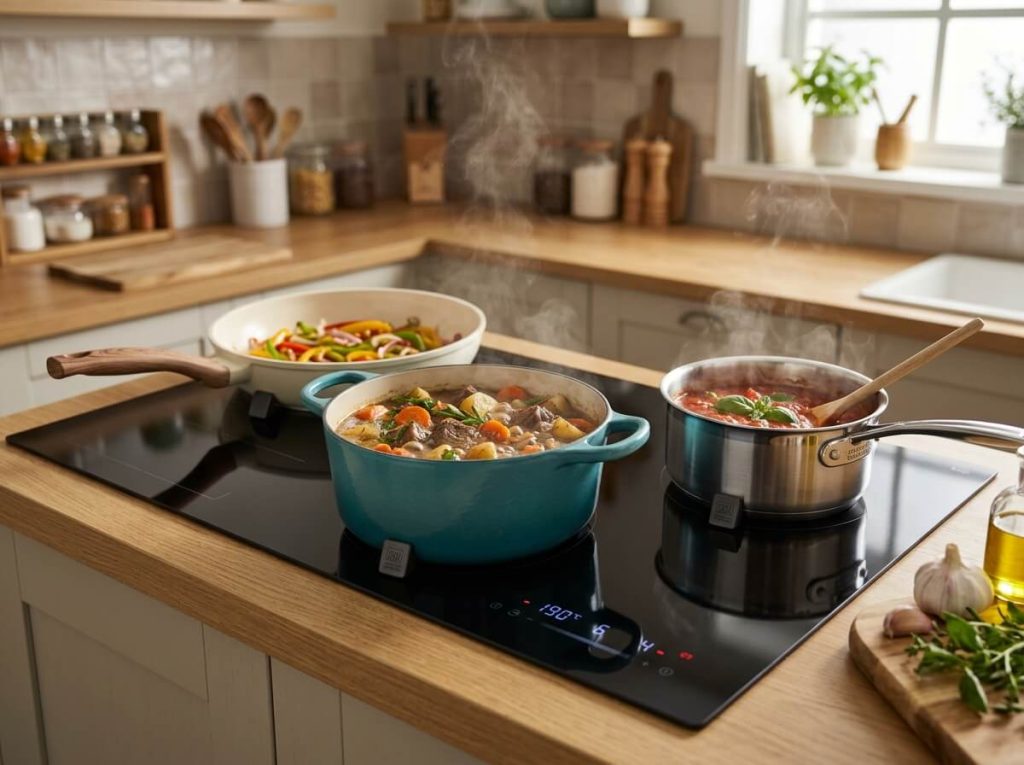
A cookware coating and a cookware base are two different parts of the pan, governed by two different sets of rules, and a pan can be completely non-toxic while being completely useless on an induction stove.
The coating — ceramic, PTFE-free nonstick, enamel, or bare metal — determines what touches your food and whether it leaches anything under heat.
The base determines whether the cooktop can generate heat in the pan at all.
Buying “non-toxic” cookware tells you nothing about the second question, and that’s exactly where most shoppers get tripped up.
How induction cooktops actually generate heat
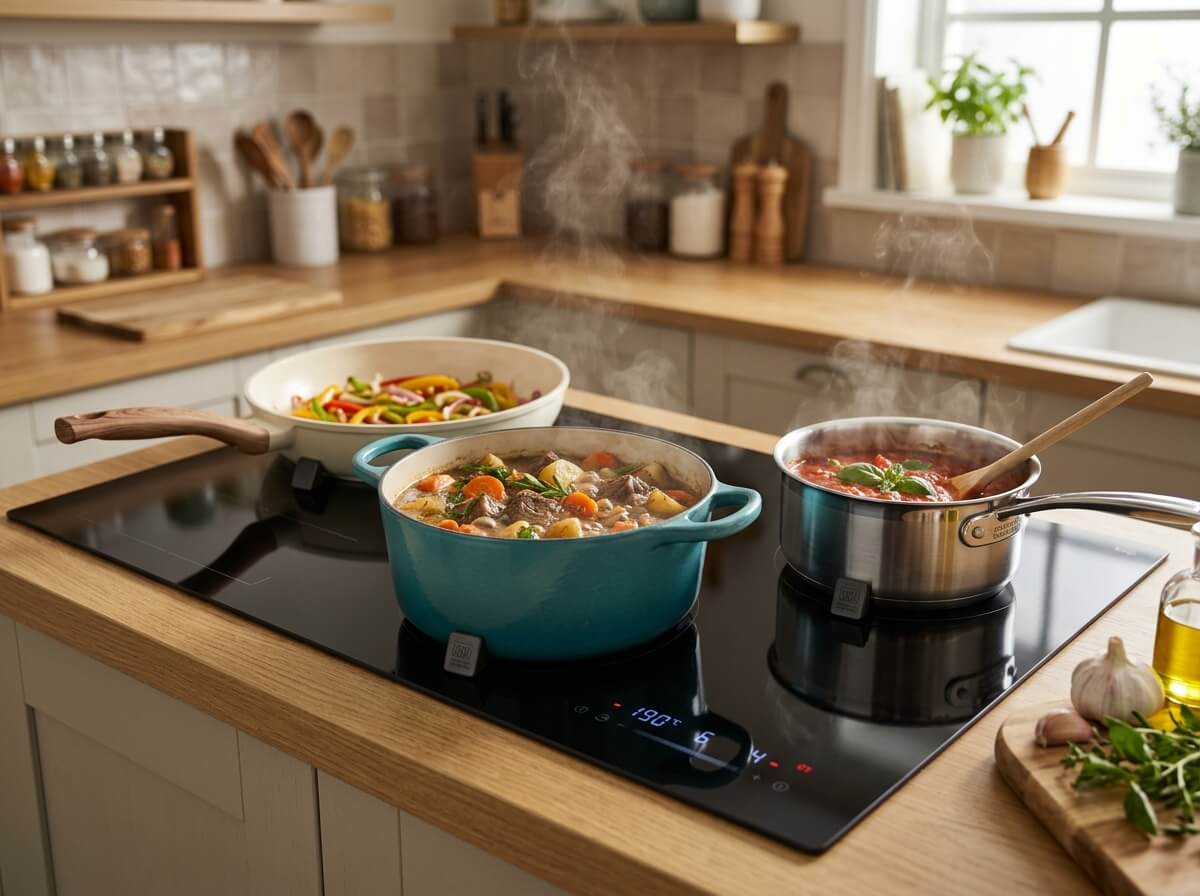
An induction cooktop doesn’t heat a burner or a glass surface the way a gas or standard electric range does.
Instead, a coil beneath the cooktop’s surface generates a rapidly alternating electromagnetic field.
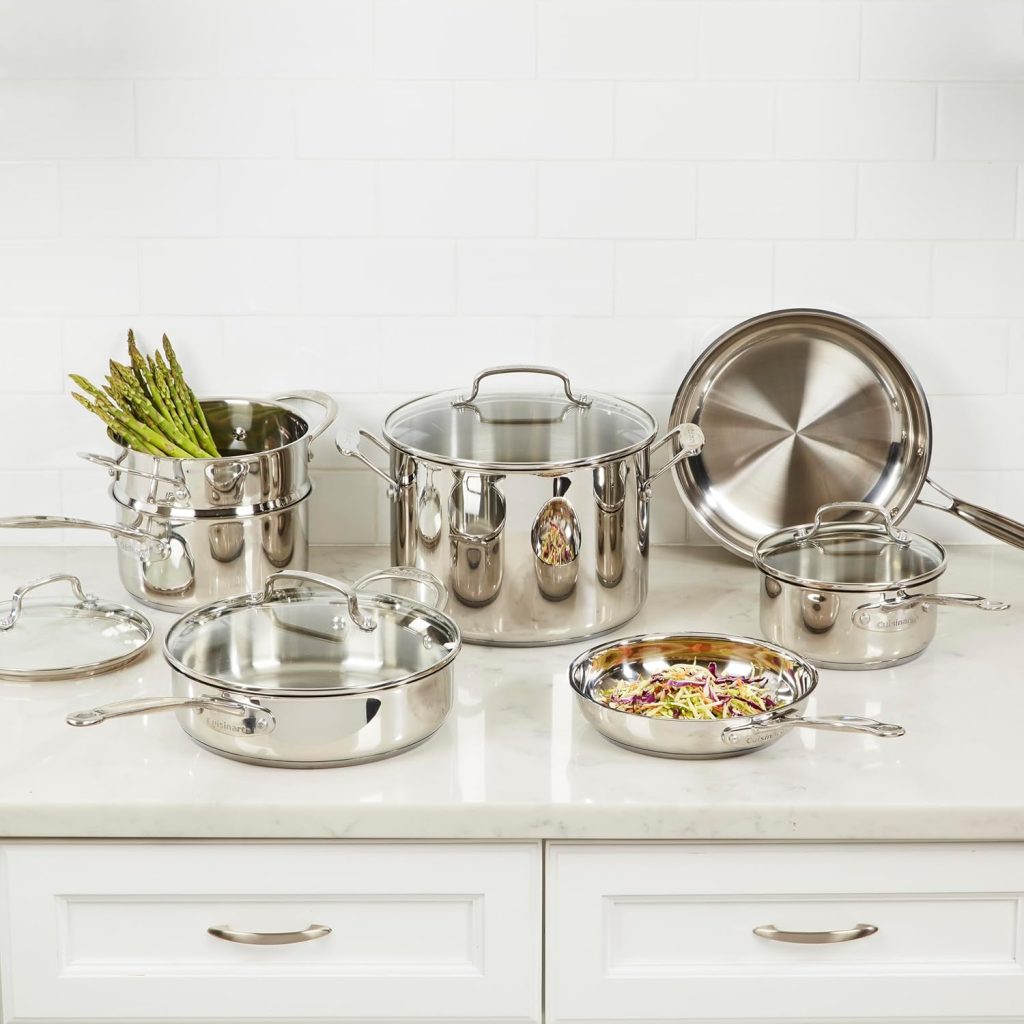
When cookware made of ferromagnetic material meaning it contains enough iron to respond to a magnet— sits on that field, the field induces electrical currents directly inside the metal of the pan.
Those currents encounter resistance, and that resistance is converted straight into heat inside the cookware itself.
The cooktop surface stays comparatively cool because it was never the thing generating the heat in the first place.
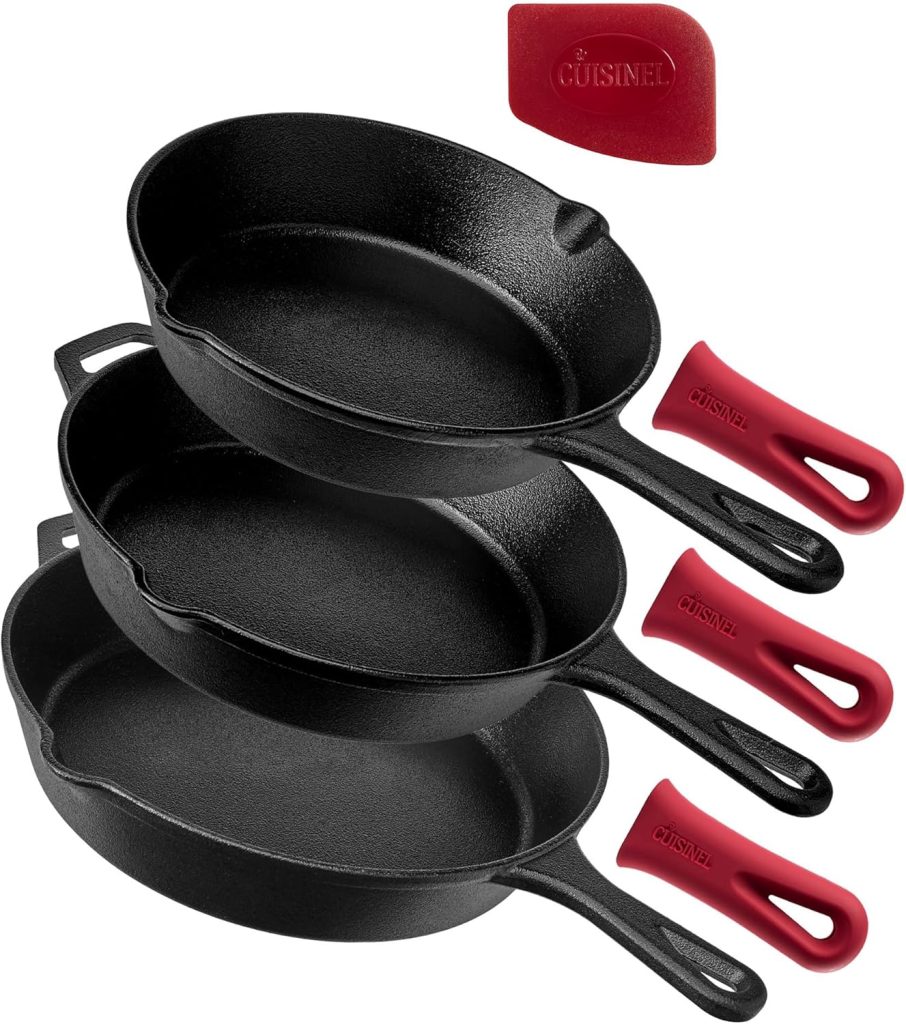
This is why induction is faster and more responsive than gas or coil electric: the energy skips the middleman and goes directly into the pan.
Why coating safety has nothing to do with compatibility
The chemistry of a non-stick or ceramic coating happens at the surface of the pan, typically fractions of a millimeter thick, and has zero magnetic properties one way or the other.
Whether a coating is PFAS-free ceramic, traditional PTFE, or an enameled glaze changes what leaches into your food under heat; it does not change whether the base beneath that coating is ferromagnetic.
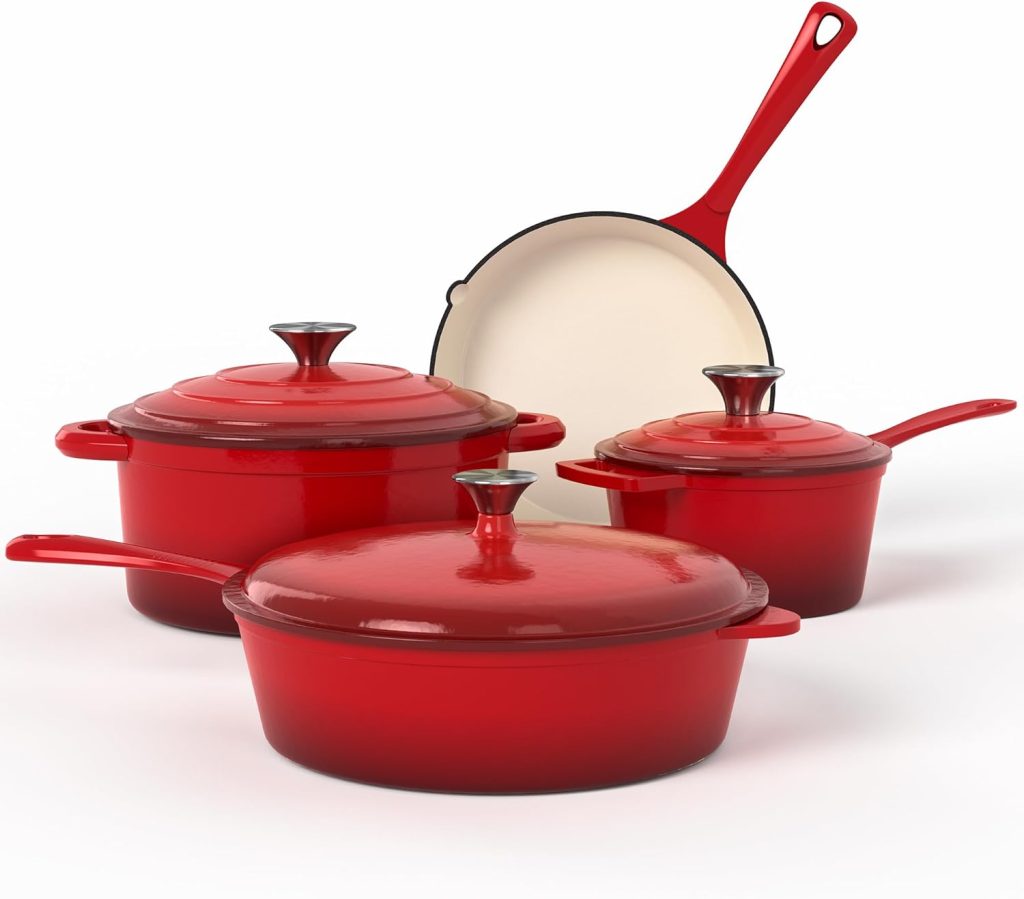
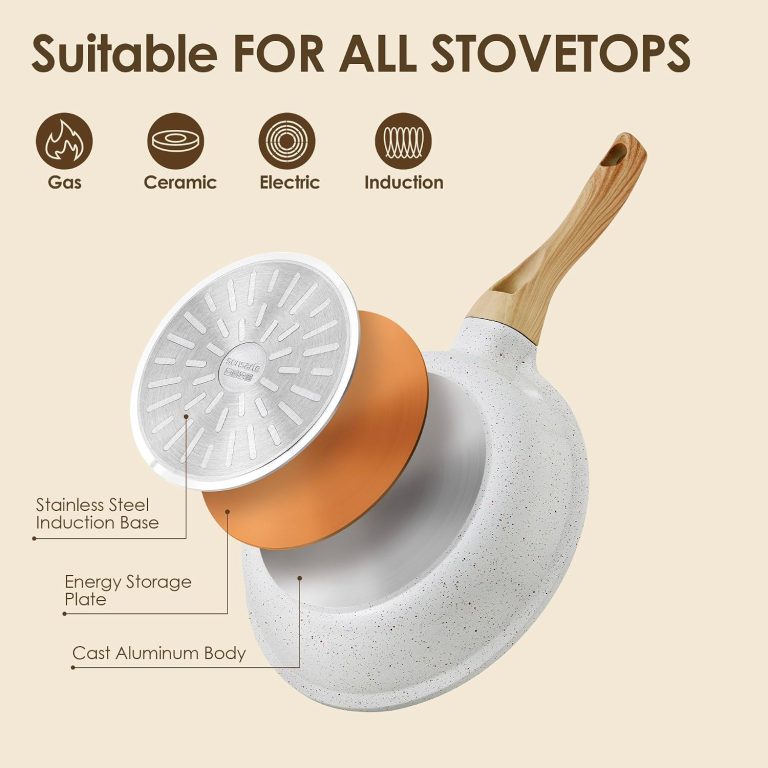
A pan becomes induction-compatible because of what its base is made of (cast iron, magnetic stainless steel, or a bonded ferromagnetic disc), not because of what’s coated on top.
That’s why two visually similar non-toxic ceramic pans from different brands can have completely different induction outcomes: the coating recipe might be nearly identical, while the base metal underneath is not.
How to Check if Your Cookware Is Induction Compatible
The fastest way to check whether your non-toxic cookware works on induction is to hold a refrigerator magnet against the bottom of the pan and see whether it grips firmly.
If it does, the base contains enough ferromagnetic material to work; if it slides off or only sticks weakly, the pan won’t generate heat on an induction cooktop no matter how safe its coating is.
- Take a standard magnet — a fridge magnet is strong enough — and hold it flat against the outside base of the pan.
- Check whether it snaps into place firmly, rather than just brushing the surface.
- Move the magnet across the entire base, not just the center, since some pans only have a small magnetic plate rather than full coverage.
- If the magnet holds strongly across most of the base, the pan is very likely induction compatible; if it slides off or barely holds, it isn’t.
- Look for a printed coil symbol on the packaging or base, which manufacturers use to explicitly mark induction compatibility.
What the buzzing or humming noise really means
A buzzing or humming sound from an induction cooktop is almost always caused by the physical vibration of the pan’s metal reacting to the rapidly switching magnetic field, not by anything wrong with the coating or the food safety of the cookware.
This phenomenon, known as magnetostriction, happens because ferromagnetic metal flexes slightly as the magnetic field cycles thousands of times per second, and that flexing is what you’re hearing.
Pans with thin, warped, or only partially magnetic bases tend to buzz more noticeably, because they don’t sit perfectly flush against the cooktop surface, which increases the vibration.
A flat pan, properly sized to its burner zone, and made from a solid ferromagnetic base will typically run quieter than one that’s thin or mismatched.
If you hear buzzing with a new non-toxic set, it’s worth checking pan flatness and burner size match before assuming anything is unsafe; the noise is a fit-and-construction issue, not a chemical one.
Non-Toxic Materials That Work on Induction
| Material | Non-Toxic Status | Induction Compatible | Notes |
|---|---|---|---|
| Magnetic stainless steel | Yes (inert, no coating to leach) | Yes | Not all stainless steel qualifies — check the magnet test |
| Cast iron | Yes (bare metal, no synthetic coating) | Yes | Naturally ferromagnetic; heats slowly but retains heat well |
| Enameled cast iron | Yes (glass-based enamel coating) | Yes | Enamel surface adds a barrier over the naturally magnetic iron base |
| Carbon steel | Yes (bare metal, seasoned surface) | Yes | Requires seasoning; naturally magnetic |
| Ceramic-coated aluminum with steel base | Yes (PFAS-free coatings common) | Yes, if base is bonded with a magnetic layer | Compatibility depends entirely on construction, not the coating |
Stainless steel is one of the most reliable non-toxic, induction-ready choices, but not all stainless steel qualifies, because compatibility depends on nickel content and construction rather than the fact that it’s labeled “stainless.”
Nickel-heavy stainless steel can block the magnetic field even though it looks and performs like any other stainless pan, which is why the magnet test matters more than the material label alone.
Cast iron and enameled cast iron are induction compatible by nature, since the iron content that makes them heavy and durable is the same property that makes them magnetic.
Cast iron carries no synthetic coating at all, and enameled versions add a glass-based surface rather than a plastic-derived one, so both options clear the non-toxic bar without needing a separate coating claim.
Carbon steel behaves like a lighter-weight cousin of cast iron: it’s naturally magnetic, contains no synthetic coating, and needs the same kind of seasoning routine to develop a natural non-stick surface over time.
Non-Toxic Materials That Won’t Work on Induction
- Pure ceramic cookware, like Xtrema, is fired clay and mineral glaze with no metal core, so it contains no ferromagnetic material and will not activate an induction cooktop at all.
- Plain aluminum has excellent heat conductivity but no magnetic properties, so it will not respond to an induction field unless it’s bonded to a magnetic base layer.
- Copper conducts heat exceptionally well but is not ferromagnetic, meaning solid copper cookware needs an added magnetic disc or cladding to work on induction.
- Glass cookware has no metal content whatsoever and is not compatible with induction cooking under any circumstances.
Pure ceramic (and why it’s often confused with ceramic-coated)
Pure ceramic cookware and ceramic-coated cookware sound identical in casual conversation, but they are built completely differently, and only one of them can ever work on induction.
Pure ceramic pieces, like those from Xtrema, are solid-fired clay and mineral glaze all the way through; there’s no metal core to respond to a magnetic field, so these pieces are limited to gas, standard electric, or glass-top stoves.
For anyone deciding between ceramic types for other reasons, including durability and heat behavior, our guide to ” Is ceramic cookware safe breaks down the full picture.
Ceramic-coated cookware, by contrast, is a metal pan, typically aluminum with a steel base that has a thin ceramic-based non-stick coating applied over the top, which is why ceramic-coated pans can be induction compatible even though pure ceramic pans never are.
Plain aluminum, copper, and glass
Aluminum and copper are prized for how evenly and quickly they conduct heat, but neither one is magnetic on its own, so a pan made purely from either material will sit dead on an induction cooktop with no response at all.
Manufacturers get around this by bonding a magnetic stainless steel plate or disc to the base, which is why some aluminum and copper cookware does work on induction; the compatibility comes entirely from that added layer, not from the aluminum or copper itself.
Glass cookware has no path around this limitation, since there’s no way to add a magnetic layer to a glass vessel without changing its fundamental design, which is why glass pots and bakeware are never induction compatible.
Ceramic-Coated Non-Toxic Cookware and Induction: Brand Snapshot
| Brand | Coating | Induction Compatibility | Safety Transparency |
|---|---|---|---|
| Caraway | Ceramic-coated aluminum, PTFE/PFOA/PFAS-free | All SKUs, across the full line | Publishes third-party lab test results on request, including leach testing |
| GreenPan | Thermolon ceramic coating, PFAS-free | Most collections, but not universal — check per collection | Holds GREENGUARD Gold certification on select lines |
| Our Place (Always Pan) | Ceramic-coated aluminum, PTFE/PFOA-free | Marketed as induction-friendly, though actual performance can vary by cooktop | Less public third-party test documentation than Caraway or GreenPan |
Caraway builds its entire line of cookware, bakeware, and its mini collection on ceramic-coated aluminum with a steel base specifically added for induction compatibility, so every current SKU in the brand’s catalog is designed to work across gas, electric, and induction stovetops.
Caraway also voluntarily runs and publishes third-party lab testing for PTFE, lead, and cadmium in the coating itself, along with leach testing for other toxic metals, which gives shoppers documentation to check rather than a marketing claim alone.
GreenPan pioneered the Thermolon ceramic coating technology that many competing brands now license or imitate, and it holds GREENGUARD Gold certification on select lines, but induction compatibility isn’t universal across every GreenPan collection the way it is with Caraway.
Shoppers choosing GreenPan specifically for induction should confirm the exact collection they’re buying rather than assuming compatibility from the brand name alone, since construction differs between GreenPan’s product lines.
Our Place’s Always Pan is generally marketed and sold as induction compatible, and most buyers report it working, but the brand has published less independent third-party testing documentation than Caraway, which matters if verified lab results are a priority alongside performance.
For a deeper side-by-side on coating chemistry, durability, and heat behavior between these two leading brands, see our full Caraway vs. GreenPan comparison.
What to Do If Your Non-Toxic Cookware Isn’t Induction Compatible
- Check whether a magnetic interface disc or converter plate works with your existing pan, since these accessories sit between the cooktop and a non-magnetic pan to bridge the compatibility gap.
- Understand that converter plates come with tradeoffs, because they typically heat less evenly and less efficiently than cookware that’s induction compatible on its own.
- Consider replacing only the pieces you use most often rather than an entire set, since a single stainless steel skillet or cast iron pan can cover most everyday cooking needs.
- Keep non-compatible pure ceramic or aluminum pieces for gas, electric coil, or oven use instead of discarding them, since they still function normally on those heat sources.
- Compare cast iron against ceramic-coated options for your next purchase using our guide to ceramic vs. cast iron cookware if you’re deciding which non-toxic material fits your induction setup best.
How to Choose a Non-Toxic Induction Cookware Set
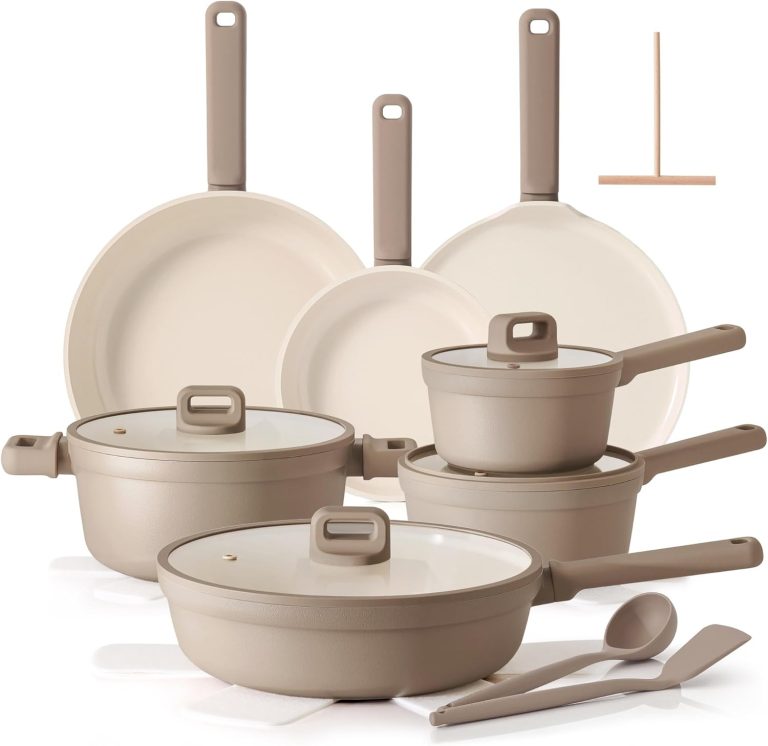
- Start by confirming induction compatibility is stated explicitly for every piece in the set, not just the flagship frying pan pictured in marketing photos.
- Prioritize brands that name their coating chemistry and disclose whether independent lab testing has been conducted, rather than relying on the word “non-toxic” alone.
- Match pan sizes to your cooktop’s burner zones, since undersized pans on oversized burners are a common source of uneven heating and buzzing.
- Choose a flat, heavy-gauge base over a thin one, since flatness and base thickness directly affect how quietly and evenly the set performs on induction.
- Decide whether you need full-set induction compatibility or just one or two pieces, since buying a smaller induction-ready starter set is often more practical than replacing everything at once.
If you’re comparing full non-toxic lineups beyond induction-specific needs, our complete non-toxic cookware guide walks through the broader field of brands and materials across every stovetop type.
FAQ
Does induction cooking make food less safe or more toxic?
No, induction cooking itself does not make food less safe or add any toxicity; the heat source only affects how quickly and evenly energy reaches the pan, not what happens chemically to your food.
Any safety concerns with cookware come from the coating and base materials the pan is made of, such as PFAS-based nonstick coatings or leaching metals, and those risks exist independently of whether you’re cooking on induction, gas, or standard electric.
Choosing induction as your heat source is a decision about cooking speed, precision, and energy efficiency, not a food-safety decision, so the non-toxic label on a pan matters the same amount regardless of your cooktop type.
Is all stainless steel induction compatible?
No, not all stainless steel is induction compatible, and compatibility depends specifically on the metal’s composition rather than the fact that it’s labeled stainless steel.
Stainless steel that contains higher nickel content can block the electromagnetic field entirely, even though it looks and cooks identically to compatible stainless steel in every other respect.
The most reliable way to confirm compatibility is the magnet test: if a magnet grips firmly to the base, the steel has enough magnetic material to work on induction, and if it slides off, it doesn’t, regardless of what the product label claims.
Why won’t my induction stove recognize my pan?
Your induction stove likely isn’t recognizing your pan because the base doesn’t contain enough ferromagnetic material to interact with the cooktop’s magnetic field, which is common with pure ceramic, plain aluminum, copper, and glass cookware.
It can also happen if only a small portion of the base is magnetic rather than the full surface, which means the cooktop detects the pan inconsistently or not at all depending on placement.
Running the magnet test across the entire base, not just the center, will confirm whether the issue is a compatibility gap rather than a cooktop malfunction, and switching to a fully magnetic base typically resolves the problem immediately.
Can I use a converter plate with non-induction non-toxic cookware?
Yes, a magnetic interface disc or converter plate can let non-induction cookware work on an induction stove by sitting between the cooktop and the pan to bridge the missing magnetic base.
The tradeoff is that converter plates generally heat less evenly and less efficiently than cookware that’s induction compatible on its own, since the heat has to transfer through an extra layer before reaching the pan itself.
Converter plates work best as a stopgap for occasional use with a favorite pure ceramic or aluminum piece, rather than as a long-term solution for cookware you use daily.
If your kitchen runs on induction and you’re building out a set from scratch, start with the pieces that clear both bars at once: a non-toxic coating and a fully magnetic base rather than assembling a collection you’ll have to work around later.