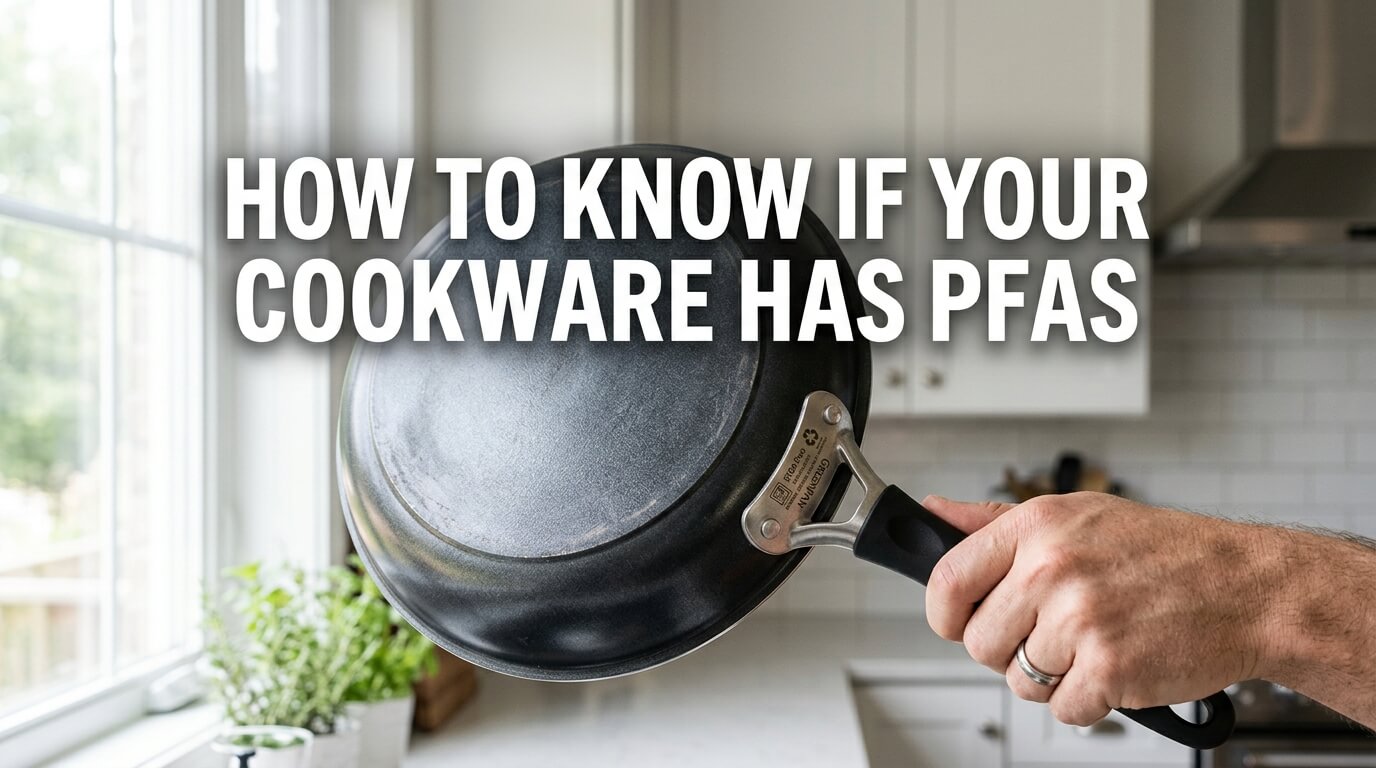
There is no reliable way to look at a pan and know for certain whether it contains PFAS labels like “PFOA-free”; don’t rule it out, and home test kits can’t confirm it either.
What you can do is check the material, inspect the coating’s condition, and understand which claims actually mean something.
PFAS, short for per- and polyfluoroalkyl substances, is a family of thousands of human-made chemicals used to make nonstick coatings slick and durable.
If your cookware has a nonstick surface, there’s a reasonable chance PFAS is part of it, even if the packaging never says so directly.
What Is PFAS, and Why Is It in Cookware in the First Place?
PFAS is not a single chemical; it’s a category name for thousands of fluorine-based compounds that share a few properties: they resist heat, oil, and water, and they take an extremely long time to break down, which is why they’re often called “forever chemicals.”
In cookware specifically, PFAS shows up almost exclusively in nonstick coatings, not in the base metal underneath.
PFAS vs. PTFE vs. PFOA — What’s the Difference?
These three terms get used almost interchangeably in marketing copy, but they mean different things:
- PFAS — The umbrella category. Every PTFE and PFOA compound is a PFAS, but not every PFAS is PTFE or PFOA.
- PTFE — The actual nonstick polymer, best known by the brand name Teflon. It’s the coating itself, applied to the metal surface of a pan.
- PFOA — A chemical historically used as a processing aid during the manufacture of PTFE coatings, not as the coating itself. PFOA was phased out of U.S. cookware production by 2015.
Understanding the distinction matters because it explains why a pan can legally say “PFOA-free” while still being coated in PTFE — a compound that is itself part of the PFAS family.
Why Manufacturers Use These Coatings
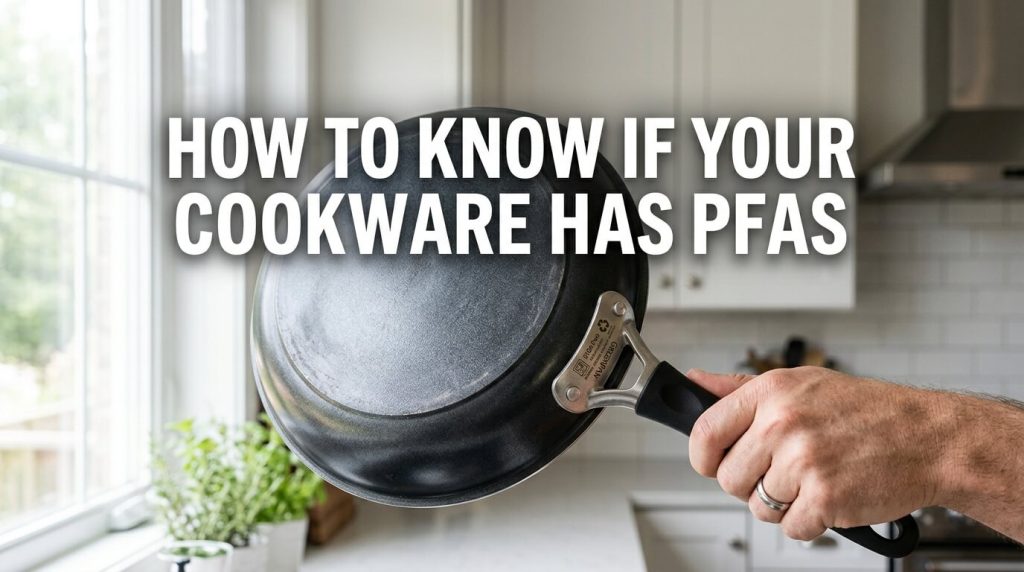
Nonstick coatings exist because they solve a real cooking problem: food releases cleanly with little or no added fat, cleanup takes seconds instead of minutes, and delicate foods like eggs or fish don’t tear apart in the pan.
PTFE became the dominant coating decades ago because no other material matched its combination of slickness, heat resistance, and low cost to produce at scale.
That’s also why it remains difficult to avoid most budget and mid-range nonstick cookware, which still defaults to it unless a brand has specifically chosen an alternative.
The Cookware Materials That Are PFAS-Free by Design
Some cookware materials are PFAS-free because of what they physically are, not because of a marketing claim.
If a pan has no coating at all, just solid metal, seasoned iron, or glass, there is nothing for PFAS to hide in.
Stainless Steel, Cast Iron, Carbon Steel, and Glass
| Material | PFAS-Free by Construction | Notes |
|---|---|---|
| Stainless steel | Yes | No coating layer; the cooking surface is the metal itself. |
| Cast iron | Yes | Seasoning is polymerized oil, not a chemical coating. |
| Carbon steel | Yes | Functions like cast iron, with a natural fat-based patina. |
| Glass | Yes | Inert surface with nothing to scratch off or degrade. |
| Enameled cast iron | Yes | The enamel is a glass-based coating, not a fluoropolymer. |
These materials also happen to be good candidates for households cooking on induction, since most of them are magnetic or compatible by design; worth checking against our guide to non-toxic cookware for induction stoves before you buy.
Is Ceramic Cookware Really PFAS-Free?
Ceramic cookware is usually PFAS-free, but “usually” is doing real work in that sentence.
Most ceramic nonstick coatings today are sol-gel based, meaning they’re derived from silica rather than fluoropolymers, which puts them outside the PFAS family by chemistry rather than by marketing claim.
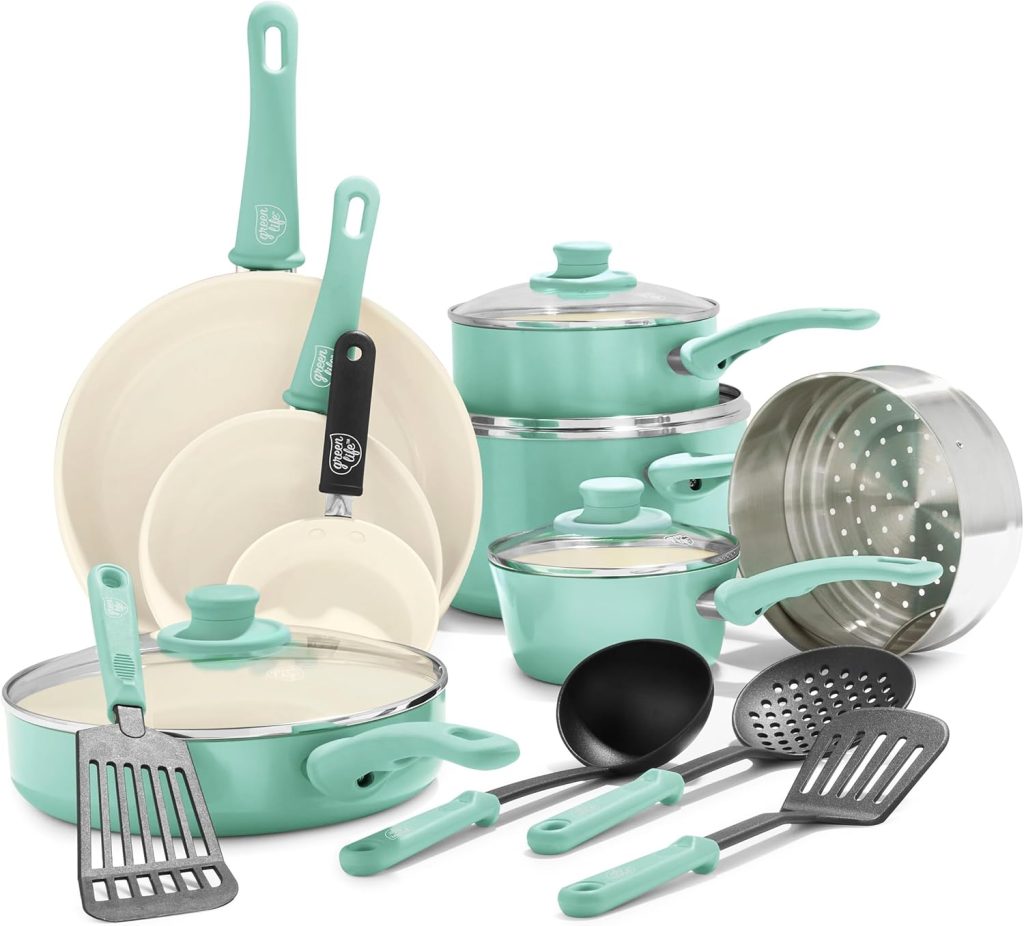
That said, “ceramic” is not a legally defined or regulated term the way “stainless steel” is, so quality and formulation vary by brand.
- A genuine sol-gel ceramic coating does not rely on PTFE and is not classified as PFAS.
- Some products marketed as “ceramic” are actually a PTFE coating with a ceramic-look finish layered over it, which does contain PFAS.
- Ceramic coatings also tend to lose their nonstick performance faster than PTFE, which is a durability trade-off rather than a safety one.
Because the labeling isn’t standardized, it’s worth reading brand-specific sourcing claims before buying.
Our full breakdown of whether ceramic cookware is safe goes deeper into how to vet a specific product.
What About Titanium Cookware?
Solid titanium cookware is PFAS-free for the same reason stainless steel is: there’s no separate coating layer to begin with.
The cooking surface is the metal itself, so there’s nothing to scratch, flake, or chemically release into food.
The complication is that “titanium” on packaging often refers to a titanium-reinforced nonstick coating, not solid titanium construction, meaning the pan can still be built on a PTFE base with titanium particles mixed in for durability.
Reading whether a product says “titanium-reinforced nonstick” versus “solid titanium” is the difference between a PFAS coating and no coating at all.
If you’re weighing ceramic against another popular non-toxic option, our Caraway vs. GreenPan comparison covers how two well-known brands approach this differently.
Why “PFOA-Free” and “PTFE-Free” Labels Don’t Mean PFAS-Free
A “PFOA-free” or “PTFE-free” label tells you one specific chemical was removed — it does not tell you the product is free of PFAS as a category.
This is the single most common point of confusion in cookware shopping, and it’s largely a labeling loophole rather than an accident.
The Loophole Behind These Claims
PFOA was effectively phased out of U.S. production by about 2015 under the EPA’s PFOA Stewardship Program, so most modern nonstick cookware is already manufactured without PFOA; today, a “PFOA‑free” label largely reflects an industry‑wide baseline rather than a strong, standalone safety differentiator.
Because cookware labeling rules focus on broad food‑contact safety rather than detailed polymer disclosure, manufacturers can accurately advertise the absence of one specific PFAS (such as PFOA) while continuing to use other PFAS chemistry, and there is generally no requirement that packaging list which replacement PFAS compounds are present.
As a result, “PFOA‑free” and even “PTFE‑free” claims do not automatically mean “PFAS‑free” or “fluorine‑free”; they tell you only that those named substances are absent, not whether other, less‑studied PFAS replacement chemistries are involved, which is why single‑compound labels function more as marketing reassurance than as comprehensive proof of non‑PFAS safety.
What New State Disclosure Laws Mean for Your Next Purchase (2026)
Federal labeling requirements for PFAS in cookware still don’t exist, but a growing number of states have stepped in with their own rules.
As of 2026, several states either restrict intentionally added PFAS in cookware outright or require a visible disclosure label when it’s present, which gives shoppers a genuinely new signal to look for.
| State | What Changed | Effective |
|---|---|---|
| Colorado | Bans intentionally added PFAS in cookware sold in the state. | January 1, 2025–2026 (phased) |
| Illinois | Prohibits the sale of cookware with intentionally added PFAS. | January 1, 2026 |
| Minnesota | Bans intentionally added PFAS in cookware under its consumer protection law (Amara’s Law). | January 1, 2025 |
| Maine | Restricts PFAS-containing cookware among other product categories. | Phased through 2026 |
| Vermont | Prohibits PFAS-containing cookware above a set concentration threshold. | January 1, 2026 |
| Connecticut | Requires a visible “made with PFAS” label if intentionally added PFAS is present. | July 1, 2026 |
These laws don’t apply nationwide, and a product sold in a state without a ban can still legally contain PFAS with no disclosure at all.
But if you see a cookware product labeled as compliant with Colorado’s, Illinois’s, or Minnesota’s PFAS restrictions, that’s a stronger and more specific signal than a generic “PFOA-free” claim, because it reflects a legal standard rather than a voluntary marketing choice.
5 Signs Your Current Cookware May Be Releasing PFAS
For cookware you already own, the coating’s physical condition is the most useful thing you can check, since PFAS is most likely to transfer into food when a coating breaks down rather than while it’s intact. Independent testing backs this up.
A widely cited Ecology Center investigation (“What’s Cooking? PFAS and Other Chemical Hazards in Nonstick Cooking and Baking Pans”) found that 79% of the nonstick cooking pans and 20% of the nonstick baking pans tested were coated with PTFE, a polymer form of PFAS.
The report explains that PTFE‑based coatings can release PFAS over their lifecycle—especially during manufacturing, high‑temperature cooking, and disposal—highlighting that wear, scratches, and overheating increase the potential for particles and fumes from the coating to be released, rather than guaranteeing that any minor damage automatically causes migration in every use.
If you bake as often as you cook stovetop, the same logic applies to pans covered in our best non-toxic bakeware guide, since the study found meaningful PFAS use in baking pans too.
- Visible scratches, scuffs, or gouges in the nonstick surface, especially from metal utensils.
- Flaking or peeling, where small pieces of the coating have separated from the metal.
- A dull, worn patch in the center of the pan where the coating has thinned from repeated use.
- Warping, where the pan no longer sits flat, can indicate the coating has been exposed to temperatures beyond what it was rated for.
- Smoke or an odd odor during normal cooking, which typically means the coating is being overheated.
Scratches, Flaking, or a Dull, Warped Coating
- A single light scratch from a spatula edge is common and, on its own, isn’t a reason to replace a pan immediately.
- Deep gouges, especially ones you can catch a fingernail on, mean the coating has been breached down to or near the metal.
- Any coating that’s visibly flaking off into food should be treated as a pan you stop using, not one you monitor further.
- A dull, worn center patch surrounded by intact coating around the edges is a sign of gradual wear rather than sudden damage, and it’s worth watching closely.
Overheating Signs — Smoking, Odor, Warping
- Nonstick coatings are generally rated to stay stable up to around 500°F; consistent smoking well below that suggests something is already compromised.
- A chemical or acrid smell during normal medium-heat cooking is not typical and shouldn’t be treated as background noise.
- Warping usually happens from an empty pan left on high heat, dropping a hot pan into cold water, or a dishwasher cycle that wasn’t recommended for that coating.
- Once a pan has visibly warped, its surface has likely developed micro-cracks even where none are visible.
Can You Actually Test Your Cookware for PFAS Yourself?
Not with any consumer product currently on the market; the test kits sold to home users are built to detect PFAS in drinking water, not in a solid nonstick coating, and there isn’t a reliable at-home equivalent for cookware.
That gap matters because it’s the question most people actually want answered and the one that’s hardest to get a straight answer to.
What At-Home Kits Can and Can’t Tell You
Search “PFAS test kit” and nearly every result on the market is designed for water: you collect a sample, mail it to a lab, and get results on specific compounds like PFOA and PFOS at trace concentrations measured in parts per trillion.
None of that process transfers to a pan’s coating, because the chemistry involved is different, and the coating is a solid polymer bonded to metal rather than something dissolved in liquid.
There is no consumer-facing kit that lets you swab a pan and get a validated PFAS reading at home.
The closest thing to a DIY option is a handheld X-ray fluorescence (XRF) device, which some health departments have piloted in community screening programs.
These devices detect total fluorine on a surface, and a 2025 King County, Washington pilot project found that handheld XRF performed well at flagging items with high fluorine levels, including nonstick pans.
But fluorine detection is not the same as confirmed PFAS; it’s a screening flag, not an identification, and the devices themselves aren’t something most households own or can rent easily.
Treat any fluorine reading as a reason to investigate further, not as proof one way or the other.
How Professionals Actually Test for It (XRF and Lab Screening)
Labs that test cookware for PFAS typically combine two methods: a fluorine screening step, using techniques like wavelength-dispersive XRF to detect total fluorine concentration on a coated surface, followed by targeted chemical analysis such as LC-MS/MS to identify and quantify specific PFAS compounds if fluorine is present.
This two-step process is what allows a lab to move from “there’s fluorine here” to “this is PFOA at this concentration,” and it requires equipment and expertise well beyond anything sold directly to consumers.
Kitchnfam does not conduct this testing in-house; when we reference test results in our buying guides, we’re citing published third-party studies, not our own lab work.
What to Do If You Think Your Cookware Has PFAS
If you suspect a pan contains PFAS, the practical next step depends on the coating’s condition and how the pan gets used, not on the material alone.
A scratched pan used daily at high heat is a different situation from an intact one used occasionally on low heat.
Families shopping for young children in particular may want to prioritize replacement sooner, given developing bodies’ higher sensitivity to chemical exposure; our guide to non-toxic cookware for babies covers material choices specifically for that use case.
- Assess the coating’s physical condition using the five signs above.
- Check whether the pan is used for high-heat cooking (searing, stir-frying) or gentle, lower-temperature cooking.
- Decide whether to retire the pan now, monitor it, or contact the manufacturer for clarity.
- If replacing, choose a PFAS-free-by-construction material rather than another PTFE-coated pan.
When to Replace vs. When It’s Likely Fine
- Replace now if the coating is flaking, peeling, or visibly gouged down to the metal, regardless of how the pan is used.
- Replace now if the pan regularly smokes or produces an odor at normal cooking temperatures.
- Replace soon if the coating shows a dull, thinned patch and the pan is used for high-heat searing or stir-frying several times a week.
- Monitor if the coating is intact with only light, cosmetic scratching, and the pan is used occasionally at low-to-medium heat.
- Deprioritize replacement if the pan is solid metal, cast iron, or glass with no coating to begin with — there’s nothing to degrade.
This kind of layered check is more useful than a single blanket rule, because coating condition and cooking habits interact.
A lightly scratched pan used twice a month for oatmeal carries a different level of exposure than the same scratch on a pan used daily for searing meat at high heat.
How to Ask a Manufacturer Directly
Manufacturers aren’t required to volunteer PFAS information, but many will respond to a direct, specific question, especially now that several states require this kind of disclosure. A short message like this tends to get a useful answer:
“Does this cookware’s coating contain any PFAS, including PTFE, PFOA, PFOS, or GenX? I’m asking because I want to confirm compliance with my state’s PFAS disclosure requirements before purchasing.”
Naming the specific compounds and referencing state law signals that you’re asking a substantive question, not a vague one, and it makes a vague or evasive answer easier to spot.
If you’ve decided your current cookware needs replacing, choosing the right materials up front saves you from going through this evaluation again in a few years.
Our guide to the best non-toxic cookware breaks down specific, vetted options across stainless steel, cast iron, and genuine ceramic construction.
FAQ
Does PFOA-free mean my cookware is safe?
No, “PFOA-free” only confirms one specific PFAS compound was removed, not that the cookware is free of PFAS as a category.
PFOA was phased out of U.S. cookware manufacturing by 2015, so the label describes something now true of nearly all cookware on the market rather than a meaningful safety differentiator.
Manufacturers can legally use a different PFAS compound in its place without disclosing the substitution.
If PFAS-free status matters to you, look for materials that are PFAS-free by construction, such as stainless steel, cast iron, or verified sol-gel ceramic, rather than relying on a single-chemical label.
Is ceramic cookware guaranteed to be PFAS-free?
Most genuine ceramic cookware is PFAS-free, but the term “ceramic” isn’t a regulated category, so it’s not guaranteed by the word alone.
Authentic sol-gel ceramic coatings are silica-based rather than fluoropolymer-based, which puts them outside the PFAS family by chemistry.
However, some products marketed as ceramic are actually PTFE-coated pans with a ceramic-style finish layered on top, which does contain PFAS.
Checking a brand’s specific sourcing and coating claims, rather than the word “ceramic” on its own, is the more reliable way to confirm.
Can I test my own pots and pans for PFAS at home?
Not with any product currently marketed to consumers. Home PFAS test kits are built to analyze drinking water samples, not solid nonstick coatings, so they don’t transfer to cookware testing.
The closest option, handheld XRF devices used in some public health pilot programs, detects total fluorine on a surface as a screening flag rather than confirming PFAS specifically, and these devices aren’t something most households can access.
Confirming PFAS in a coating requires lab-based fluorine screening followed by targeted chemical analysis, which is only available through professional testing services.
Is it safe to keep using a scratched nonstick pan?
A pan with flaking, peeling, or gouges down to the metal should be replaced rather than monitored; a pan with only light, cosmetic scratches on an otherwise intact coating carries a lower risk and can often keep being used.
How the pan is cooked matters as much as the scratch itself; occasional low-to-medium heat use is lower risk than daily high-heat searing or stir-frying.
The combination of coating damage and high-heat use is what increases the chance of PFAS compounds transferring into food, so both factors matter more than either one alone.