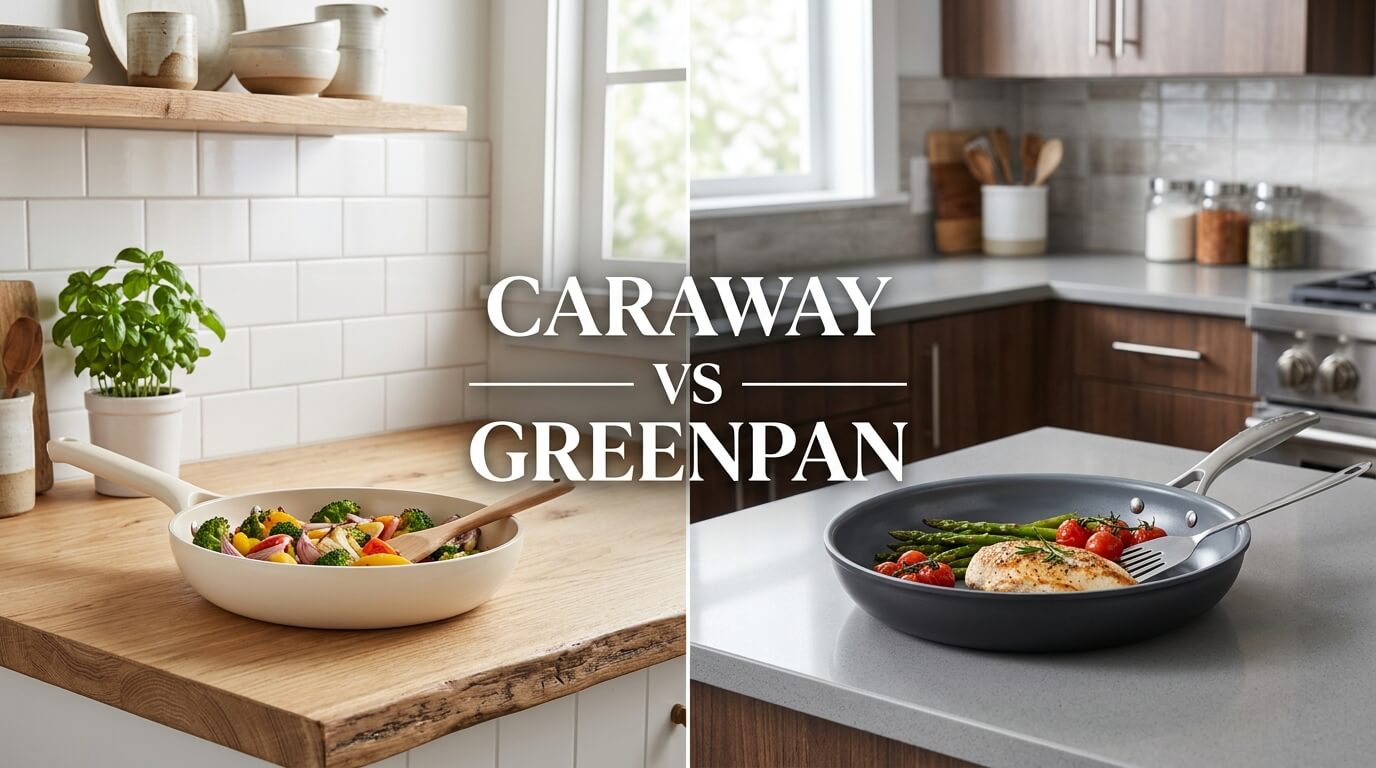
Caraway and GreenPan both sell ceramic non-stick cookware free of PFAS, PTFE, and PFOA, but they back up that claim very differently.
Caraway currently publishes third-party lab results showing no detectable lead, cadmium, or PFAS in its coating.
GreenPan stopped sharing lab results publicly around 2020, and settled a 2019 lawsuit over what its Thermolon coating actually contains.
That gap in transparency, not the coating material itself, is the real difference to weigh before you compare price, durability, or induction compatibility.
Caraway vs GreenPan at a Glance
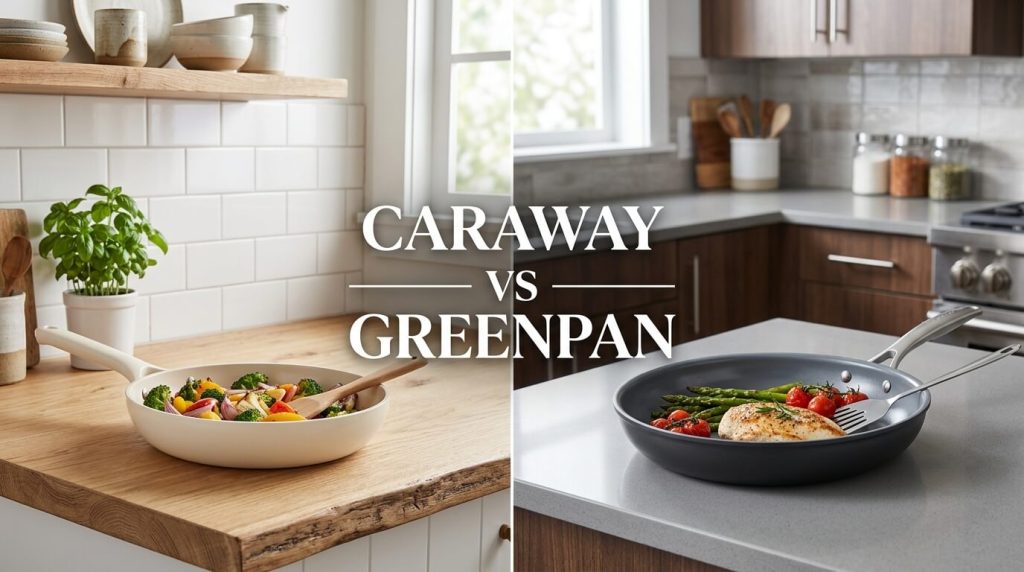
Both brands make ceramic-coated, PFAS-free cookware aimed at home cooks who want an alternative to Teflon, but they differ on price, care requirements, and how openly they share safety data.
| Category | Caraway | GreenPan |
|---|---|---|
| Basic starter set price | ~$445 (2 fry pans, 2 pots) | ~$300 (2 fry pans, 2 pots, saute pan, 2 utensils) |
| Core construction | Aluminum core, stainless steel base plate, single collection | Varies by collection: aluminum, hard-anodized aluminum, or stainless steel base |
| Induction compatible | Yes, every piece | Most collections; some budget aluminum-only lines are not |
| Dishwasher/metal utensils | Hand wash only; wood or silicone utensils recommended | Varies; higher-end lines like Valencia Pro are dishwasher- and metal-utensil-safe |
| Oven-safe temperature | Up to about 550°F | 350°F to 600°F depending on collection |
| Warranty | 1 year, US customers only | 2 years on the coating, lifetime on materials and workmanship |
| Third-party safety testing published | Yes, ongoing | Stopped publishing results publicly around 2020 |
If neither brand ends up matching what you need, our full guide to the best non-toxic cookware overall covers other PFAS-free options worth comparing before you buy.
Which Is More Non-Toxic: Caraway or GreenPan?
Both brands claim their coatings are free of PFAS, PTFE, PFOA, lead, and cadmium, and both have third-party test data to point to at some point in their history.
The meaningful difference is that Caraway makes its current results available, while GreenPan has not published new results in several years.
What each brand’s ceramic coating is made of
Understanding how ceramic cookware coatings are tested for safety starts with knowing what’s actually in them.
Both Caraway and GreenPan use a sol-gel coating — a process where a liquid solution of mineral compounds is applied to a metal surface and cured into a hard, glass-like layer.
Neither brand discloses its full formula. Based on patent filings and industry reporting, Caraway’s coating is widely believed to be built primarily from silicon dioxide, the main component of sand and quartz, along with undisclosed binders and reinforcing agents that give it non-stick properties.
GreenPan describes its Thermolon coating in similar terms: a silicon dioxide-based ceramic layer applied through the same general sol-gel method.
In practice, both are marketed as mineral-based alternatives to the fluoropolymer coatings used in traditional non-stick pans.
Third-party testing and transparency: why GreenPan’s silence matters
Caraway publishes third‑party lab reports for its cookware and bakeware and states that testing panels include PFAS (such as PFOA and other legacy compounds) and heavy metals like lead and cadmium, in accordance with regulatory guidance such as California Proposition 65 and relevant food‑contact standards, with extractable metals evaluated under food‑contact conditions.
According to Caraway, these reports show no detectable levels of the substances tested for, and the company states it screens for over 200 types of PFAS and more than 20 heavy metals across its product lines.
GreenPan has made similar non-toxicity claims for years, and earlier independent testing — including analysis by the Ecology Center — did not find PFAS, lead, or cadmium in its cookware.
What’s changed is availability going forward: GreenPan has not made new third-party test results public since around 2020, and multiple reviewers who have asked the company directly report being unable to obtain current data.
That doesn’t mean GreenPan’s coating has changed or become unsafe. It means buyers currently have less to check their claims against than they do with Caraway.
If you want to verify any brand’s claims yourself, our guide on how to check any pan for PFAS walks through what to look for.
The 2019 GreenPan lawsuit, explained
In 2019, a proposed class‑action lawsuit was filed in California against The Cookware Company, the maker of GreenPan, alleging that its “completely toxin-free” and related non‑toxic marketing claims for the Thermolon ceramic coating were false or misleading.
The complaint asserted, based on patent information and other sources, that the Thermolon coating contained compounds such as silane, aluminum oxide, tetraethoxysilane, methyltrimethoxysilane, and potassium titanate, which it characterized as “known toxins,” and argued that this was inconsistent with GreenPan’s “toxin‑free” advertising.
The parties later reached an individual settlement, after which the court dismissed the plaintiff’s claims with prejudice, with no findings of liability and no admission of wrongdoing by GreenPan.
Because the lawsuit ended in settlement rather than a trial on the merits, the alleged coating composition and toxicity claims were never adjudicated at trial, and the court did not issue any findings on the accuracy of the plaintiff’s chemical allegations.
GreenPan continues to treat the detailed Thermolon formulation as proprietary, so its exact coating composition is not publicly disclosed, and the 2019 lawsuit remains an example of documented questions about that composition and the company’s “toxin‑free” marketing that were never resolved through a public court ruling.
That’s a materially different situation than a coating that has been repeatedly tested and cleared by outside labs, which is closer to Caraway’s current position.
It’s worth separating two different kinds of claims you’ll see across cookware review sites, because they don’t carry the same weight.
Lab-verified claims — like “no detectable PFAS” or “no detectable lead” — come from actual third-party test reports that can, at least in principle, be requested and checked.
Reviewer-observed claims — like “lasts longer” or “performs 40% better after 100 uses” — usually come from a single reviewer’s personal use of one or two pans, without a published testing protocol.
Both types of claims show up constantly in cookware comparisons, but only one of them is independently verifiable.
| Claim type | Example | How to verify it |
|---|---|---|
| Lab-verified | “No detectable lead or cadmium” | Ask the brand for the specific lab report and testing date |
| Reviewer-observed | “Coating lasts noticeably longer” | Check whether the reviewer discloses the sample size, cooking frequency, and testing period |
Durability: Which Coating Actually Lasts Longer?
With proper care, Caraway’s coating tends to hold its non-stick surface slightly longer than entry-level GreenPan collections, but GreenPan’s higher-end lines, Valencia Pro and GP5, close much of that gap through sturdier, thicker construction.
Construction differences: cast aluminum vs. multi-ply
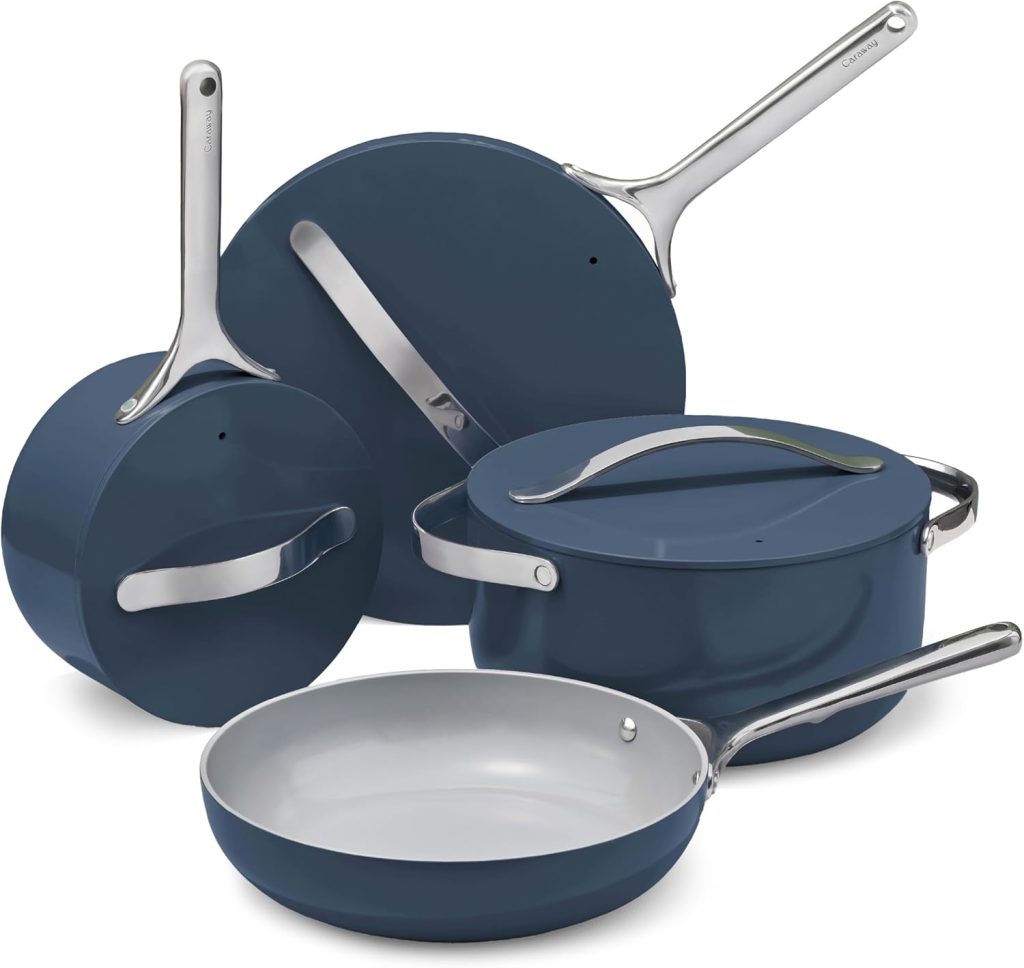
Caraway makes one line of ceramic cookware: an aluminum core roughly 4mm thick with a stainless steel induction plate welded to the base.
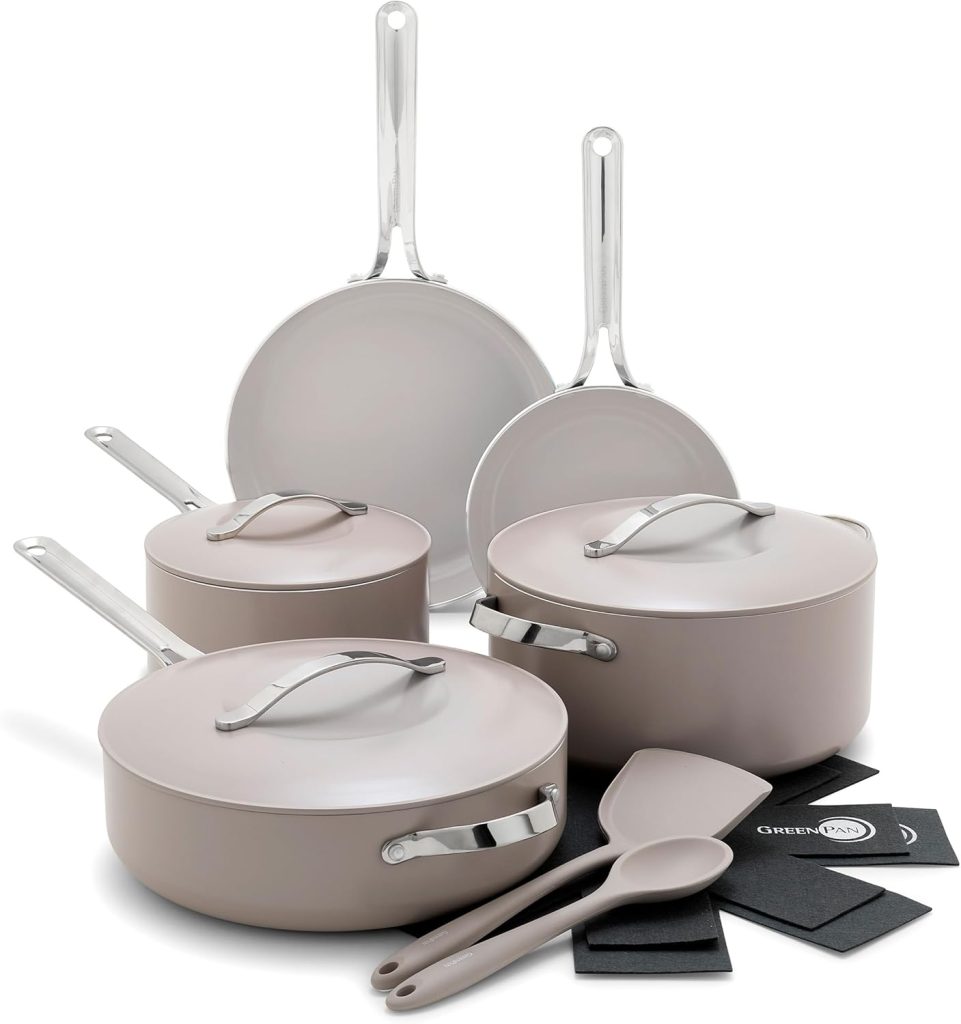
GreenPan’s construction varies significantly by collection. Budget lines use thinner, straightforward aluminum bodies, while premium collections like Valencia Pro use hard-anodized aluminum — aluminum that’s gone through an electrochemical process, making it harder and more resistant to warping — and the newest 3-ply and 5-ply GreenPan lines add additional layers of stainless steel for extra rigidity.
In broad terms, GreenPan’s top-tier construction is more robust than anything Caraway currently offers, since Caraway has stuck to a single build across its whole line rather than offering a heavier-duty tier.
Real-world coating lifespan and common failure points
Owner reports and long-term reviews point to a fairly consistent set of complaints for each brand.
- Caraway’s exterior coating is prone to chipping within the first few months of regular use, even when the interior non-stick performance holds up.
- Some Caraway fry pans develop a slight concavity near the rim over time, which can let eggs or liquids drift toward the edge of the pan.
- Caraway’s interior non-stick performance commonly starts declining somewhere between 8 and 12 months of daily cooking.
- GreenPan’s entry-level and mid-range collections often lose meaningful non-stick performance within 6 to 12 months of daily use.
- GreenPan owners report inconsistent quality across collections, making it harder to know what to expect without checking the specific line.
- Warranty claims on GreenPan’s coating are sometimes denied because the company attributes wear to improper care rather than a manufacturing defect.
A note on “test results” you’ll see elsewhere: several cookware review sites cite very specific durability statistics figures like a stated percentage improvement in food release after a fixed number of uses without describing who ran the test, how many pans were used, or what counts as a “use.”
Before treating any such figure as fact, it’s reasonable to ask three questions: Was the raw data published anywhere, rather than just summarized?
Who conducted the testing: the brand, an independent lab, or the reviewer’s own kitchen? And was the testing protocol described in enough detail that someone else could repeat it?
If the answer to all three is no, treat the number as one person’s impression rather than a verified result.
Once you understand how ceramic performs against sustained daily use, it’s also worth seeing how ceramic compares to cast-iron cookware if long-term durability is your top priority.
Performance in the Kitchen: Heat, Cooking, and Care
Caraway tends to heat up faster and cook more evenly, according to hands-on testers, while GreenPan’s performance varies more by collection; care requirements are where the two brands differ most clearly, since Caraway is hand-wash only, and some GreenPan lines are not.
Heat-up speed and heat retention
Testers who’ve cooked with both brands side by side generally report that Caraway heats up quickly and distributes heat evenly across the cooking surface, which shows up in tasks like bringing water to a boil or searing proteins without hot spots.
GreenPan’s Valencia Pro line also heats quickly, though some reviewers note it loses heat somewhat faster once removed from a burner compared to Caraway’s thicker aluminum body.
Neither difference is large enough to be a deciding factor on its own, but if consistent, even heat across the whole pan matters to your cooking style.
Caraway’s single-collection construction has a slight edge over GreenPan’s thinner budget lines, specifically.
Dishwasher and metal-utensil compatibility
| Care requirement | Caraway | GreenPan |
|---|---|---|
| Dishwasher safe | No — hand wash recommended for all products | Depends on collection; Valencia Pro and similar premium lines are dishwasher-safe |
| Metal utensils | Not recommended; use wood, silicone, or nylon | Depends on collection; some premium lines claim metal-utensil safety |
| General care note | Low to medium heat recommended across the line | Same general guidance; check the specific collection’s manual |
Induction, Oven Safety, and Everyday Compatibility
Both brands work on induction across most of their current lineups, but GreenPan’s compatibility depends on which specific collection you buy, while every piece of Caraway cookware includes a built-in induction-ready base.
Induction cooktop compatibility by collection
If you’re shopping specifically for non-toxic cookware that works on induction stoves, collection choice matters more with GreenPan than with Caraway.
| Brand / Collection | Induction Compatible |
|---|---|
| Caraway (all products) | Yes — every piece includes a stainless steel base plate |
| GreenPan Valencia Pro | Yes |
| GreenPan GP5 | Yes |
| GreenPan Reserve | Yes |
| GreenPan Rio (budget line) | No — aluminum-only construction |
| Older GreenPan aluminum lines | Check individual product specs; some lack a magnetic base |
Oven-safe temperature limits
| Brand / Collection | Maximum Oven-Safe Temperature |
|---|---|
| Caraway (all products) | About 550°F |
| GreenPan Valencia Pro | Up to 600°F |
| GreenPan Rio (budget line) | Up to 350°F |
| Other GreenPan collections | Varies; check the specific product page |
Price and Warranty: What You’re Actually Paying For
Caraway costs noticeably more for a comparable starter set, while GreenPan spans a much wider price range depending on which collection you choose.
Set pricing side by side
| Set Comparison | Caraway | GreenPan |
|---|---|---|
| Basic starter set | ~$445 for 2 fry pans and 2 pots | ~$300 for 2 fry pans, 2 pots, a saute pan, and 2 utensils |
| Price range across collections | Single price tier | Ranges from budget (Rio) to premium (Valencia Pro, GP5) |
| Included accessories | Storage lid system on full sets | Utensils on some starter sets |
Warranty terms and what they actually cover
| Term | Caraway | GreenPan |
|---|---|---|
| Warranty length | 1 year (US customers only) | 2 years on coating; lifetime on materials and workmanship |
| Coverage | Manufacturing defects | Manufacturing defects; excludes normal wear and tear |
| Return window | 30 days | 60 days, unused items in original packaging only |
Which Should You Buy? A Decision Framework by Priority
Neither brand is a universal winner; the right pick depends on whether you’re optimizing for verified safety data, budget flexibility, or day-to-day convenience.
Choose Caraway if…
- You want to buy from the brand that currently publishes the most accessible third-party safety testing.
- You want every piece in your set to work on induction without checking each product individually.
- You’re comfortable hand-washing your cookware and sticking to wood or silicone utensils.
- You value a matched aesthetic and the included magnetic storage system.
Choose GreenPan if…
- You want more flexibility to start at a lower price point and upgrade later.
- You want the option of a dishwasher-safe, metal-utensil-safe pan in a higher-end collection.
- You want a longer stated warranty period on the non-stick coating.
- You want a wider range of collections to choose from as your budget or needs change.
If you have young kids or are pregnant
If a family member’s developing health is part of your decision, it’s worth prioritizing whichever brand and collection currently has the clearest published lab data behind it, since neither company runs testing specifically calibrated to infant or prenatal exposure; both rely on general food-contact safety standards.
For a closer look at options built with that audience in mind, see our picks for the safest cookware for feeding babies and toddlers, which covers brands and specific products beyond just these two.
FAQ
Is Caraway or GreenPan more non-toxic?
Both brands claim their ceramic coatings are free of PFAS, PTFE, PFOA, lead, and cadmium, and both have third-party test data supporting that claim at some point.
Caraway currently makes its results available to check, publishing Prop 65 leaching tests and LFGB reports on its own site.
GreenPan has not published new third-party results since around 2020, even though earlier independent testing, including work by the Ecology Center, did not find those substances in its cookware either.
Neither company’s coating is unsafe; the meaningful difference is how easy it currently is to verify each brand’s claims for yourself.
Why did GreenPan stop publishing test results?
GreenPan has not made a public statement clearly explaining why it stopped sharing new third-party test results around 2020.
What is documented is that GreenPan settled a class-action lawsuit in 2019 over allegedly misleading “non-toxic” marketing, with court filings citing several undisclosed substances found in the Thermolon coating.
The settlement was reached out of court, meaning those specific findings were never proven or disproven in front of a judge.
Since then, several reviewers have reported being unable to obtain current lab data directly from the company, leaving buyers with less recent information to check GreenPan’s safety claims against.
Which lasts longer, Caraway or GreenPan?
With proper care, Caraway’s non-stick coating tends to hold its performance slightly longer than GreenPan’s entry-level and mid-range collections, typically starting to decline somewhere between 8 and 12 months of daily use.
GreenPan’s premium lines, like Valencia Pro and GP5, use sturdier hard-anodized or multi-ply construction that narrows this gap considerably, even though their non-stick surface can still show wear within 6 to 12 months for heavy daily cooks.
In both cases, low to medium heat, non-metal utensils, and hand washing extend the coating’s usable life far more than brand choice alone does.
Can I use metal utensils or a dishwasher with either brand?
Caraway recommends against both the company’s advice to hand washing and using only wood, silicone, or nylon utensils across its entire product line.
GreenPan’s answer depends on the specific collection: budget lines generally carry the same hand-wash, non-metal-utensil guidance as Caraway, but premium collections like Valencia Pro are marketed as dishwasher-safe and metal-utensil-safe.
If you specifically want that convenience, you’ll need to check the exact GreenPan collection you’re considering rather than assuming it applies brand-wide.
Whichever brand fits your priorities, check current pricing and available colors directly on each brand’s site before buying, since both frequently run sales on entry-level sets that can shift which option makes the most financial sense.