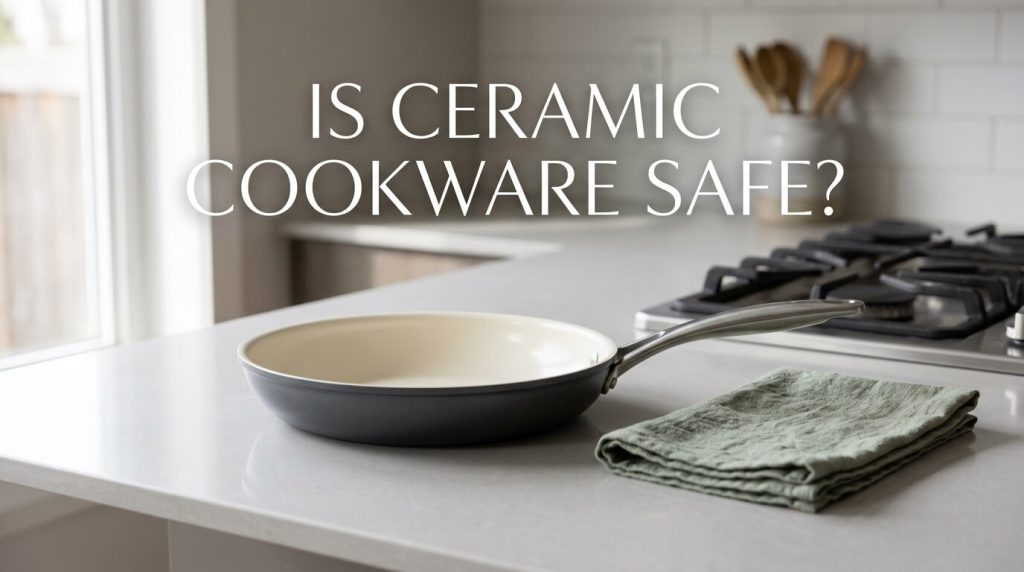
Ceramic cookware is safe to cook with, but the honest answer has a condition attached: most of what’s sold as “ceramic cookware” isn’t ceramic all the way through.
It’s metal cookware — usually aluminum — wearing a thin ceramic coating, and the safety picture depends on which version you own, how old that coating is, and whether the brand actually tested the finished product rather than just the base material.
True 100% ceramic cookware is a smaller, simpler category with far fewer variables.
This guide walks through both, using FDA limits, published lab data, and independent testing rather than marketing claims.
What Is Ceramic Cookware, Really?
“Ceramic cookware” is used to describe two genuinely different products, and confusing them is the single biggest reason people get conflicting answers about safety.
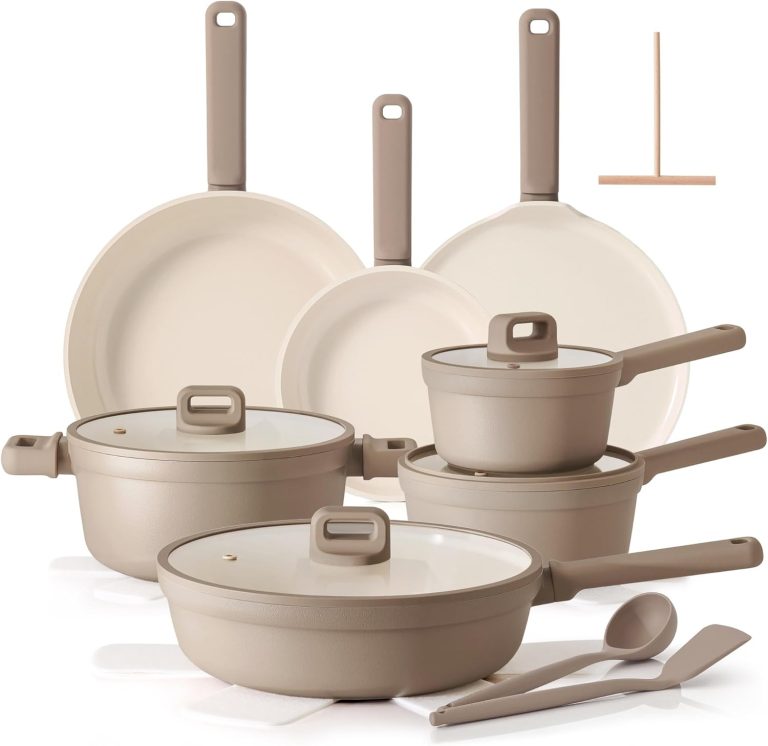
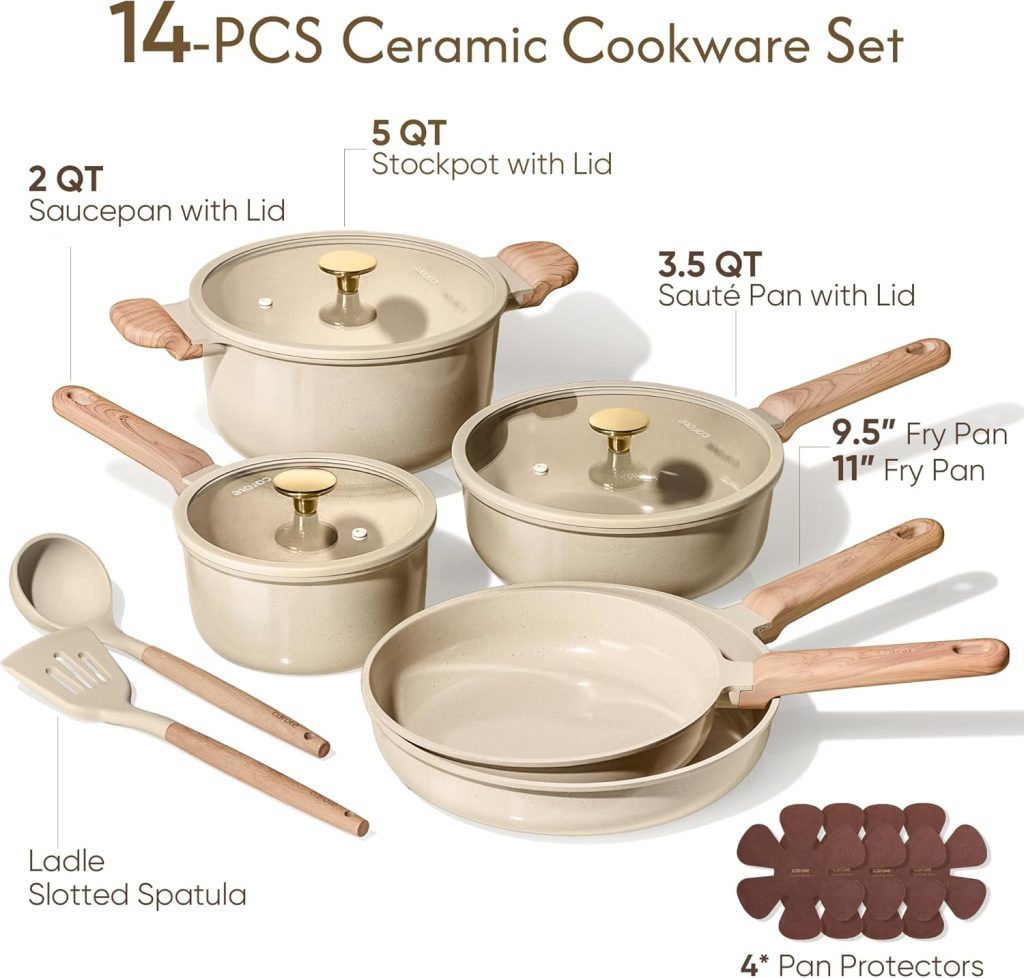
Ceramic-coated cookware is a metal pan — almost always aluminum, occasionally stainless steel — with a thin nonstick layer built from ceramic-derived materials applied over the metal.
100% ceramic cookware contains no metal at all; it’s shaped from clay and minerals, then fired at very high temperatures until it hardens into a single solid piece.
100% Ceramic vs. Ceramic-Coated Cookware
| Feature | 100% Ceramic | Ceramic-Coated |
|---|---|---|
| Construction | Solid clay/mineral body, no metal core | Metal pan (usually aluminum) with a thin coating |
| Market share | Small niche | The large majority of “ceramic” cookware sold |
| What can wear out | Nothing to coat or delaminate | The coating can scratch, thin, or flake off |
| What’s exposed if damaged | Same material throughout | Bare metal underneath the coating |
| Weight and fragility | Heavier, can chip or crack if dropped | Lighter, more impact-resistant |
| Heat behavior | Retains heat, generally handles high heat well | The coating can degrade with prolonged high heat |
| Typical price point | Higher | Lower to mid-range |
How the Coating Is Applied (the Sol-Gel Process)
Ceramic-coated cookware gets its nonstick surface from a sol-gel process: a liquid silica-based solution is applied to the metal pan and then cured at high heat until it hardens into a thin, glass-like layer.
This is chemically distinct from how traditional nonstick coatings are made, and it’s the reason ceramic-coated pans are marketed as an alternative to Teflon.
The resulting coating is inorganic, built primarily from silicon and oxygen compounds rather than the fluoropolymer chemistry used in conventional nonstick cookware.
Some formulations also incorporate metal oxide additives, including titanium dioxide, to improve the coating’s slip and hardness, which becomes relevant later in this guide.
What Is Sol-Gel Ceramic Coating, and Is It Safe?
Sol-gel is the manufacturing process most “ceramic-coated” nonstick cookware actually uses. It starts as a liquid solution of silica (derived from sand) mixed with other mineral compounds, which is sprayed or applied onto a metal pan — usually aluminum — and then cured at high heat.
As it cures, the liquid solution (“sol”) transforms into a solid, glass-like coating (“gel”), which is where the process gets its name.
This is different from traditional PTFE-based nonstick coatings (like Teflon), which rely on a synthetic polymer rather than a mineral-based glass layer.
Because sol-gel coatings are inorganic and don’t require the fluorinated compounds used in PTFE manufacturing, most sol-gel ceramic cookware is marketed as PFAS-free and, based on its composition, that claim generally holds up better than similar claims made about products using other coating types.
That said, “sol-gel” alone doesn’t guarantee safety. The safety of a specific pan still depends on:
- What’s underneath the coating. Most sol-gel ceramic cookware has an aluminum core, which is safe as long as the coating stays intact and prevents direct contact with food.
- Manufacturing quality control. Not every brand using sol-gel technology holds itself to the same purity and testing standards — this is why checking for published third-party testing matters more than the coating type alone.
- Coating durability over time. Like any surface coating, sol-gel ceramic wears down with use, and once it’s scratched or worn through, the safety profile changes.
In short: sol-gel ceramic coating is a legitimate, generally safer alternative to PTFE-based nonstick when it’s manufactured and maintained properly, but the technology itself isn’t a guarantee, and brand-specific verification still matters.
Is Ceramic Cookware Non-Toxic? The PFAS Question
Ceramic cookware is genuinely free of PFAS when it’s made correctly, which is the main reason it’s marketed as a non-toxic alternative to traditional nonstick pans.
PFAS, or per- and polyfluoroalkyl substances, is the chemical family that includes PTFE (Teflon) and PFOA, both linked to environmental persistence and health concerns when coatings degrade or overheat.
A properly made ceramic coating simply doesn’t use this chemistry, so it doesn’t carry the same forever-chemical concern.
How Ceramic Differs From Teflon (PTFE)
PTFE (Teflon) is a synthetic fluoropolymer — a type of plastic — that belongs to the PFAS chemical family.
It creates an extremely slick, heat-stable surface, but it can release irritating fumes if a pan is left empty on high heat, and it belongs to a chemical class facing increasing regulatory scrutiny worldwide.
Ceramic (sol-gel) coating is an inorganic, silica-based layer with no fluoropolymer content.
It doesn’t carry the same fume-release concern at high heat, but it’s a mechanically different coating with different durability characteristics, covered in the lifespan section below.
Why “Non-Toxic” Isn’t a Regulated Term
There is no legal, standardized definition of “non-toxic” that cookware manufacturers are required to meet before printing it on a box.
The term functions as a marketing claim rather than a certification, which means two pans can both say “non-toxic” while having very different actual compositions, testing histories, and transparency levels.
This is exactly why the specifics — PFAS status, heavy metal testing, nanoparticle disclosure — matter more than the label itself.
If you want to check a specific pan’s PFAS status directly rather than relying on packaging claims, this guide on how to tell if cookware has PFAS walks through what to look for.
Does Ceramic Cookware Contain Lead or Cadmium?
Ceramic cookware can contain lead or cadmium, but not because the base ceramic or coating material requires it; these heavy metals show up almost exclusively in glazes, pigments, and decorative elements rather than the structural clay or coating itself.
Historically, lead and cadmium were used to create bright, vivid colors and smooth, glossy finishes in ceramic glazes, and that risk hasn’t fully disappeared from the global market, particularly with imported or decorative pieces.
FDA Limits and Prop 65, Explained
The FDA’s enforcement policy for ceramic food-contact ware sets category‑specific guideline limits for lead migration, expressed in micrograms of lead per milliliter of acetic acid leaching solution (for example, 3.0 µg/mL for flatware, 2.0 µg/mL for small hollowware, 0.5 µg/mL for cups/mugs, 1.0 µg/mL for large hollowware, and 0.5 µg/mL for pitchers).
Migration is tested using standardized acidic food simulants to represent realistic exposure to acidic foods, but this is not a direct simulation of all cooking conditions.
Some industry documents describe advisory cadmium values (e.g., around 0.5 ppm for certain categories), yet the FDA’s primary ceramic enforcement guideline formally addresses lead, so cadmium should not be presented as having equivalent FDA migration limits.
California’s Proposition 65 is a separate, stricter disclosure law: it requires a warning label on any product that exposes consumers to specific listed chemicals — including lead and cadmium — above the state’s safe-harbor thresholds.
A product sold in California without a Prop 65 warning is signaling that the manufacturer believes it stays under those tighter limits, but Prop 65 is a warning requirement, not a certification of zero heavy metal content.
Where Lead Risk Actually Shows Up — Body, Glaze, and Decoration
This is where most cookware guides stop short: brand-level claims like “PFAS-free” or “Prop 65 compliant” often describe the base body or coating, not every component of the finished product.
Independent lab testing has repeatedly found that the food-contact cooking surface can test clean while a decorative logo, colored rim, or lid finish tests dramatically higher for lead or cadmium — because those elements are frequently applied as a separate overglaze or decal after the main firing, using different materials and processes.
| Component | What It Usually Contains | Why It Matters |
|---|---|---|
| Food-contact cooking surface | Base clay body or sol-gel coating | This is what most brand safety claims and third-party test reports actually cover. |
| Glaze or coating layer | Silica-based sol-gel, or a fired ceramic glaze | Generally, the most tested and disclosed component, but formulations vary by brand and product line. |
| Decoration — logos, rim bands, colored trim, lids | Overglaze paints, decals, or metallic accents are applied after the main firing | Independent testing has found some decorative elements carrying lead levels dramatically above the base body’s results, even on cookware whose main surface passed testing. |
Documented independent testing has found decorative elements — a painted logo on the underside of a pan, a colored lid, a metallic rim — testing at lead levels many times higher than what would be expected of a food-contact surface, even on cookware from brands that publish clean results for their main cooking surface.
The takeaway isn’t that any specific current product is unsafe; it’s that “the brand passed testing” and “every part of this specific pan passed testing” are two different claims, and it’s worth asking which one you’re actually being told.
Are the Nanoparticles in Ceramic Coatings a Concern?
The nanoparticle question in ceramic coatings is a real, distinct issue from PFAS, and it deserves a direct answer: some ceramic-coated cookware uses metal oxide nanoparticles, most notably titanium dioxide, to improve coating performance, and these can migrate into food once the coating is scratched or worn.
Bulk titanium dioxide is generally considered low-risk, but the nanoparticle form raises separate questions that researchers are still actively studying, so it’s a reasonable factor to weigh rather than one to dismiss or panic over.
What Are the Dangers of Ceramic Cookware?
Most of the real risk with ceramic cookware comes down to wear, misuse, or unverified manufacturing, not the material itself. Specific dangers to be aware of include:
- Scratched or worn coating releasing particles into food. Once the ceramic surface is compromised, tiny fragments of the coating can flake off and end up in whatever you’re cooking.
- Overheating beyond the pan’s rated temperature. Most ceramic coatings are only rated for moderate heat; consistently exceeding that threshold can cause the coating to break down faster and potentially release fumes.
- Using metal utensils on the surface. Metal spatulas and whisks scratch ceramic coatings more easily than silicone or wood, accelerating the wear that leads to the flaking issue above.
- Confusing ceramic-coated with 100% ceramic cookware. These are genuinely different products with different risk profiles — ceramic-coated has a metal core and a sol-gel surface layer, while 100% ceramic has no metal at all. Assuming they behave the same way can lead to using the wrong care routine for the wrong product.
- Buying from brands without published safety data. The biggest actual danger isn’t the material — it’s buying from a brand that hasn’t disclosed what’s in its coating or backed up its “non-toxic” claims with any verifiable testing.
The good news: most of these risks are preventable with proper care and by choosing a brand that’s transparent about its manufacturing process and testing.
What Happens When the Coating Wears or Scratches
- A scratched or thinning ceramic coating loses its nonstick performance well before it becomes a visible safety problem, which is often the first sign something has changed.
- Metal utensils, abrasive scrubbers, and dishwasher detergent are the most common causes of premature coating wear on ceramic-coated pans.
- Once the coating is compromised, the exposed material underneath is typically aluminum, which is generally considered low-risk but is a different exposure question than the ceramic coating itself.
- Independent consumer testing has previously flagged elevated titanium levels in several well-known ceramic-coated brands, consistent with titanium dioxide nanoparticle use in their coatings.
- A pan that looks fine on the surface can still be past its effective, tested lifespan if it’s lost its slip and started requiring extra oil to prevent sticking.
What the Research Actually Shows
The American Ceramic Society has reported that consumer testing in 2020–2021 found high titanium levels in several major ceramic‑coated cookware brands, consistent with titanium dioxide nanoparticles being used in their coatings.
Separate peer‑reviewed research, published in 2016, identified titanium dioxide nanoparticles embedded in quasi‑ceramic non‑stick frying pan coatings and showed that both titanium ions and nanoparticles can migrate into food simulants during use, especially under acidic conditions and when the surface is scratched.
Some cookware brands have told consumer advocates or journalists that they do use nanoparticle‑based metal oxides in their ceramic coatings while marketing the pans as “non‑toxic” and “PFAS‑free,” which is not necessarily contradictory, because nanoparticle use and PFAS‑free status are distinct issues; however, shoppers who specifically want to avoid nanoparticles must ask about them directly rather than relying on a general “non‑toxic” label.
In 2019, GreenPan faced a class‑action lawsuit alleging that its marketing was misleading regarding certain metal oxides in its coating; that case was dismissed in 2020, which does not resolve the scientific questions about nanoparticle migration but shows how the issue has already been contested commercially.
How Long Does Ceramic Cookware Actually Last?
Ceramic cookware typically lasts one to three years with regular use before the coating meaningfully degrades, and that lifespan is itself a safety-relevant fact, not just a performance complaint.
A pan that was accurately marketed as PFAS-free and non-toxic when new doesn’t necessarily stay in that same condition once its coating has worn thin, because the questions shift from “what’s in the coating” to “what’s happening” as the coating breaks down and what’s now exposed underneath.
Why Ceramic Loses Its Nonstick Faster Than Teflon
Published comparative testing shows that current ceramic sol‑gel nonstick coatings generally lose their nonstick performance faster than PTFE under repeated cooking and abrasive wear.
In a 2025 study in Results in Engineering, researchers tested five commercial ceramic sol‑gel coatings against a PTFE coating and found that the PTFE surface maintained a much lower and more consistent peel force (food‑release force) even after 90 cooking cycles, with average peel stress up to about three times lower than the best‑performing ceramic coating.
This indicates that PTFE retained its nonstick behavior at roughly three times the level of the top ceramic coating under the same test conditions.
A separate study (accepted in 2024) in the Journal of Food Engineering evaluated the effectiveness and durability of commercial nonstick coatings using pancake batter as a model food, and likewise reported that fluoropolymer coatings (PFA/PTFE) required far less detachment force than ceramic sol‑gel coatings across repeated cycles, meaning the PTFE‑type coatings were several‑fold better at maintaining low release force than the ceramic systems under comparable use.
In practical terms, these results support the idea that most ceramic‑coated pans reach the “time to replace” point significantly sooner than an equivalent PTFE nonstick pan, so issues like coating breakdown, potential nanoparticle release, and metal exposure become relevant earlier in the life of a ceramic pan rather than only as a late‑stage concern.
Signs It’s Time to Replace Your Pan
- Food sticks noticeably more than it did when the pan was new, even with adequate oil or butter.
- The surface has visible scratches, dullness, or discoloration where the coating has thinned.
- Small flakes or chips are visible anywhere on the cooking surface.
- The pan has been through the dishwasher repeatedly, which accelerates coating breakdown even if damage isn’t visually obvious yet.
- It’s been in regular rotation for more than about three years, which is near the outer edge of documented ceramic coating lifespans, even with careful use.
How to Use Ceramic Cookware Safely
Ceramic cookware is safest when it’s used within a fairly specific set of conditions: moderate heat, non-metal utensils, and hand-washing, all of which directly extend the life of the coating and delay the point where wear-related exposure becomes a factor.
These aren’t arbitrary suggestions; each one maps directly to one of the degradation mechanisms covered above.
Heat, Utensils, and Cleaning Rules
- Cook on low to medium heat rather than high, since ceramic coatings are more prone to thermal stress and premature breakdown at high temperatures than PTFE is.
- Preheat with oil or food already in the pan rather than heating it empty, since an empty pan on a hot burner can cause thermal shock and micro-cracking in the coating.
- Use wood, silicone, or nylon utensils, since metal utensils are one of the most common causes of visible scratching.
- Hand wash rather than using the dishwasher, since dishwasher detergent is abrasive and shortens coating life measurably.
- Store pans with a cloth or protective layer between them if stacking, since surface-to-surface contact causes avoidable scratching over time.
Cooking Acidic Foods in Ceramic Cookware
Acidic foods like tomato sauce, citrus, and vinegar-based dishes are generally fine to cook in ceramic-coated cookware with an intact coating, since the coating itself is designed to be a barrier between the food and the metal underneath.
The concern with acidity is specific to compromised coatings and to glazed ceramic pieces with lead or cadmium in the glaze, where acidic, hot, or long-duration contact is the exact combination that accelerates heavy metal leaching.
If your pan’s coating is intact and the product has been tested for heavy metal migration, acidic cooking isn’t a special risk category; if the coating is scratched or you’re using an untested decorative or vintage piece, acidic foods are precisely where any existing risk would show up first.
How to Choose Genuinely Safe Ceramic Cookware
Choosing safe ceramic cookware comes down to verification rather than trusting packaging language, since “non-toxic” and “ceramic” are both unregulated marketing terms on their own.
For a full comparison across materials, not just ceramic, our full guide to the best non-toxic cookware covers how ceramic stacks up against stainless steel, cast iron, and other non-toxic options.
Questions to Ask Before You Buy
- Has the finished, decorated product — not just the base body or coating — been tested by a named third-party lab such as SGS, Intertek, or TÜV?
- Does the brand publish the actual test reports, including report numbers and dates, rather than just a summary claim?
- Does the coating use titanium dioxide or other metal oxide nanoparticles, and is the brand willing to answer that question directly?
- Is the product Prop 65 compliant, and does the brand explain what that compliance actually covers?
- What is the expected coating lifespan, and does the brand give clear guidance on when to replace the pan?
Red Flags That Signal Lower Safety Standards
- The brand makes broad safety claims (“100% non-toxic,” “completely safe”) without linking to any specific test report.
- There’s no clear country of manufacture, and the packaging is vague about where the cookware was produced.
- The listing has bright, heavily decorated colors or metallic trim with no separate mention of testing on those elements specifically.
- Customer reviews mention the coating failing, discoloring, or flaking within the first few months of normal use.
- The price is dramatically lower than comparable cookware from brands with published, verifiable testing.
If you’re deciding between two specific, well-known ceramic brands rather than evaluating the category broadly, our Caraway vs. GreenPan comparison breaks down how two of the most searched options actually differ on testing, coating composition, and durability.
Once you’ve settled on a pan that checks out on testing and disclosure, the remaining safety question is really about your own kitchen habits and specific use case, which is exactly what the questions below are meant to cover.
If you’re setting up a full non-toxic kitchen rather than replacing a single pan, it’s worth reading the guides linked throughout this article before you buy, since ceramic is rarely the only material decision you’ll be making.
Frequently Asked Questions
Is ceramic cookware safe for babies and toddlers?
Ceramic cookware that’s properly tested and free of PFAS is generally considered safe for preparing food for babies and toddlers, and its lack of fluoropolymer coating is often seen as an advantage over traditional nonstick for this use case.
The bigger consideration for this age group is heavy metal testing specifically, since infants and young children are more vulnerable to lead and cadmium exposure at lower thresholds than adults.
Choose cookware with published third-party testing that explicitly covers heavy metals, avoid decorative or vintage ceramic pieces for food prep entirely, and see our guide to the best non-toxic cookware for babies for options evaluated specifically against that stricter standard.
Is ceramic cookware still safe once it’s scratched?
A scratched ceramic pan isn’t automatically dangerous, but it’s past the point where its original safety claims fully apply, since the coating is the barrier that was tested and marketed as non-toxic in the first place.
Once scratched, you’re typically cooking on exposed aluminum, which is generally considered low-risk for occasional contact, but isn’t the same tested surface the product was sold as.
Light surface scuffing from normal use is common, and not an emergency, but visible flaking, chipping, or a pan that’s lost most of its nonstick performance is a reasonable point to retire it rather than continue using it daily.
Is ceramic cookware safe to use on induction stoves?
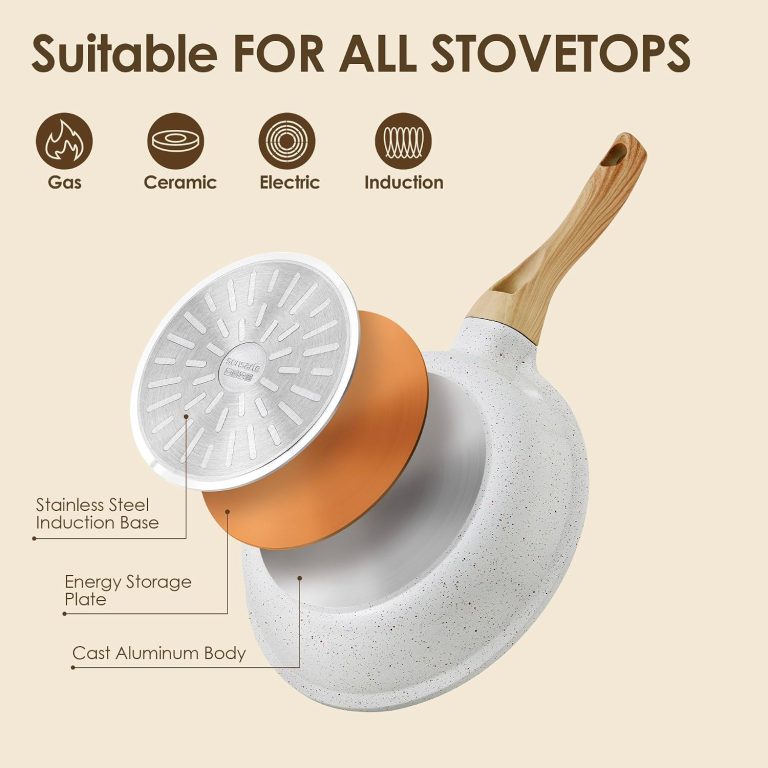
Ceramic cookware is safe to use on induction stoves, but only if it has a magnetic base, since induction cooktops work by generating heat directly in ferromagnetic metal rather than heating the pan from below like gas or electric.
Many ceramic-coated pans are built on an aluminum or aluminum-core base, which is not inherently magnetic, so induction compatibility depends entirely on the specific product’s construction rather than the fact that it’s labeled “ceramic.”
Check for an induction-compatible label or a magnetic base layer before buying if this is your cooktop type, and see our dedicated guide on non-toxic ceramic cookware for induction stoves for models built specifically for that use.
Is ceramic cookware safer than stainless steel or cast iron?
Ceramic cookware isn’t inherently safer than stainless steel or cast iron — each has a different risk profile, and “safer” depends on which specific concern matters most to you.
Stainless steel and cast iron have no coating to wear out or scratch, which removes the coating-degradation and nanoparticle questions entirely, but cast iron requires seasoning, and stainless steel lacks ceramic’s easy-release convenience.
Ceramic’s advantage is a genuinely PFAS-free nonstick surface, at the cost of a shorter functional lifespan and the coating-specific questions covered throughout this guide.
For a full side-by-side on durability, maintenance, and safety trade-offs, see our detailed ceramic vs. cast iron cookware comparison.
If you’re ready to shop with these questions in hand, start with brands that publish their actual third-party test reports rather than summary claims.
It’s the single fastest way to separate genuine testing from marketing language.