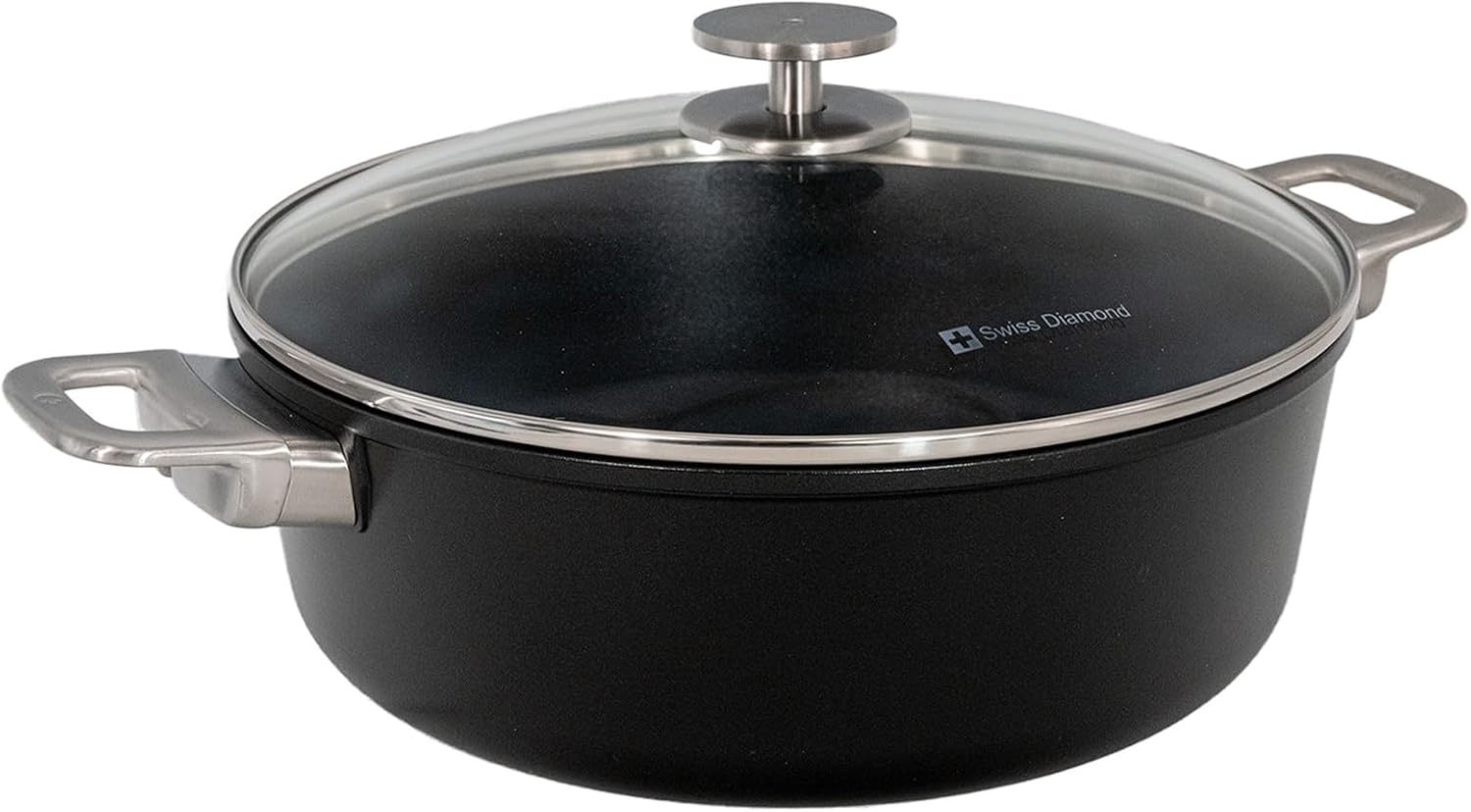
Yes, Swiss Diamond cookware, including the handle and glass lid, is oven safe up to 500°F (260°C), but that number comes with a placement condition most guides leave out.
How Do I Know If My Cookware Is Oven Safe?
Oven safety comes down to checking the manufacturer’s label or documentation for a specific symbol or temperature limit rather than guessing based on how a pan looks or feels.
Not every material behaves the same way under sustained oven heat, so the check has to be specific to the piece you’re holding, not the cookware category in general.
Oven-Safe Symbols and Label Language to Look For
- Look for a small printed icon of an oven, sometimes shown with wavy lines underneath, stamped on the bottom of the pan or included on the packaging.
- Check for the words “oven safe” or “oven proof” printed directly on the cookware, often paired with a maximum temperature.
- Look separately for handle and lid ratings, since these components are frequently rated lower than the pan body itself.
- If no symbol is present, check the product page or manual on the manufacturer’s website using the model name, since many brands publish the rating online even when it’s missing from the physical item.
Why Material and Handle Type Matter for Oven Safety
A pan’s base material sets its general heat tolerance, but the handle and any coating are usually the limiting factor, not the metal underneath.
Stainless steel and cast iron typically tolerate very high oven temperatures on their own, while nonstick coatings, including ceramic and diamond-based coatings, are usually the component that sets the actual ceiling.
Plastic or rubberized handle grips almost always cap the rating well below what the base metal could otherwise handle, which is why checking the handle separately from the pan body matters.
Is Swiss Diamond Cookware Oven Safe?
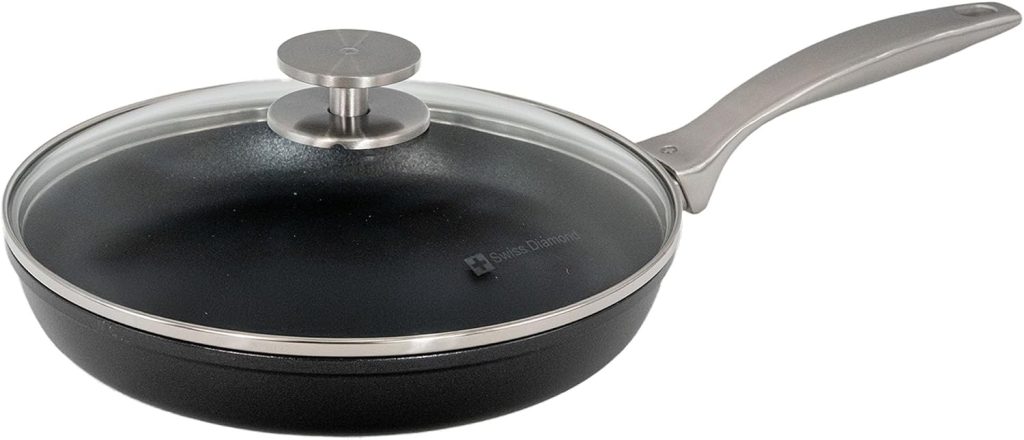
Yes, Swiss Diamond cookware is rated oven safe up to 500°F (260°C), and that rating covers the pan body, the ergonomic handle, and the tempered glass lid together, not just the cooking surface.
Maximum Oven Temperature and Handle Safety
| Component | Oven-Safe Rating |
|---|---|
| Pan body | Up to 500°F (260°C) |
| Handle | Up to 500°F (260°C), same rating as the pan body |
| Tempered glass lid | Up to 500°F (260°C) |
| Handle after oven use | Gets hot; pot holders required when removing from the oven |
This is a notable difference from many other nonstick pans, where the handle or lid is rated well below the pan body itself.
Swiss Diamond’s documentation states all three components share the same 500°F ceiling, which simplifies the check compared to cookware where each part needs to be verified separately.
Placement Rules: Staying Away From Heating Elements
- Place the pan in the center of the oven rather than close to the oven walls or door.
- Keep the pan at least two inches away from any heating coil, since the area immediately surrounding the element runs hotter than the oven’s set temperature and can exceed the pan’s rated maximum even when the oven itself is set correctly.
- Avoid using the broiler setting with Swiss Diamond cookware, since broiling concentrates heat much closer to the cookware than standard baking or roasting.
- Always use a pot holder or oven mitt when removing the pan, since the handle reaches the same temperature as the rest of the cookware after time in the oven.
What Is Swiss Diamond Cookware?
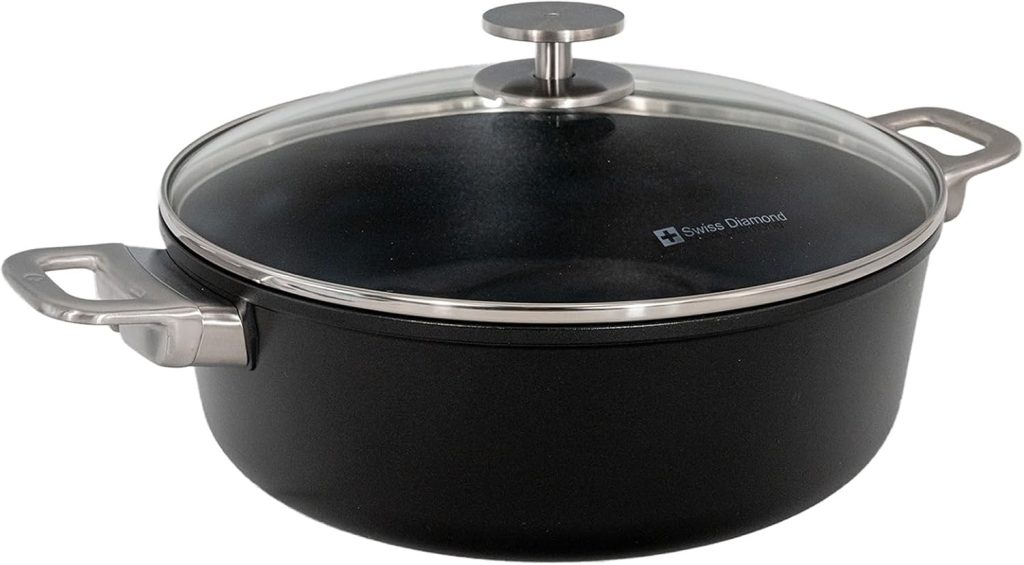
Swiss Diamond is a nonstick cookware brand built around a cast aluminum body with a coating reinforced by real diamond crystals, designed and manufactured under Swiss production standards.
Swiss Diamond Non-Stick Coating
Diamond-reinforced nonstick coating, as Swiss Diamond describes it, refers to a nonstick coating with actual diamond crystals embedded in the surface layer during manufacturing.
The company states this construction is intended to resist peeling, cracking, and blistering longer than standard nonstick coatings when the pan is used and cleaned as directed.
The high production temperatures involved in bonding the diamond crystals into the coating are also the basis for the brand’s PFOA-free claim, discussed in more detail below.
Cast Aluminum Base and Construction
The base of Swiss Diamond cookware is pressure-cast aluminum, a construction chosen for even heat distribution without hot spots and resistance to warping over repeated heating and cooling cycles.
Aluminum conducts heat efficiently on its own, and the brand notes that this efficiency is part of why Swiss Diamond pans often need a lower stovetop heat setting than a cook might be used to with other materials.
If you’re weighing aluminum-based nonstick against fully uncoated options, whether ceramic cookware is safe is a useful comparison point, since ceramic coatings sit on a similar aluminum base but rely on a different coating chemistry.
Is Swiss Diamond Cookware Safe and Healthy?
Yes, Swiss Diamond cookware is considered safe for everyday cooking, based on the brand’s own disclosed materials and a third-party test it cites for its PFOA-free claim.
PFOA, Lead, and Cadmium-Free Claims
Swiss Diamond states that its cookware contains no PFOA, lead, or cadmium throughout the production process, and the brand attributes this specifically to the high heat used during manufacturing, which it says eliminates any trace of PFOA that might otherwise be present in the coating.
The company cites a test from the Danish Technological Institute as third-party confirmation of its no-PFOA claim.
This is Swiss Diamond’s own disclosed testing source, not an independent finding Kitchnfam has verified directly, so readers who want to confirm current certification status should check the brand’s own documentation.
For a broader framework on how to evaluate any cookware’s PFAS status yourself rather than relying on brand claims alone, see how to check if cookware has PFAS.
Where Swiss Diamond Fits Among Non-Toxic Cookware Materials
Swiss Diamond falls into the coated-nonstick category of non-toxic cookware, alongside ceramic and diamond-infused ceramic pans from other brands, rather than the uncoated category that includes stainless steel, cast iron, and pure titanium.
This distinction matters because coated cookware, even PFOA-free coated cookware, depends on the coating staying intact to maintain both its nonstick performance and its safety profile, while uncoated materials don’t carry that same maintenance dependency.
One limitation worth flagging directly: Swiss Diamond’s standard lines are not compatible with induction cooktops, which matters if that’s your stovetop type.
Our guide to non-toxic cookware for induction stoves covers which non-toxic materials and constructions do work on induction.
How Do You Care for a Swiss Diamond Frying Pan?
Swiss Diamond cookware holds up best with hand washing, low to medium heat, and non-metal utensils, even though the manufacturer states it’s technically compatible with slightly harsher use.
Daily Cleaning and Dishwasher Guidance
- Wash the pan with hot, soapy water before its first use and after every use to prevent food residue from building up on the surface.
- Hand washing is recommended over the dishwasher, since harsh detergents and high heat cycles in a dishwasher can reduce nonstick performance faster over time.
- Avoid abrasive detergents, oven cleaners, or scouring pads, all of which can affect the quality of the nonstick surface.
- Clean the pan thoroughly after each use rather than letting it sit, since leftover residue is a primary cause of long-term performance loss.
Utensils and Heat Settings to Avoid Damage
- Use silicone, wooden, or nylon utensils rather than metal, since sharp edges and points can scratch the coating even though the diamond reinforcement adds some scratch resistance.
- Avoid cutting or chopping food directly in the pan, since this introduces the same kind of sharp-edge contact as metal utensils.
- Use low to medium heat for most cooking tasks, since the aluminum base conducts heat efficiently enough that high heat is rarely necessary and increases the risk of coating damage.
- Avoid preheating an empty pan for more than a few minutes, since prolonged empty preheating is one of the more common causes of coating damage reported by owners.
Why Is My Swiss Diamond Pan Sticking?
In most cases, a Swiss Diamond pan that has started sticking has either a carbonized buildup on the surface from cleaning residue or damage from overheating, and telling the two apart determines whether the pan can be restored.
Carbonized Oil Buildup and How to Fix It
- Check the surface for a dark, uneven discoloration rather than a uniform dull look, since carbonized buildup typically appears as blotchy or streaky darkening from oil residue that’s been repeatedly reheated.
- Wash the pan with hot, very soapy water and a soft sponge, going beyond a quick rinse to fully break down any residue film.
- If the buildup doesn’t lift with standard washing, try a baking soda paste treatment on the affected areas, which is the at-home method the brand itself recommends for this specific issue.
- Rewash the pan normally after the treatment and test its nonstick performance with a small amount of food before assuming it’s fully restored.
- If the baking soda treatment doesn’t resolve the sticking, the coating has likely sustained damage beyond a cleaning issue, which points to the second cause below.
Overheating Damage That Can’t Be Reversed
Overheating a nonstick pan, Swiss Diamond or otherwise, can cause the coating to blister, crack, or peel, and none of these outcomes are fixable with cleaning or restoration methods.
This kind of damage typically comes from cooking on high heat for extended periods, preheating an empty pan too long, or letting oil exceed its smoke point repeatedly, all of which the brand’s own use-and-care documentation identifies as the primary causes of irreversible coating failure.
If a pan shows visible blistering, cracking, or flaking rather than just discoloration, it needs to be replaced rather than restored, since continuing to cook on damaged coating only accelerates further breakdown of the surface.
If you’re deciding whether Swiss Diamond fits into a broader non-toxic kitchen setup, or comparing it against cookware made closer to home, our guide to non-toxic cookware made in the USA is worth a look alongside this one, since manufacturing origin is a factor some readers weigh alongside coating type and oven safety.
For the full picture across every non-toxic material Kitchnfam covers, from titanium to ceramic to stainless steel, start with our guide to best non-toxic cookware.
Frequently Asked Questions
Is Swiss Diamond cookware induction compatible?
No, Swiss Diamond’s standard cookware lines are not compatible with induction cooktops, since induction requires a magnetic base and Swiss Diamond’s cast aluminum construction isn’t magnetic on its own.
This is a common point of confusion because the brand’s cookware works across gas, electric, ceramic glass, and halogen cooktops without issue, which leads some shoppers to assume induction compatibility as well.
If you cook on an induction range, check specifically for an induction-labeled Swiss Diamond line before buying, since not all of the brand’s cookware includes the magnetic base induction cooking requires.
Can Swiss Diamond cookware go in the dishwasher?
Technically yes, Swiss Diamond states its cookware is dishwasher safe, but the brand recommends hand washing instead to preserve nonstick performance over time.
Dishwasher detergents tend to be harsher than hand dish soap, and the high heat cycles common in dishwashers can accelerate wear on nonstick coatings generally, including diamond-reinforced ones.
If you do use a dishwasher occasionally, that’s within the manufacturer’s stated tolerance, but making it your routine is more likely to shorten how long the coating performs well compared to consistent hand washing.
Can you use metal utensils on Swiss Diamond cookware?
Swiss Diamond’s official guidance recommends against metal utensils, favoring silicone, wooden, or nylon tools instead, even though the diamond-reinforced coating does add some scratch resistance compared to standard nonstick surfaces.
Some owners report using metal utensils carefully without immediate issues, and light scuff marks from spatula use are considered normal cosmetic wear rather than damage.
Sharp-edged tools, cutting or chopping directly in the pan, and electric beaters touching the surface are the more clear-cut risks, since these can cause scratches deep enough to affect performance rather than just appearance.
How long does Swiss Diamond cookware typically last?
Swiss Diamond cookware is designed to resist peeling, cracking, and blistering longer than standard nonstick coatings when used and cleaned according to the brand’s care instructions, though the company doesn’t publish a specific guaranteed lifespan figure.
In practice, how long any nonstick pan lasts depends heavily on adherence to heat settings, cleaning routine, and utensil choice, all covered above, more than on the coating type alone.
Pans that show only surface discoloration from carbonized buildup can often be restored and continue performing well, while pans with visible blistering or cracking from overheating have reached the end of their usable life regardless of brand.